


Shopping Cart
Remove All Your shopping cart is currently empty

Synonyms:
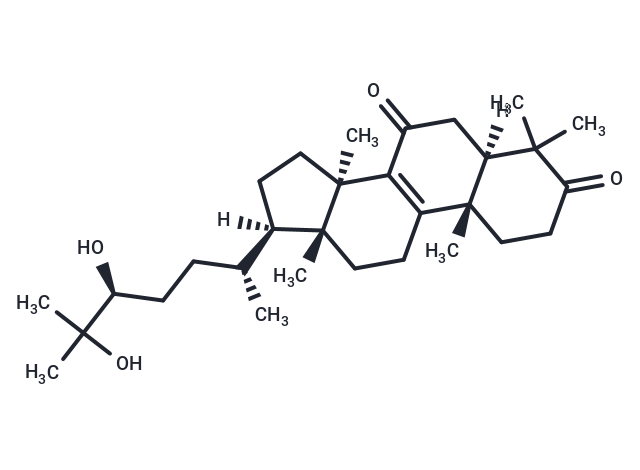
| Pack Size | Price | USA Stock | Global Stock | Quantity |
|---|---|---|---|---|
| 5 mg | $900 | Inquiry | Inquiry |
| Description | Lucidumol A has relatively good effect against aldose reductase with IC50 of 19.1uM. Lucidumol A has cytotoxic activity, it reduced cell growth in three human carcinoma cells (Caco-2, HepG2, and HeLa cells) dose dependently with LC50s from 20.87 to 84.36 uM. |
| In vitro | The medicinal mushroom Ganoderma lucidum is well recognized for its effective cancer-preventative and therapeutic properties, while specific components responsible for these anticancer effects are not well studied. METHODS AND RESULTS: Six triterpenoids that are ganolucidic acid E, Lucidumol A, ganodermanontriol, 7-oxo-ganoderic acid Z, 15-hydroxy-ganoderic acid S, and ganoderic acid DM were isolated and identified from an extract of the mushroom. All compounds reduced cell growth in three human carcinoma cells (Caco-2, HepG2, and HeLa cells) dose dependently with LC50s from 20.87 to 84.36 μM. Moreover, the six compounds induced apoptosis in HeLa cells with a maximum increase (22%) of sub-G1 accumulations and 43.03% apoptotic cells in terminal deoxynucleotidyl transferase dUTP nick end labeling (TUNEL) assay (15-hydroxy-ganoderic acid S treatment). Apoptosis was further confirmed by annexin-V staining. Four of the compounds also caused apoptosis in Caco-2 cells with maximum 9.5% increase of sub-G1 accumulations (7-oxo-ganoderic acid Z treatment) and maximum 29.84% apoptotic cells in TUNEL assay (ganoderic acid DM treatment). Contrarily, none of the compounds induced apoptosis in HepG2 cells. CONCLUSIONS: The different responses of the three cell lines following these treatments indicated that the bioactive properties of these compounds may vary from cells of different sites of origin and are likely acting under diverse regulatory mechanisms. |
| Molecular Weight | 472.7 |
| Formula | C30H48O4 |
| Cas No. | 217476-73-8 |
| Smiles | C[C@]12C3=C([C@]4(C)[C@@](CC3=O)(C(C)(C)C(=O)CC4)[H])CC[C@]1(C)[C@@]([C@@H](CC[C@@H](C(C)(C)O)O)C)(CC2)[H] |
| Relative Density. | 1.09 g/cm3 (Predicted) |
| Storage | Powder: -20°C for 3 years | In solvent: -80°C for 1 year Shipping with blue ice/Shipping at ambient temperature. |
 For example, if the intended dosage is 10 mg/kg for animals weighing 20 g , with a dosing volume of 100 μL per animal, and a total of 10 animals are to be administered, using a formulation of
  10% DMSO+ 40% PEG300+ 5% Tween 80+ 45% Saline/PBS/ddH2O , the resulting working solution concentration would be 2 mg/mL.
Dissolve 2 mg of the compound in 100 μL DMSO to obtain a stock solution at a concentration of 20 mg/mL . If the required concentration exceeds the compound's known solubility, please contact us for technical support before proceeding.
1) Add 100 μL of the DMSO stock solution to 400 µL PEG300 and mix thoroughly until the solution becomes clear.
2) Add 50 µL Tween 80 and mix well until fully clarified.
3) Add 450 µL Saline,PBS or ddH2O and mix thoroughly until a homogeneous solution is obtained.
| Size | Quantity | Unit Price | Amount | Operation |
|---|
 Feedback
 Hello! How can I help you today?
Copyright © 2015-2026 TargetMol Chemicals Inc. All Rights Reserved.
