


Shopping Cart
Remove All Your shopping cart is currently empty

Synonyms:
| Pack Size | Price | USA Stock | Global Stock | Quantity |
|---|---|---|---|---|
| 25 mg | $1,520 | 6-8 weeks | 6-8 weeks | |
| 50 mg | $1,980 | 6-8 weeks | 6-8 weeks | |
| 100 mg | $2,500 | 6-8 weeks | 6-8 weeks |
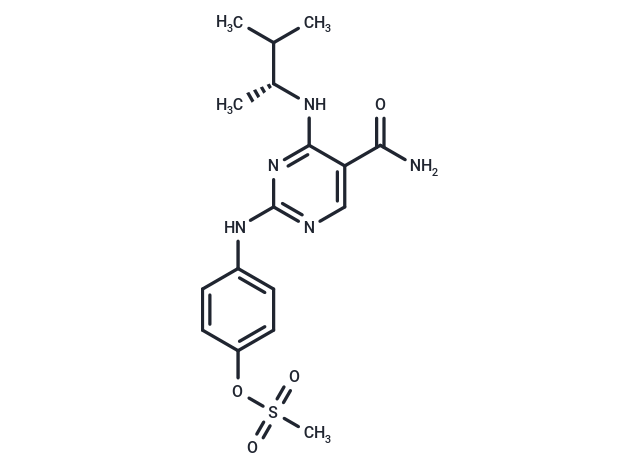
| Description | JAK3-IN-9 is a potent and orally active inhibitor of the Janus kinase 3 (JAK3) enzyme, displaying an impressive IC50 value of 1.7 nM. It exhibits high selectivity towards the JAK3 signaling pathway, making it a valuable tool for studying autoimmune diseases. Additionally, JAK3-IN-9 possesses desirable characteristics such as low toxicity and excellent oral bioavailability. It also demonstrates promising anti-arthritis activity, thus enhancing its potential as a therapeutic agent [1]. |
| Targets & IC50 | JAK3:1.7 nM |
| In vitro | JAK3-IN-9 (compound 11i) selectively inhibits JAK3 with an IC50 of 1.7 nM [1]. In Cell Viability Assays using PBMCs at 1 μM concentration and 30-minute incubation, it shows preferential inhibition of JAK3 [1]. |
| In vivo | JAK3-IN-9, referred to as compound 11i, demonstrated selective inhibition of JAK3 cytokine signaling in primary cells when administered orally at dosages of 3, 10, and 30 mg/kg to female Lewis rats once daily for 20 days. Additionally, it exhibited a high area under the curve (AUC) of 2104 μg/ml, increased the half-life to 2.56 hours, and showed favorable oral bioavailability of 48% upon a single intravenous injection at 1 mg/kg in male DBA1j mice aged 8 to 12 weeks. Furthermore, JAK3-IN-9 significantly reduced paw swelling in a dose-dependent manner, with an effective dose (ED50) value of 10 mg/kg, after oral administration once daily for 20 days at a dose of 30 mg/kg. These results, obtained from studies conducted on male DBA1j mice and female Lewis rats, indicate its potential as an anti-arthritis agent in the CIA mice model. |
| Molecular Weight | 393.46 |
| Formula | C17H23N5O4S |
| Cas No. | 1430095-30-9 |
| Smiles | N([C@@H](C(C)C)C)C=1C(C(N)=O)=CN=C(NC2=CC=C(OS(C)(=O)=O)C=C2)N1 |
| Storage | Powder: -20°C for 3 years | In solvent: -80°C for 1 year Shipping with blue ice/Shipping at ambient temperature. |
 For example, if the intended dosage is 10 mg/kg for animals weighing 20 g , with a dosing volume of 100 μL per animal, and a total of 10 animals are to be administered, using a formulation of
  10% DMSO+ 40% PEG300+ 5% Tween 80+ 45% Saline/PBS/ddH2O , the resulting working solution concentration would be 2 mg/mL.
Dissolve 2 mg of the compound in 100 μL DMSO to obtain a stock solution at a concentration of 20 mg/mL . If the required concentration exceeds the compound's known solubility, please contact us for technical support before proceeding.
1) Add 100 μL of the DMSO stock solution to 400 µL PEG300 and mix thoroughly until the solution becomes clear.
2) Add 50 µL Tween 80 and mix well until fully clarified.
3) Add 450 µL Saline,PBS or ddH2O and mix thoroughly until a homogeneous solution is obtained.
| Size | Quantity | Unit Price | Amount | Operation |
|---|
 Feedback
 Hello! How can I help you today?
Copyright © 2015-2026 TargetMol Chemicals Inc. All Rights Reserved.
