Shopping Cart
Remove All
  • TargetMol
    Your shopping cart is currently empty

Fulvine

Copy Product Info
😃Good
Catalog No. T40688Cas No. 6029-87-4

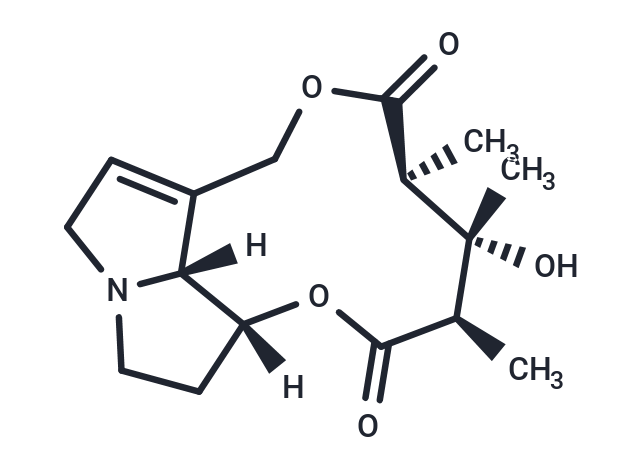
Fulvine is a pyrrolizidine alkaloid isolated from the seeds of Crotalaria fulva, exhibiting hepatotoxicity. It can be used to induce hypertensive pulmonary vascular disease in animal models and is commonly employed to establish liver and lung injury models.

Fulvine

Fulvine

Copy Product Info
😃Good
Catalog No. T40688Cas No. 6029-87-4
Fulvine is a pyrrolizidine alkaloid isolated from the seeds of Crotalaria fulva, exhibiting hepatotoxicity. It can be used to induce hypertensive pulmonary vascular disease in animal models and is commonly employed to establish liver and lung injury models.
Pack SizePriceUSA WarehouseGlobal WarehouseQuantity
25 mg$1,520InquiryInquiry
Add to Cart
Add to Quotation
In Stock Estimated shipping dateUSA Warehouse[1-2 days] Global Warehouse[5-7 days]
All TargetMol products are for research purposes only and cannot be used for human consumption. We do not provide products or services to individuals. Please comply with the intended use and do not use TargetMol products for any other purpose.
Questions
TargetMol
View More

Resource Download

Product Introduction

Bioactivity
Description
Fulvine is a pyrrolizidine alkaloid isolated from the seeds of Crotalaria fulva, exhibiting hepatotoxicity. It can be used to induce hypertensive pulmonary vascular disease in animal models and is commonly employed to establish liver and lung injury models.
Disease Modeling Protocol
Pulmonary vasculitis model
  • Modeling Mechanism:

    Fulvine (a pyrrolizidine alkaloid from the genus *Pyrrolizidine*) is metabolized in the liver through dehydrogenation to produce active pyrrole derivatives, which are then transported to lung tissue via the bloodstream. These derivatives directly damage pulmonary vascular endothelial cells and smooth muscle: ① Inducing fibrinoid necrosis in pulmonary arteries/microarteries, triggering an inflammatory response primarily characterized by neutrophil infiltration; ② Stimulating the transformation of adventitia fibroblasts into smooth muscle cells, leading to full-thickness thickening of the vessel wall; ③ Simultaneously damaging pulmonary veins/microvenules, resulting in collagen deposition in the venous wall and luminal occlusion, ultimately leading to diffuse pulmonary vascular inflammation and fibrosis.

  • Related Products:

    Fulvine (T40688)

  • Modeling Method:

    Experimental Subject:

    Rats, Wistar (albino), Female, 6–7 weeks old, Body weight 140–170 g

    Dosage and Administration Route:

    ① Core modelling: Oral (80 mg/kg) or intraperitoneal injection (50 mg/kg), Dissolved in sterile physiological saline (intraperitoneal injection) or suspended in feed (oral), Continuous observation for 4–6 weeks post-administration;
    ② Control treatment: Control group administered equal volume saline solution (intraperitoneal injection) or blank feed (oral administration), with all other conditions identical;

    Dosing Frequency and Duration Model:

    Single Dose

  • Validation:

    1. Pathological Indicators: - Vascular Lesions: HE staining showed fibrinoid necrosis in the pulmonary arteries/microarteries (positive in 32/41 rats), neutrophil infiltration in the vessel walls, and abnormal proliferation of smooth muscle cells in the adventitia; thickening of the walls of pulmonary veins/microvenules and collagen deposition (elastic fiber staining showed elastic membrane folds); - Tissue Damage: Diffuse edema and hemorrhage in the lung tissue, interstitial iron pigment deposition (Perl staining positive), and peribronchial lymphocyte aggregation; 2. Cellular Indicators: - Mast Cell Count: The number of mast cells in the lung tissue was significantly increased, reaching 323 cells/mm² after 4 weeks (0.8 cells/mm² in the control group, p<0.01); 3. Functional Indicators: - Right Ventricular Function: The ratio of left ventricular (including interventricular septum) to right ventricular weight decreased to 1-2.5 (3.03-4.55 in the control group), indicating right ventricular hypertrophy.

*Precautions: These animals were euthanized with ether at varying intervals within one to six weeks after using Fuliven. Four rats were euthanized after one week, three after two weeks, four after three weeks, ten after four weeks, ten after five weeks, and another rat was euthanized after six weeks.

*References:Wagenvoort CA,et,al. Effect of fulvine on pulmonary arteries and veins of the rat. Thorax. 1974 Sep;29(5):522-9.

Chemical Properties
Molecular Weight309.36
FormulaC16H23NO5
Cas No.6029-87-4
SmilesO=C1O[C@]2([C@@]3(N(CC2)CC=C3COC(=O)[C@@H](C)[C@](C)(O)[C@H]1C)[H])[H]
Storage & Solubility Information
StoragePowder: -20°C for 3 years | In solvent: -80°C for 1 year | Shipping with blue ice/Shipping at ambient temperature.

Calculator

  • Molarity Calculator
  • Dilution Calculator
  • Reconstitution Calculator
  • Molecular Weight Calculator

In Vivo Formulation Calculator (Clear solution)

Please enter your animal experiment information in the following box and click Calculate to obtain the stock solution preparation method and in vivo formula preparation method:
TargetMol | Animal experiments For example, if the intended dosage is 10 mg/kg for animals weighing 20 g , with a dosing volume of 100 μL per animal, TargetMol | Animal experiments and a total of 10 animals are to be administered, using a formulation of TargetMol | reagent 10% DMSO+ 40% PEG300+ 5% Tween 80+ 45% Saline/PBS/ddH2O , the resulting working solution concentration would be 2 mg/mL.

Stock Solution Preparation:

Dissolve 2 mg of the compound in 100 μL DMSOTargetMol | reagent to obtain a stock solution at a concentration of 20 mg/mL . If the required concentration exceeds the compound's known solubility, please contact us for technical support before proceeding.

Preparation of the In Vivo Formulation:

1) Add 100 μL of the DMSOTargetMol | reagent stock solution to 400 μL PEG300TargetMol | reagent and mix thoroughly until the solution becomes clear.

2) Add 50 μL Tween 80 and mix well until fully clarified.

3) Add 450 μL Saline,PBS or ddH2OTargetMol | reagent and mix thoroughly until a homogeneous solution is obtained.

This example is provided solely to demonstrate the use of the In Vivo Formulation Calculator and does not constitute a recommended formulation for any specific compound. Please select an appropriate dissolution and formulation strategy based on your experimental model and route of administration.
All co-solvents required for this protocol, includingDMSO, PEG300/PEG400, Tween 80, SBE-β-CD, and Corn oil, are available for purchase on the TargetMol website.
1 Enter information below:
mg/kg
g
μL
2 Enter the in vivo formulation:
% DMSO
%
% Tween 80
% Saline/PBS/ddH2O

Dose Conversion

You can also refer to dose conversion for different animals. More Dose Conversion

Tech Support

Please see Inhibitor Handling Instructions for more frequently ask questions. Topics include: how to prepare stock solutions, how to store products, and cautions on cell-based assays & animal experiments, etc

Keywords

Related Tags: buy Fulvine | purchase Fulvine | Fulvine cost | order Fulvine | Fulvine chemical structure | Fulvine formula | Fulvine molecular weight