


Shopping Cart
Remove All Your shopping cart is currently empty

Synonyms:
| Pack Size | Price | USA Stock | Global Stock | Quantity |
|---|---|---|---|---|
| 10 mg | Inquiry | Inquiry | Inquiry | |
| 50 mg | Inquiry | Inquiry | Inquiry |
| Description | CT20p is an anticancer peptide derived from the hydrophobic terminal of BaxC. It exhibits a unique cytotoxic effect independent of the full-length Bax, targeting mitochondria to induce fusion-like aggregation and mitochondrial membrane hyperpolarization. CT20p reduces α5β1 integrin levels, inhibits F-actin polymerization, thus disrupting the cytoskeleton and preventing cell adhesion. CT20p is applicable in breast cancer research. |
| Molecular Weight | 2176.66 |
| Formula | C103H170N24O25S |
| Cas No. | 1407967-57-0 |
| Smiles | C([C@@H](C(N[C@H](C(N[C@H](C(N[C@H](C(NCC(N)=O)=O)CCSC)=O)CCCCN)=O)CCCCN)=O)NC([C@@H](NC([C@@H](NC([C@@H](NC([C@@H](NC([C@@H](NC([C@@H](NC([C@@H](NC([C@@H](NC(CNC([C@@H](NC([C@@H](NC([C@H](CC1=CC=CC=C1)NC([C@@H](NC([C@@H](NC([C@@H](NC(C)=O)[C@@H](C)C)=O)[C@@H](C)O)=O)[C@H](CC)C)=O)=O)[C@H](C)C)=O)C)=O)=O)[C@@H](C)C)=O)CC(C)C)=O)[C@@H](C)O)=O)C)=O)CO)=O)CC(C)C)=O)[C@@H](C)O)=O)[C@H](CC)C)=O)C=2C=3C(NC2)=CC=CC3 |
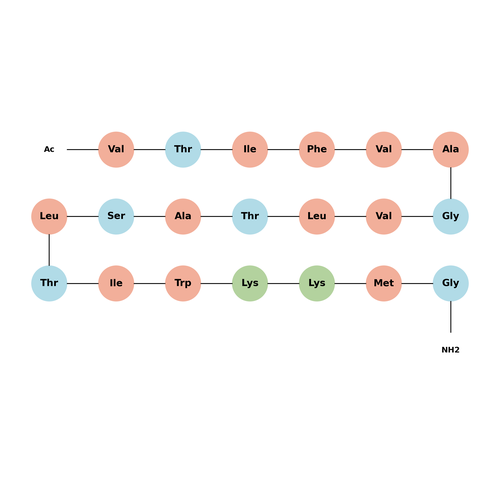
| Sequence | Ac-Val-Thr-Ile-Phe-Val-Ala-Gly-Val-Leu-Thr-Ala-Ser-Leu-Thr-Ile-Trp-Lys-Lys-Met-Gly-NH₂ |
| Sequence Short | VTIFVAGVLTASLTIWKKMG |
| Storage | Keep away from moisture Powder: -20°C for 3 years | In solvent: -80°C for 1 year Shipping with blue ice/Shipping at ambient temperature. |
 For example, if the intended dosage is 10 mg/kg for animals weighing 20 g , with a dosing volume of 100 μL per animal, and a total of 10 animals are to be administered, using a formulation of
  10% DMSO+ 40% PEG300+ 5% Tween 80+ 45% Saline/PBS/ddH2O , the resulting working solution concentration would be 2 mg/mL.
Dissolve 2 mg of the compound in 100 μL DMSO to obtain a stock solution at a concentration of 20 mg/mL . If the required concentration exceeds the compound's known solubility, please contact us for technical support before proceeding.
1) Add 100 μL of the DMSO stock solution to 400 µL PEG300 and mix thoroughly until the solution becomes clear.
2) Add 50 µL Tween 80 and mix well until fully clarified.
3) Add 450 µL Saline,PBS or ddH2O and mix thoroughly until a homogeneous solution is obtained.
| Size | Quantity | Unit Price | Amount | Operation |
|---|
 Feedback
 Hello! How can I help you today?
Copyright © 2015-2026 TargetMol Chemicals Inc. All Rights Reserved.
