


Shopping Cart
Remove All Your shopping cart is currently empty

Synonyms:
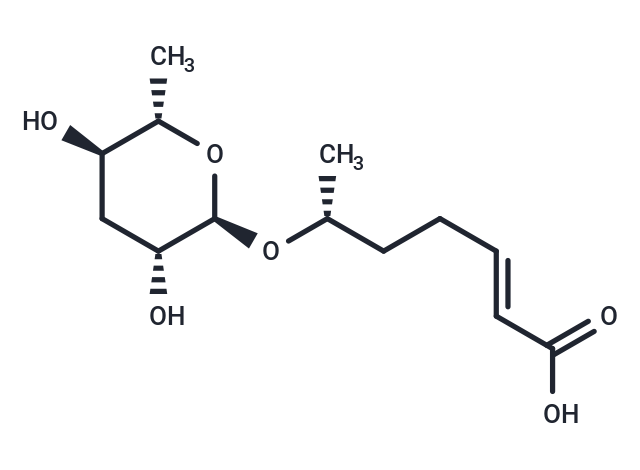
| Pack Size | Price | USA Stock | Global Stock | Quantity |
|---|---|---|---|---|
| 5 mg | $697 | Inquiry | Inquiry | |
| 10 mg | $1,190 | Inquiry | Inquiry |
| Description | Ascr#7 is a small-molecule glycolipid pheromone secreted by Caenorhabditis elegans, belonging to the ascaroside family. These compounds are often referred to as "dauer pheromones" and serve as critical chemical signals regulating development, social behavior, and stress responses in nematodes. The expression of Ascr#7 is strongly dependent on diet and developmental stage. Its primary biological function is to induce the formation of long-lived and highly stress-resistant dauer larvae. This mechanism allows nematodes to arrest normal development and enter a specialized diapause state for survival during adverse environmental conditions such as food scarcity or high population density. |
| In vitro | Ascr#7 acts as a potent developmental regulator in C. elegans by triggering the shift to the dauer pathway via sensory GPCRs. Its biosynthesis and secretion are dynamically modulated by nutritional status and population density, serving as a proxy for environmental quality [1]. |
| Molecular Weight | 274.31 |
| Formula | C13H22O6 |
| Cas No. | 1139837-37-8 |
| Smiles | O([C@@H](CC/C=C/C(O)=O)C)[C@H]1[C@H](O)C[C@@H](O)[C@H](C)O1 |
| Storage | Keep away from direct sunlight Powder: -20°C for 3 years | In solvent: -80°C for 1 year Shipping with blue ice/Shipping at ambient temperature. | |||||||||||||||||||||||||||||||||||
| Solubility Information | H2O: 80.00 mg/mL (291.64 mM), Sonication is recommended. DMSO: 160.00 mg/mL (583.28 mM), Sonication is recommended. | |||||||||||||||||||||||||||||||||||
Solution Preparation Table | ||||||||||||||||||||||||||||||||||||
H2O/DMSO
Note : The dilution table applies only to solid products. For liquid products, please calculate the stock solution based on the stated concentration and/or density. | ||||||||||||||||||||||||||||||||||||
 For example, if the intended dosage is 10 mg/kg for animals weighing 20 g , with a dosing volume of 100 μL per animal, and a total of 10 animals are to be administered, using a formulation of
  10% DMSO+ 40% PEG300+ 5% Tween 80+ 45% Saline/PBS/ddH2O , the resulting working solution concentration would be 2 mg/mL.
Dissolve 2 mg of the compound in 100 μL DMSO to obtain a stock solution at a concentration of 20 mg/mL . If the required concentration exceeds the compound's known solubility, please contact us for technical support before proceeding.
1) Add 100 μL of the DMSO stock solution to 400 µL PEG300 and mix thoroughly until the solution becomes clear.
2) Add 50 µL Tween 80 and mix well until fully clarified.
3) Add 450 µL Saline,PBS or ddH2O and mix thoroughly until a homogeneous solution is obtained.
| Size | Quantity | Unit Price | Amount | Operation |
|---|
 Feedback
 Hello! How can I help you today?
Copyright © 2015-2026 TargetMol Chemicals Inc. All Rights Reserved.
