


Shopping Cart
Remove All Your shopping cart is currently empty

Synonyms: AkaLumine hydrochloride (1176235-08-7 free base), AkaLumine hydrochloride
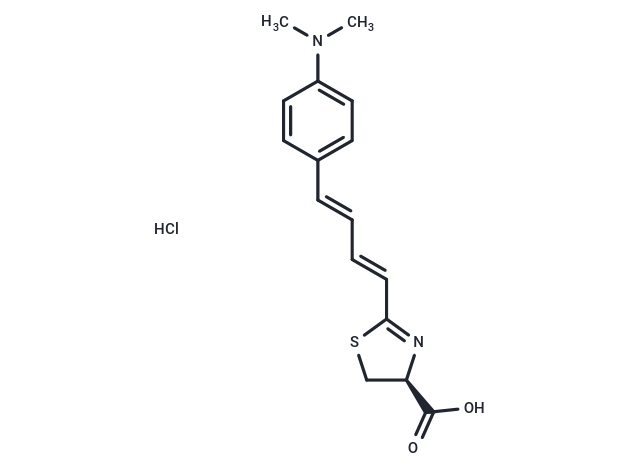
| Pack Size | Price | USA Stock | Global Stock | Quantity |
|---|---|---|---|---|
| 1 mg | $71 | In Stock | In Stock | |
| 2 mg | $98 | In Stock | In Stock | |
| 5 mg | $172 | In Stock | In Stock | |
| 10 mg | Inquiry | In Stock | In Stock | |
| 25 mg | Inquiry | In Stock | In Stock | |
| 50 mg | Inquiry | Inquiry | Inquiry | |
| 100 mg | Inquiry | Inquiry | Inquiry |
| Description | AkaLumine hydrochloride is a luciferin analog, a luciferase substrate (Km=2.06 μM), emitting near-infrared light (λmax=677 nm) with high tissue penetration, used for deep tissue bioimaging research. |
| Targets & IC50 | Recombinant Fluc protein:2.06 μM |
| In vitro | Methods:Mouse lung cancer LLC/luc cells stably expressing firefly luciferase and human breast cancer MDA-MB-231/luc cells were used. AkaLumine hydrochloride was incubated at concentration gradients of 0.1–250 μM, and bioluminescence was detected by IVIS Spectrum 1 minute after substrate addition. Results: This substrate reached maximum signal at a low concentration of 2.5 μM, whereas D-luciferin and CycLuc1 showed dose-dependent increases. [1] |
| In vivo | Methods: Nude mice with bone metastasis models established by intracardiac injection of MDA-MB-231-luc cells were used. AkaLumine hydrochloride was administered by intravenous injection at a dose of 3 μmol as a single dose 0.25–2 hours before imaging; the solvent formulation was not specified. Results: Fluorescence signals were detected in the chest and knee joints with AkaLumine hydrochloride, but the signals were relatively faint with lower resolution compared to P800SO3. [2] Methods: The in vivo activity of AkaLumine hydrochloride was validated in a BALB/c nude mouse subcutaneous xenograft model of HEK 293T cells expressing different luciferases. AkaLumine hydrochloride was administered by intraperitoneal injection at a dose of 50 mg/kg (dissolved in 33 mM normal saline), with dynamic imaging performed within 30 minutes after substrate injection using 30-second acquisition intervals, with D-LH2 and others as substrate controls. Results: The Akaluc/AkaLumine hydrochloride pair emitted light with a peak at 660 nm, while pairing with other luciferases reached the near-infrared region. The Akaluc/AkaLumine hydrochloride combination showed significantly higher luminescence brightness than Akaluc/D-LH2, and Luc2 paired with this substrate also exhibited relatively high luminescence signals. [3] |
| Synonyms | AkaLumine hydrochloride (1176235-08-7 free base), AkaLumine hydrochloride |
| Animal Research | Instructions I. Solution preparation 1. Stock solution preparation Dissolve AkaLumine hydrochloride in deionized water or dimethyl sulfoxide (DMSO). 2. Working solution preparation: Prepare a stock solution of no more than 50 mg/mL, with a common concentration of 40 mg/mL. For example, 40 mg AkaLumine hydrochloride can be dissolved in 1 mL deionized water or DMSO. Notes: Storage: It is recommended to prepare and use immediately; if storage is required, it should be stored at low temperature to ensure stability. II. In vivo imaging: 1. Administration: Inject the prepared AkaLumine hydrochloride solution into experimental animals by intraperitoneal injection. 2. Dosage: The specific dose is adjusted according to the experimental situation, generally ranging from 50–200 mg/kg. 3. Imaging: After injection, use an imaging system that can detect NIR luminescence for bioluminescence imaging. The above information is based on published literature. Experimental procedures should be appropriately modified to meet specific research demands. |
| Molecular Weight | 338.85 |
| Formula | C16H19ClN2O2S |
| Cas No. | 2558205-28-8 |
| Smiles | Cl.CN(C)c1ccc(\C=C\C=C\C2=N[C@H](CS2)C(O)=O)cc1 |
| Relative Density. | no data available |
| Storage | Store at low temperature,Keep away from direct sunlight,Keep away from moisture Powder: -20°C for 3 years | In solvent: -80°C for 1 year Shipping with blue ice/Shipping at ambient temperature. | ||||||||||||||||||||||||||||||||||||||||
| Solubility Information | DMSO: 120 mg/mL (354.14 mM), Sonication is recommended.  H2O: 25 mg/mL (73.78 mM), Sonication is recommended. | ||||||||||||||||||||||||||||||||||||||||
| In Vivo Formulation | 10% DMSO+40% PEG300+5% Tween-80+45% Saline: 5 mg/mL (14.76 mM), Sonication is recommended. Please add the solvents sequentially, clarifying the solution as much as possible before adding the next one. Dissolve by heating and/or sonication if necessary. Working solution is recommended to be prepared and used immediately. The formulation provided above is for reference purposes only. In vivo formulations may vary and should be modified based on specific experimental conditions. | ||||||||||||||||||||||||||||||||||||||||
Solution Preparation Table | |||||||||||||||||||||||||||||||||||||||||
H2O/DMSO
DMSO
Note : The dilution table applies only to solid products. For liquid products, please calculate the stock solution based on the stated concentration and/or density. | |||||||||||||||||||||||||||||||||||||||||
 For example, if the intended dosage is 10 mg/kg for animals weighing 20 g , with a dosing volume of 100 μL per animal, and a total of 10 animals are to be administered, using a formulation of
  10% DMSO+ 40% PEG300+ 5% Tween 80+ 45% Saline/PBS/ddH2O , the resulting working solution concentration would be 2 mg/mL.
Dissolve 2 mg of the compound in 100 μL DMSO to obtain a stock solution at a concentration of 20 mg/mL . If the required concentration exceeds the compound's known solubility, please contact us for technical support before proceeding.
1) Add 100 μL of the DMSO stock solution to 400 µL PEG300 and mix thoroughly until the solution becomes clear.
2) Add 50 µL Tween 80 and mix well until fully clarified.
3) Add 450 µL Saline,PBS or ddH2O and mix thoroughly until a homogeneous solution is obtained.
| Size | Quantity | Unit Price | Amount | Operation |
|---|
 Feedback
 Hello! How can I help you today?
Copyright © 2015-2026 TargetMol Chemicals Inc. All Rights Reserved.
