


Shopping Cart
Remove All Your shopping cart is currently empty

Decyl-TPP bromide ((1-Decyl)triphenylphosphonium bromide) may be used as an intermediate for chemical synthesis and an inactive control or as a reference to mitoquinone (MitoQ).
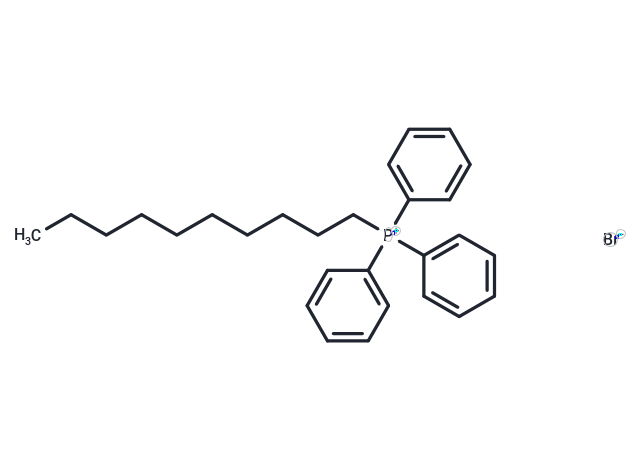

| Description | Decyl-TPP bromide ((1-Decyl)triphenylphosphonium bromide) may be used as an intermediate for chemical synthesis and an inactive control or as a reference to mitoquinone (MitoQ). |
| Cell Research | 1. As a mitochondrial membrane potential probe 1. Solution preparation: Dissolve Decyl-TPP bromide in a suitable solvent (e.g., ethanol or DMSO) to prepare a stock solution with a concentration typically between 1-10 mM. 2. Treatment: Add the solution to cell culture or tissue, and the use concentration is typically between 1-5 μM. 3. Fluorescence measurement: Decyl-TPP bromide accumulates in mitochondria, and its emission light (typically at 470 nm, with an excitation wavelength of 360 nm) can be measured by a fluorescence spectrophotometer or fluorescence microscope. 4. Data interpretation: Decyl-TPP can be used as a reference or control compound to assess changes in mitochondrial membrane potential, such as comparative studies with other mitochondrial-targeted compounds such as Mitoquinone (MitoQ). 2. Mitochondrial-targeted studies Compound comparison: In experiments involving Mitoquinone or other mitochondrial-targeted antioxidants, Decyl-TPP can be used as a control compound to study the effects of these compounds on mitochondrial health and function. b. Assessment of mitochondrial function: By comparing Decyl-TPP fluorescence intensity and mitochondrial accumulation, researchers can evaluate the effects of these compounds on key mitochondrial processes such as mitochondrial membrane potential and reactive oxygen species (ROS) generation. III. As an inactive control in antioxidant studies 1. Control experiments: Decyl-TPP bromide is used together with active mitochondrial-targeted antioxidants or compounds in cell culture or animal models. 2. Effect comparison: Evaluate the effects of these compounds on oxidative stress markers, mitochondrial membrane potential, and cell health, and analyze the effects of experimental compounds by comparison with Decyl-TPP. IV. Use in mitochondrial dysfunction models 1. Treatment: Decyl-TPP bromide is added to cell culture or animal models that have induced mitochondrial dysfunction (e.g., oxidative stress, metabolic inhibitor treatment). 2. Observation: Track changes in mitochondrial membrane potential and mitochondrial damage by measuring the fluorescence of Decyl-TPP bromide. |
| Synonyms | Triphenyldecylphosphonium·bromide, Decyltriphenylphosphonium bromide, Decyl-TPP, DecylTPP, Decyl TPP. (1-Decyl)triphenylphosphonium bromide, (1-Decyl)triphenylphosphonium bromide |
| Molecular Weight | 483.46 |
| Formula | C28H36BrP |
| Cas No. | 32339-43-8 |
| Smiles | CCCCCCCCCC[P+](C1=CC=CC=C1)(C2=CC=CC=C2)C3=CC=CC=C3.[Br-] |
| Relative Density. | no data available |
| Storage | keep away from direct sunlight | Powder: -20°C for 3 years | In solvent: -80°C for 1 year |
| Solubility Information | DMSO: Soluble |
 For example, if the intended dosage is 10 mg/kg for animals weighing 20 g , with a dosing volume of 100 μL per animal, and a total of 10 animals are to be administered, using a formulation of
  10% DMSO+ 40% PEG300+ 5% Tween 80+ 45% Saline/PBS/ddH2O , the resulting working solution concentration would be 2 mg/mL.
Dissolve 2 mg of the compound in 100 μL DMSO to obtain a stock solution at a concentration of 20 mg/mL . If the required concentration exceeds the compound's known solubility, please contact us for technical support before proceeding.
1) Add 100 μL of the DMSO stock solution to 400 μL PEG300 and mix thoroughly until the solution becomes clear.
2) Add 50 μL Tween 80 and mix well until fully clarified.
3) Add 450 μL Saline,PBS or ddH2O and mix thoroughly until a homogeneous solution is obtained.

| Size | Quantity | Unit Price | Amount | Operation |
|---|
 Feedback
 Hello! How can I help you today?
Copyright © 2015-2026 TargetMol Chemicals Inc. All Rights Reserved.
