


Shopping Cart
Remove All Your shopping cart is currently empty

Synonyms: TAMRA Azide, isomer 5
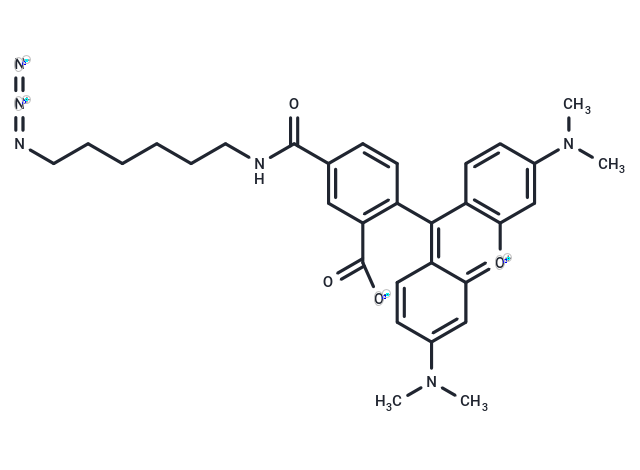

| Pack Size | Price | USA Stock | Global Stock | Quantity |
|---|---|---|---|---|
| 1 mg | $90 | In Stock | In Stock | |
| 5 mg | $222 | In Stock | In Stock | |
| 10 mg | $333 | In Stock | In Stock | |
| 25 mg | $668 | In Stock | In Stock | |
| 50 mg | $935 | In Stock | In Stock | |
| 100 mg | $1,260 | - | In Stock |
| Description | 5-TAMRA Azide (TAMRA Azide, isomer 5) is the orange-fluorescent probe that is compatible with various excitation sources including mercury arc, tungsten and xenon arc lamps, the 544 nm line of the Helium-Neon laser and the 532 nm green laser line. It is predominantly used for detection of terminal alkyne-tagged biomolecules via a copper-catalyzed click reaction (CuAAC). |
| In vitro | Instructions: I. Solution preparation 1. Stock solution: Dissolve 5-TAMRA Azide in anhydrous DMSO or DMF to prepare a 1–10 mM stock solution. The specific concentration can be adjusted according to experimental requirements. Notes: Powder: Store at -20°C in a dark, dry environment. Solution: Store at -20°C in a dark environment after aliquoting to avoid repeated freezing and thawing. II. Click Chemistry labeling 5-TAMRA Azide is a fluorescent labeling molecule commonly used in click chemistry reactions. It can react with molecules containing azide or alkyne groups to generate stable triazole bonds. 1. Reaction conditions: 1) Reaction buffer: Amine-free buffer (such as PBS or Tris-HCl) with a pH of 6.8–8.5 is usually used. 2) Catalyst system: Add Cu(I) catalysts (such as CuSO₄ and ascorbic acid) and stabilizers (such as triethylamine or TBTA) to accelerate the reaction. 3) After mixing, react at room temperature or with slight heating (37°C) for 1–2 hours. 2. Purification: Remove unbound 5-TAMRA Azide and byproducts by dialysis, gel filtration or HPLC. Notes Operation in dark room: 5-TAMRA Azide is light sensitive and should be handled and stored in a dark room or in dark conditions. Choice of copper catalyst: Use high-purity Cu(I) catalyst to avoid excessive byproducts in the reaction. Fresh preparation: It is recommended to prepare it before use to ensure reaction efficiency. The above information is based on published literature. Experimental procedures should be appropriately modified to meet specific research demands. |
| Synonyms | TAMRA Azide, isomer 5 |
| Molecular Weight | 554.64 |
| Formula | C31H34N6O4 |
| Cas No. | 1006592-61-5 |
| Smiles | [N-]=[N+]=NCCCCCCNC(=O)C=1C=CC(=C(C1)C(=O)[O-])C=2C=3C=CC(=CC3[O+]=C4C=C(C=CC42)N(C)C)N(C)C |
| Relative Density. | no data available |
| Storage | Store at low temperature,Keep away from direct sunlight,Keep away from moisture Powder: -20°C for 3 years | In solvent: -80°C for 1 year Shipping with blue ice/Shipping at ambient temperature. |
 For example, if the intended dosage is 10 mg/kg for animals weighing 20 g , with a dosing volume of 100 μL per animal, and a total of 10 animals are to be administered, using a formulation of
  10% DMSO+ 40% PEG300+ 5% Tween 80+ 45% Saline/PBS/ddH2O , the resulting working solution concentration would be 2 mg/mL.
Dissolve 2 mg of the compound in 100 μL DMSO to obtain a stock solution at a concentration of 20 mg/mL . If the required concentration exceeds the compound's known solubility, please contact us for technical support before proceeding.
1) Add 100 μL of the DMSO stock solution to 400 µL PEG300 and mix thoroughly until the solution becomes clear.
2) Add 50 µL Tween 80 and mix well until fully clarified.
3) Add 450 µL Saline,PBS or ddH2O and mix thoroughly until a homogeneous solution is obtained.
| Size | Quantity | Unit Price | Amount | Operation |
|---|
 Feedback
 Hello! How can I help you today?
Copyright © 2015-2026 TargetMol Chemicals Inc. All Rights Reserved.
