


Shopping Cart
Remove All Your shopping cart is currently empty

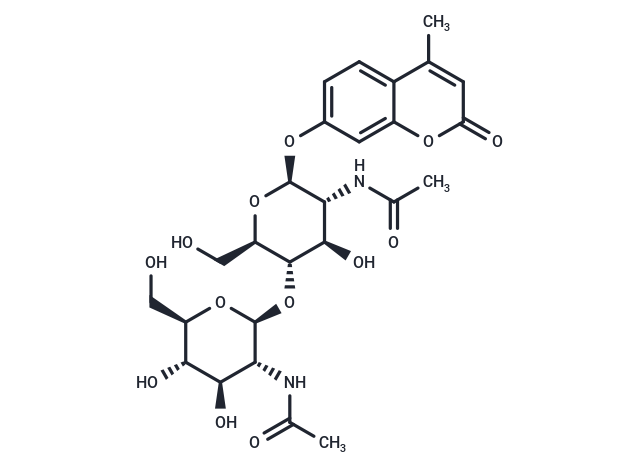
Synonyms: 4-Methylumbelliferyl β-D-N,N'-diacetylchitobioside, 4-Methylumbelliferyl N,N-diacetyl-β-D-chitobioside
| Pack Size | Price | USA Stock | Global Stock | Quantity |
|---|---|---|---|---|
| 5 mg | $497 | 35 days | 35 days |
| Description | MUF-diNAG (4-μU-(GlcNAc)2) is a fluorogenic substrate specifically designed for chitinases and chitobiosidases, which enzymatically cleave the molecule to release the fluorescent moiety 4-μU, MUF-diNAG exhibit pH-dependent excitation maxima at 320 and 360 nm and an emission maximum between 445 and 455 nm, thereby enabling sensitive and quantitative analysis of chitinolytic enzyme activity in biochemical and microbiological assays. |
| In vitro | MUF-diNAG functions as a fluorogenic substrate for chitinases, including human Chitotriosidase (CHIT1). The enzyme recognizes the N,N'-diacetylchitobiose moiety and cleaves the β-glycosidic bond between the sugar chain and the 4-MU group. While the intact substrate is non-fluorescent, hydrolysis releases free 4-Methylumbelliferone, which emits blue fluorescence at 450 nm when excited at 360 nm [2]. |
| In vivo | In models of Gaucher disease, the hydrolysis of MUF-diNAG in plasma serves as a biochemical marker for the total burden of lipid-laden macrophages. Furthermore, CHIT1 is secreted by activated macrophages during immune responses; thus, the substrate is employed to assess the severity of inflammation in conditions such as sarcoidosis, malaria, and fungal infections [1][2]. |
| Synonyms | 4-Methylumbelliferyl β-D-N,N'-diacetylchitobioside, 4-Methylumbelliferyl N,N-diacetyl-β-D-chitobioside |
| Molecular Weight | 582.55 |
| Formula | C26H34N2O13 |
| Cas No. | 53643-12-2 |
| Smiles | O([C@@H]1[C@@H](CO)O[C@@H](OC=2C=C3C(=CC2)C(C)=CC(=O)O3)[C@H](NC(C)=O)[C@H]1O)[C@H]4[C@H](NC(C)=O)[C@@H](O)[C@H](O)[C@@H](CO)O4 |
| Storage | Store at low temperature Powder: -20°C for 3 years | In solvent: -80°C for 1 year Shipping with blue ice/Shipping at ambient temperature. | ||||||||||||||||||||
| Solubility Information | DMF: 10 mg/mL (17.17 mM), Sonication is recommended. DMSO: 10 mg/mL (17.17 mM), Sonication is recommended. | ||||||||||||||||||||
Solution Preparation Table | |||||||||||||||||||||
DMF/DMSO
Note : The dilution table applies only to solid products. For liquid products, please calculate the stock solution based on the stated concentration and/or density. | |||||||||||||||||||||
 For example, if the intended dosage is 10 mg/kg for animals weighing 20 g , with a dosing volume of 100 μL per animal, and a total of 10 animals are to be administered, using a formulation of
  10% DMSO+ 40% PEG300+ 5% Tween 80+ 45% Saline/PBS/ddH2O , the resulting working solution concentration would be 2 mg/mL.
Dissolve 2 mg of the compound in 100 μL DMSO to obtain a stock solution at a concentration of 20 mg/mL . If the required concentration exceeds the compound's known solubility, please contact us for technical support before proceeding.
1) Add 100 μL of the DMSO stock solution to 400 µL PEG300 and mix thoroughly until the solution becomes clear.
2) Add 50 µL Tween 80 and mix well until fully clarified.
3) Add 450 µL Saline,PBS or ddH2O and mix thoroughly until a homogeneous solution is obtained.
| Size | Quantity | Unit Price | Amount | Operation |
|---|
 Feedback
 Hello! How can I help you today?
Copyright © 2015-2026 TargetMol Chemicals Inc. All Rights Reserved.
