


Shopping Cart
Remove All Your shopping cart is currently empty

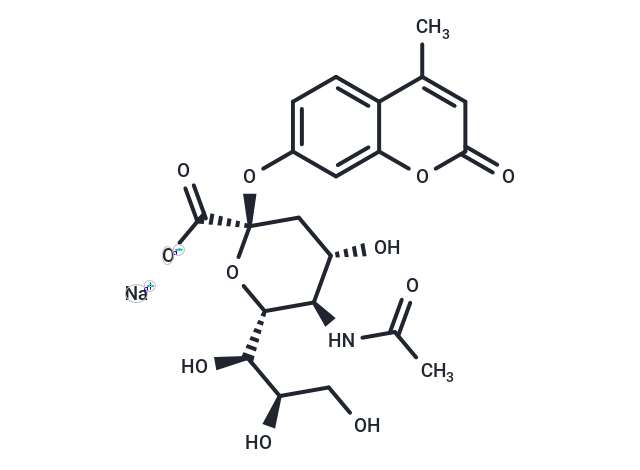
4-MUNANA is a fluorescent substrate employed in neuraminidase activity assays and serves as a neuraminidase substrate analogue.

| Pack Size | Price | USA Stock | Global Stock | Quantity |
|---|---|---|---|---|
| 1 mg | $31 | In Stock | In Stock | |
| 5 mg | $80 | In Stock | In Stock | |
| 10 mg | $126 | In Stock | In Stock | |
| 25 mg | $263 | In Stock | In Stock | |
| 50 mg | $392 | In Stock | In Stock | |
| 100 mg | $519 | - | In Stock |
| Description | 4-MUNANA is a fluorescent substrate employed in neuraminidase activity assays and serves as a neuraminidase substrate analogue. |
| In vitro | Instructions: I. Solution preparation 1. Stock solution: Dissolve 4-MUNANA in a suitable buffer to prepare a stock solution with a concentration of 1–10 mM. The specific concentration can be adjusted according to the experimental requirements. 2. Working solution: Dilute the 4-MUNANA stock solution to a working concentration (usually 100–500 µM). The specific concentration can be adjusted according to the experimental requirements. Notes: Powder: Store at -20°C or lower in a dark, dry environment. Stock solution: Store at -20°C in a dark place after aliquoting. Avoid repeated freezing and thawing. Store at 4°C for a short period of time. II. Operation steps Neuraminidase activity detection 1. Detection buffer: Prepare a buffer suitable for neuraminidase activity, such as 50 mM sodium acetate (pH 5.5). 2. Enzyme reaction: Mix a sample containing neuraminidase (such as a virus sample or cell lysate) with the 4-MUNANA working solution. 3. Incubate at 37°C for 30–60 Minutes (time can be optimized according to the experiment). 4. After the reaction is completed, add an equal volume of stop solution (such as 0.1 M glycine buffer, pH 10.4) to enhance the fluorescence signal. 5. Fluorescence detection Detection method: Use a fluorescence spectrophotometer or microplate reader to detect the fluorescence signal generated by the reaction. Excitation wavelength: ~365 nm Emission wavelength: ~450 nm Notes Standard curve: Use known concentrations of 4-methylumbelliferone to prepare a standard curve for quantitative analysis of neuraminidase activity. Control experiment: Set up negative control (no enzyme) and positive control (containing known inhibitors) to verify the specificity of the detection. The above information is based on published literature. Experimental procedures should be appropriately modified to meet specific research demands. |
| Synonyms | 4-Methylumbelliferyl-N-acetyl-α-D-Neuraminic Acid sodium salt |
| Molecular Weight | 489.41 |
| Formula | C21H24NNaO11 |
| Cas No. | 76204-02-9 |
| Smiles | [Na+].CC(=O)N[C@@H]1[C@@H](O)C[C@](Oc2ccc3c(C)cc(=O)oc3c2)(O[C@H]1[C@H](O)[C@H](O)CO)C([O-])=O |
| Storage | Powder: -20°C for 3 years | In solvent: -80°C for 1 year Shipping with blue ice/Shipping at ambient temperature. |
| Solubility Information | DMF: 15 mg/mL (30.65 mM), Sonication is recommended. H2O: 80 mg/mL (163.46 mM), Sonication is recommended. Ethanol: 0.25 mg/mL (0.51 mM), Sonication is recommended. PBS (pH 7.2): 10 mg/mL (20.43 mM), Sonication is recommended. DMSO: 255 mg/mL (521.04 mM), Sonication is recommended.  |
 For example, if the intended dosage is 10 mg/kg for animals weighing 20 g , with a dosing volume of 100 μL per animal, and a total of 10 animals are to be administered, using a formulation of
  10% DMSO+ 40% PEG300+ 5% Tween 80+ 45% Saline/PBS/ddH2O , the resulting working solution concentration would be 2 mg/mL.
Dissolve 2 mg of the compound in 100 μL DMSO to obtain a stock solution at a concentration of 20 mg/mL . If the required concentration exceeds the compound's known solubility, please contact us for technical support before proceeding.
1) Add 100 μL of the DMSO stock solution to 400 μL PEG300 and mix thoroughly until the solution becomes clear.
2) Add 50 μL Tween 80 and mix well until fully clarified.
3) Add 450 μL Saline,PBS or ddH2O and mix thoroughly until a homogeneous solution is obtained.

| Size | Quantity | Unit Price | Amount | Operation |
|---|
 Feedback
 Hello! How can I help you today?
Copyright © 2015-2026 TargetMol Chemicals Inc. All Rights Reserved.
