


Shopping Cart
Remove All Your shopping cart is currently empty

Synonyms:
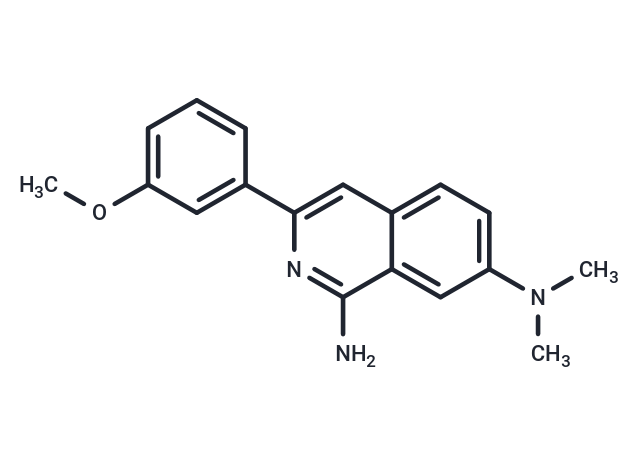
| Pack Size | Price | USA Stock | Global Stock | Quantity |
|---|---|---|---|---|
| 2 mg | $53 | 5 days | 5 days | |
| 5 mg | $119 | 5 days | 5 days | |
| 1 mL x 10 mM (in DMSO) | $107 | 5 days | 5 days |
| Description | 3-arylisoquinolinamine derivative is a compound with antitumor activity. |
| Targets & IC50 | OVCAR-3 (ovary):14 nM , Pancreas PANC-1:19 nM , Kidney Caki-1:22 nM , MDA-MB-231 cells:21 nM , Colon HCT 116 cells:17 nM , Prostate PC3:19 nM , SNB19 (Glioblastoma):32 nM , SK-MEL-28 cells:32 nM |
| In vitro | 3-arylisoquinolinamine derivative (7b) shows more effective activity against Paclitaxel-resistant HCT-15 human colorectal cancer cell lines when compared to the original cytotoxic cancer drug, Paclitaxel. The cell cycle dynamics is analyzed by flow cytometry. Treatment of human HCT-15 cells with 3-arylisoquinolinamine derivative (7b) blocks or delays the progression of cells from the G0/G1 phase into the S phase, and induces cell death. 3-arylisoquinolinamine derivative (7b) inhibits the cell growth (IC50: 14 nM to 32 nM). In cell cycle analysis using HCT-15 cells, the treatment of 1 nM of 3-arylisoquinolinamine derivative (7b) displays a significant increase in G0/G1 phase at 24 h with a decrease in G2/M phase, but the increase of G0/G1 phase at 48 h is not significant. At a higher concentration of 3-arylisoquinolinamine derivative (7b) (10 nM), there are a significant increase in G0/G1 phase and a decrease in G2/M phase, and the emergence of sub-G1phase, at both 24 h and 48 h. 3-arylisoquinolinamine derivative (7b) blocks or delays the progression of cells from the G0/G1 phase into S phase, and induces cell death [1]. 3-arylisoquinolinamine derivative (compound 13; IC50: 15 nM in HCT-15 cells, 17 nM in HCT116 cells) shows potent antiproliferative activities with IC50 value in the low nanomolar range in both cells and higher antitumor activities than that of Paclitaxel against Paclitaxel-resistant HCT-15 colorectal cancer cells [2]. |
| In vivo | The 3-arylisoquinolinamine derivative demonstrates superior antitumor efficacy, achieving 69.2% inhibition of tumor growth in an animal model, outperforming the control drug, Paclitaxel, which exhibits 48.8% inhibition [2]. |
| Animal Research | The six-week-old female athymic mice (BALB/c nu/nu) are used. All study medications (vehicle control, Paclitaxel: 10 mg/kg/day, 3-arylisoquinolinamine derivative: 10 mg/kg/day) are given by intraperitoneal injections three times per week starting from day 10 and ending on day 29 after inoculation of HCT 15 cells. To quantify tumor growth, three perpendicular diameters of the tumors are measured with calipers every 3-5 days, and the bodyweight of the mice was monitored for toxicity. The tumor volume is calculated [2]. |
| Molecular Weight | 293.36 |
| Formula | C18H19N3O |
| Cas No. | 1029008-71-6 |
| Smiles | COc1cccc(c1)-c1cc2ccc(cc2c(N)n1)N(C)C |
| Relative Density. | 1.190 g/cm3 (Predicted) |
| Storage | Powder: -20°C for 3 years | In solvent: -80°C for 1 year Shipping with blue ice/Shipping at ambient temperature. | |||||||||||||||||||||||||||||||||||
| Solubility Information | DMSO: 50 mg/mL (170.44 mM), Sonication is recommended. | |||||||||||||||||||||||||||||||||||
| In Vivo Formulation | 10% DMSO+40% PEG300+5% Tween-80+45% Saline: 2.5 mg/mL (8.52 mM), Sonication is recommended. Please add the solvents sequentially, clarifying the solution as much as possible before adding the next one. Dissolve by heating and/or sonication if necessary. Working solution is recommended to be prepared and used immediately. The formulation provided above is for reference purposes only. In vivo formulations may vary and should be modified based on specific experimental conditions. | |||||||||||||||||||||||||||||||||||
Solution Preparation Table | ||||||||||||||||||||||||||||||||||||
DMSO
Note : The dilution table applies only to solid products. For liquid products, please calculate the stock solution based on the stated concentration and/or density. | ||||||||||||||||||||||||||||||||||||
 For example, if the intended dosage is 10 mg/kg for animals weighing 20 g , with a dosing volume of 100 μL per animal, and a total of 10 animals are to be administered, using a formulation of
  10% DMSO+ 40% PEG300+ 5% Tween 80+ 45% Saline/PBS/ddH2O , the resulting working solution concentration would be 2 mg/mL.
Dissolve 2 mg of the compound in 100 μL DMSO to obtain a stock solution at a concentration of 20 mg/mL . If the required concentration exceeds the compound's known solubility, please contact us for technical support before proceeding.
1) Add 100 μL of the DMSO stock solution to 400 µL PEG300 and mix thoroughly until the solution becomes clear.
2) Add 50 µL Tween 80 and mix well until fully clarified.
3) Add 450 µL Saline,PBS or ddH2O and mix thoroughly until a homogeneous solution is obtained.
| Size | Quantity | Unit Price | Amount | Operation |
|---|
 Feedback
 Hello! How can I help you today?
Copyright © 2015-2026 TargetMol Chemicals Inc. All Rights Reserved.
