


Shopping Cart
Remove All Your shopping cart is currently empty
BCL2 (B-cell leukemia/lymphoma 2, N-Histidine-tagged), also known as Bcl-2, belongs to the Bcl-2 family. Bcl-2 family proteins regulate and contribute to programmed cell death or apoptosis. It is a large protein family and all members contain at least one of four BH (bcl-2 homology) domains. Certain members such as Bcl-2, Bcl-xl and Mcl1 are anti-apoptotic, whilst others are pro-apoptotic. Most Bcl-2 family members contain a C-terminal transmembrane domain that functions to target these proteins to the outer mitochondrial and other intracellular membranes. It is expressed in a variety of tissues. BCL2 blocks the apoptotic death of some cells such as lymphocytes. It also regulates cell death by controlling the mitochondrial membrane permeability and inhibits caspase activity either by preventing the release of cytochrome c from the mitochondria and/or by binding to the apoptosis-activating factor. Constitutive expression of BCL2, such as in the case of translocation of BCL2 to Ig heavy chain locus, is thought to be the cause of follicular lymphoma. Two transcript variants, produced by alternate splicing, differ in their C-terminal ends.Cancer ImmunotherapyImmune CheckpointImmunotherapyTargeted Therapy
| Pack Size | Price | USA Stock | Global Stock | Quantity |
|---|---|---|---|---|
| 5 μg | $48 | - | In Stock | |
| 10 μg | $75 | - | In Stock | |
| 20 μg | $118 | 7-10 days | 7-10 days | |
| 50 μg | $229 | 7-10 days | 7-10 days | |
| 100 μg | $386 | 7-10 days | 7-10 days | |
| 200 μg | $660 | 7-10 days | 7-10 days | |
| 500 μg | $1,330 | 7-10 days | 7-10 days |
| Biological Activity | Measured by its binding ability in a functional ELISA. Immobilized human BCL2-His at 10 μg/ml (100 μl/well) can bind biotinylated mouse BCL2L1-His , The EC50 of biotinylated mouse BCL2L1-His is 0.07-0.15 μg/ml. 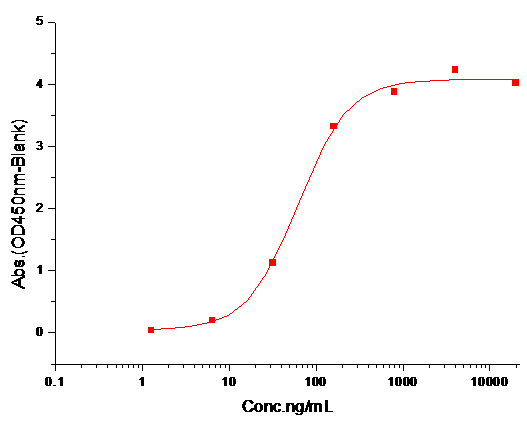 |
| Description | BCL2 (B-cell leukemia/lymphoma 2, N-Histidine-tagged), also known as Bcl-2, belongs to the Bcl-2 family. Bcl-2 family proteins regulate and contribute to programmed cell death or apoptosis. It is a large protein family and all members contain at least one of four BH (bcl-2 homology) domains. Certain members such as Bcl-2, Bcl-xl and Mcl1 are anti-apoptotic, whilst others are pro-apoptotic. Most Bcl-2 family members contain a C-terminal transmembrane domain that functions to target these proteins to the outer mitochondrial and other intracellular membranes. It is expressed in a variety of tissues. BCL2 blocks the apoptotic death of some cells such as lymphocytes. It also regulates cell death by controlling the mitochondrial membrane permeability and inhibits caspase activity either by preventing the release of cytochrome c from the mitochondria and/or by binding to the apoptosis-activating factor. Constitutive expression of BCL2, such as in the case of translocation of BCL2 to Ig heavy chain locus, is thought to be the cause of follicular lymphoma. Two transcript variants, produced by alternate splicing, differ in their C-terminal ends.Cancer ImmunotherapyImmune CheckpointImmunotherapyTargeted Therapy |
| Species | Human |
| Expression System | E. coli |
| Tag | C-His |
| Accession Number | P10415-1 |
| Synonyms | PPP1R50,Bcl-2,B-cell CLL/lymphoma 2 |
| Construction | A DNA sequence encoding the human BCL2 isoform 1 (P10415-1) (Met 1-Asp 211) was expressed, with a polyhistide tag at the C-terminus. Predicted N terminal: Met 1 |
| Protein Purity | > 90 % as determined by SDS-PAGE 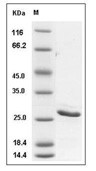 |
| Molecular Weight | 24.7 kDa (predicted) |
| Endotoxin | Please contact us for more information. |
| Formulation | Supplied as sterile 50 mM Tris, 20% glycerol, 100 mM Arg, pH 8.5. |
| Reconstitution | A Certificate of Analysis (CoA) containing reconstitution instructions is included with the products. Please refer to the CoA for detailed information. |
| Stability & Storage | It is recommended to store the product under sterile conditions at -20°C to -80°C. Samples are stable for up to 12 months. Please avoid multiple freeze-thaw cycles and store products in aliquots. |
| Shipping | Proteins are shipped with blue ice. |
| Research Background | BCL2 (B-cell leukemia/lymphoma 2, N-Histidine-tagged), also known as Bcl-2, belongs to the Bcl-2 family. Bcl-2 family proteins regulate and contribute to programmed cell death or apoptosis. It is a large protein family and all members contain at least one of four BH (bcl-2 homology) domains. Certain members such as Bcl-2, Bcl-xl and Mcl1 are anti-apoptotic, whilst others are pro-apoptotic. Most Bcl-2 family members contain a C-terminal transmembrane domain that functions to target these proteins to the outer mitochondrial and other intracellular membranes. It is expressed in a variety of tissues. BCL2 blocks the apoptotic death of some cells such as lymphocytes. It also regulates cell death by controlling the mitochondrial membrane permeability and inhibits caspase activity either by preventing the release of cytochrome c from the mitochondria and/or by binding to the apoptosis-activating factor. Constitutive expression of BCL2, such as in the case of translocation of BCL2 to Ig heavy chain locus, is thought to be the cause of follicular lymphoma. Two transcript variants, produced by alternate splicing, differ in their C-terminal ends.Cancer ImmunotherapyImmune CheckpointImmunotherapyTargeted Therapy |
| Size | Quantity | Unit Price | Amount | Operation |
|---|
 Feedback
 Hello! How can I help you today?
Copyright © 2015-2026 TargetMol Chemicals Inc. All Rights Reserved.