


Shopping Cart
Remove All Your shopping cart is currently empty

Synonyms:
| Pack Size | Price | USA Stock | Global Stock | Quantity |
|---|---|---|---|---|
| 1 mg | $46 | 35 days | 35 days |
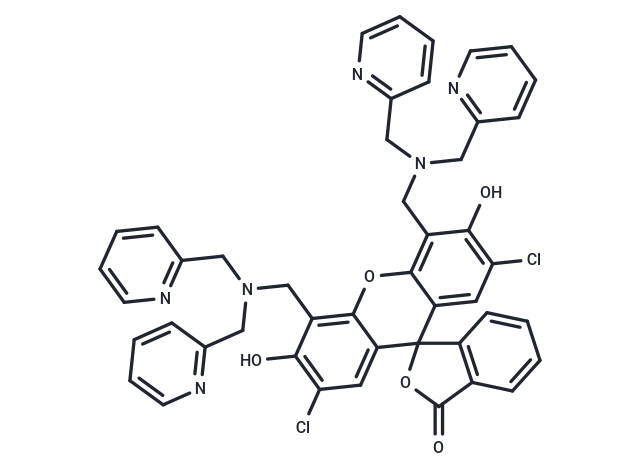
| Description | Zinpyr-1 is a zinc ion-responsive fluorescent indicator and cell membrane-permeable metal-binding probe. It binds to Mn²⁺ to form a complex with enhanced fluorescence signals. Moreover, Zinpyr-1 specifically binds to free zinc ions in serum, enabling quantitative determination of free zinc ion concentration. In plant systems, the fluorescence signal of Zinpyr-1 reflects the relative zinc ion level in root cells and is mainly localized in specific regions of root cells. It can be applied to the screening of plant zinc transporter mutants and research on zinc homeostasis regulation. |
| In vivo | Methods: A complex was constructed using Zinpyr-1 and Mn²⁺, and its fluorescence response characteristics to Zn²⁺ were detected under different pH conditions. Cell experiments were performed to evaluate its membrane permeability and cytotoxicity, and its capability for zinc ion detection and imaging was verified in serum system and Arabidopsis thaliana seedling model. Results: 1.Zinpyr-1 (10 μM, pH 6–8) could form a 1:2 complex with Mn²⁺. When used for Zn²⁺ detection, the fluorescence dynamic range was 25 times higher than that of the free ligand (106 at pH 7.0).It still maintained a high dynamic range at pH 6.0 and 8.0, and exhibited significantly better selectivity for Zn²⁺ than common monovalent and divalent cations in vivo. 2.The complex formed by Zinpyr-1 (10 μM) and Mn²⁺ possessed cell membrane permeability and showed no cytotoxicity to HeLa cells. It had extremely low background fluorescence and was remarkably activated after binding to Zn²⁺, which was suitable for zinc ion imaging in living cells. 3.The complex formed by Zinpyr-1 (0.1 mM) and Mn²⁺ could be used as a zinc-responsive MRI contrast agent [1]. 4.Zinpyr-1 could stably produce the minimum fluorescence (Fmin) and maximum fluorescence (Fmax) for the quantification of free zinc in serum, with a maximum excitation wavelength of 507 nm and a maximum emission wavelength of 526 nm, enabling reliable quantification of serum free zinc [2]. 5.Zinpyr-1 (5–20 μM, 15 min–3 h) could serve as a fluorescent probe for relative zinc levels in root cells of Arabidopsis thaliana seedlings, and the fluorescence intensity was positively correlated with intracellular zinc concentration [3]. |
| Molecular Weight | 823.72 |
| Formula | C46H36Cl2N6O5 |
| Cas No. | 288574-78-7 |
| Smiles | O=C1OC2(C=3C=CC=CC13)C4=CC(Cl)=C(O)C(=C4OC=5C2=CC(Cl)=C(O)C5CN(CC6=NC=CC=C6)CC7=NC=CC=C7)CN(CC8=NC=CC=C8)CC9=NC=CC=C9 |
| Storage | Keep away from direct sunlight,Store under nitrogen Powder: -20°C for 3 years | In solvent: -80°C for 1 year Shipping with blue ice/Shipping at ambient temperature. | ||||||||||||||||||||
| Solubility Information | DMSO: 16.00 mg/mL (19.42 mM), Sonication is recommended. | ||||||||||||||||||||
Solution Preparation Table | |||||||||||||||||||||
DMSO
Note : The dilution table applies only to solid products. For liquid products, please calculate the stock solution based on the stated concentration and/or density. | |||||||||||||||||||||
 For example, if the intended dosage is 10 mg/kg for animals weighing 20 g , with a dosing volume of 100 μL per animal, and a total of 10 animals are to be administered, using a formulation of
  10% DMSO+ 40% PEG300+ 5% Tween 80+ 45% Saline/PBS/ddH2O , the resulting working solution concentration would be 2 mg/mL.
Dissolve 2 mg of the compound in 100 μL DMSO to obtain a stock solution at a concentration of 20 mg/mL . If the required concentration exceeds the compound's known solubility, please contact us for technical support before proceeding.
1) Add 100 μL of the DMSO stock solution to 400 µL PEG300 and mix thoroughly until the solution becomes clear.
2) Add 50 µL Tween 80 and mix well until fully clarified.
3) Add 450 µL Saline,PBS or ddH2O and mix thoroughly until a homogeneous solution is obtained.
| Size | Quantity | Unit Price | Amount | Operation |
|---|
 Feedback
 Hello! How can I help you today?
Copyright © 2015-2026 TargetMol Chemicals Inc. All Rights Reserved.
