


Shopping Cart
Remove All Your shopping cart is currently empty

Synonyms:
| Pack Size | Price | USA Stock | Global Stock | Quantity |
|---|---|---|---|---|
| 10 mg | Inquiry | Inquiry | Inquiry | |
| 50 mg | Inquiry | Inquiry | Inquiry |
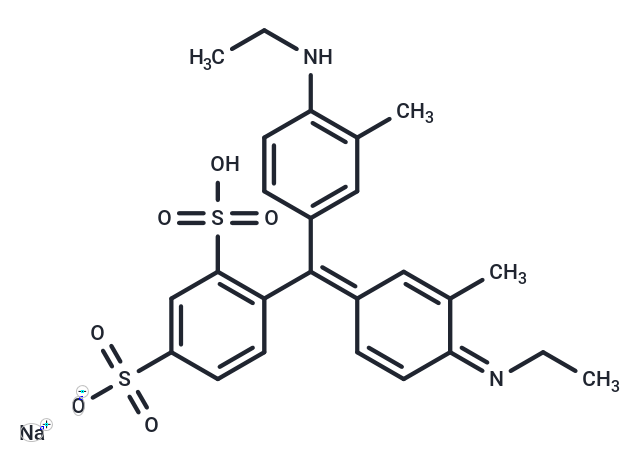
| Description | Xylene Cyanol FF, an acid triphenylmethane dye, is utilized for histochemical staining of hemoglobin peroxidase and as a tracking dye for DNA sequencing during electrophoresis. Catalyzed by Fe and Al, it accelerates oxidation with hydrogen peroxide and potassium periodate, enabling spectrophotometric determination of Fe and Al in solutions [1] [2]. |
| In vitro | Xylene Cyanol FF is utilized to trace DNA in various polyacrylamide gel electrophoresis setups. [1] The procedures are as follows: 1. For denaturing gels: (1) Prepare a gel consisting of 10% acrylamide (19:1 acrylamide:bisacrylamide) and 8.3 M urea, running it at 55°C. (2) Prepare the electrophoresis buffer using 89 mM Tris, HCl at pH 8.0, 89 mM boric acid, and 2 mM EDTA (TBE). (3) Prepare the loading buffer with 10 mM NaOH, 1 mM EDTA, and 0.1% Xylene Cyanol FF. (4) Run the gel on an IBI model STS 45 apparatus at 70 W (50 V/cm, constant power) or on a Hoefer SE 600 apparatus at 60°C (31 V/cm, constant voltage). (5) Dry the gel on Whatman 3MM paper and expose it to X-ray film for up to 15 hours. 2. For another denaturing gel method: (1) Prepare a gel containing 8% acrylamide (19:1 acrylamide:bisacrylamide). (2) Make a DNA suspension with 40 mM Tris-HCl at pH 8.0, 20 mM acetic acid, 2 mM EDTA, and 12.5 mM magnesium acetate (TAEMg). (3) Boil the DNA suspension and cool slowly to 16°C. (4) Prepare a dye solution with TAEMg, 50% glycerol, 0.02% bromophenol blue, and 0.02% Xylene Cyanol FF to adjust the sample to a final volume of 10 µL. (5) Run the gel on the Hoefer SE-600 apparatus at 11 V/cm and 16°C, and expose it to X-ray film for up to 15 hours or stain with Stainsall dye. The above information is based on published literature. Experimental procedures should be appropriately modified to meet specific research demands. |
| Molecular Weight | 538.61 |
| Formula | C25H27N2NaO6S2 |
| Cas No. | 2650-17-1 |
| Smiles | O=S(C(C=C(C=C1)S(=O)([O-])=O)=C1/C(C2=CC(C)=C(C=C2)NCC)=C3C=C(/C(C=C/3)=N\CC)C)(O)=O.[Na+] |
| Storage | Powder: -20°C for 3 years | In solvent: -80°C for 1 year Shipping with blue ice/Shipping at ambient temperature. |
 For example, if the intended dosage is 10 mg/kg for animals weighing 20 g , with a dosing volume of 100 μL per animal, and a total of 10 animals are to be administered, using a formulation of
  10% DMSO+ 40% PEG300+ 5% Tween 80+ 45% Saline/PBS/ddH2O , the resulting working solution concentration would be 2 mg/mL.
Dissolve 2 mg of the compound in 100 μL DMSO to obtain a stock solution at a concentration of 20 mg/mL . If the required concentration exceeds the compound's known solubility, please contact us for technical support before proceeding.
1) Add 100 μL of the DMSO stock solution to 400 µL PEG300 and mix thoroughly until the solution becomes clear.
2) Add 50 µL Tween 80 and mix well until fully clarified.
3) Add 450 µL Saline,PBS or ddH2O and mix thoroughly until a homogeneous solution is obtained.
| Size | Quantity | Unit Price | Amount | Operation |
|---|
 Feedback
 Hello! How can I help you today?
Copyright © 2015-2026 TargetMol Chemicals Inc. All Rights Reserved.
