


Shopping Cart
Remove All Your shopping cart is currently empty

Synonyms:
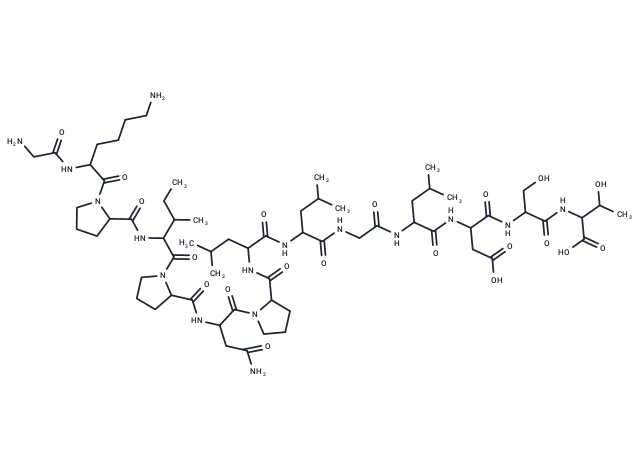
| Pack Size | Price | USA Stock | Global Stock | Quantity |
|---|---|---|---|---|
| 5 mg | $115 | Inquiry | Inquiry |
| Description | The recognized V5 epitope represents 95GKPIPNPLLGLDST108 of RNA polymerase α subunit of simian parain uenza virus type 5. This short peptide sequence was chosen because high-af nity antibodies can be reliably produced in many different species1. |
| In vitro | A 14-amino-acid V5 epitope derived from simian parain?uenza virus type 5 was inserted into the C terminus of the capsid protein (before the stop codon ofORF2) to construct a recombinant marker virus. We demonstrated that the V5 epitope was displayed on the surface of the capsid protein. Furthermore, the recombinant marker virus behaved similarly to the parental virus in vitro and in mice and could be differentiated from the parental virus via polymerase chain reaction (PCR) and serological methods [2][3]. |
| In vivo | A V5/His-epitope tag was added to the amino terminus of each coding sequence to distinguish the plasmid-encoded protein from endogenous LRRK2. Plasmids were transiently transfected into COS7 cells, and cell lysates were analyzed by SDS-PAGE and Western blotting with antibodies speci?c for the V5 epitope tag or LRRK24. |
| Molecular Weight | 1421.64 |
| Formula | C64H108N16O20 |
| Smiles | CCC(C)C(C(=O)N1CCCC1C(=O)NC(CC(=O)N)C(=O)N2CCCC2C(=O)NC(CC(C)C)C(=O)NC(CC(C)C)C(=O)NCC(=O)NC(CC(C)C)C(=O)NC(CC(=O)O)C(=O)NC(CO)C(=O)NC(C(C)O)C(=O)O)NC(=O)C3CCCN3C(=O)C(CCCCN)NC(=O)CN |
| Relative Density. | no data available |
| Sequence | H-Gly-{DL-Lys}-{DL-Pro}-{DL-xiIle}-{DL-Pro}-{DL-Asn}-{DL-Pro}-{DL-Leu}-{DL-Leu}-Gly-{DL-Leu}-{DL-Asp}-{DL-Ser}-{DL-xiThr}-OH |
| Sequence Short | GKPXPNPLLGLDSX |
| Storage | Keep away from moisture Powder: -20°C for 3 years | In solvent: -80°C for 1 year Shipping with blue ice/Shipping at ambient temperature. |
| Solubility Information | H2O: ≥55.4 mg/mL, Sonication is recommended. DMSO: ≥71.082 mg/mL, Sonication is recommended. Ethanol: ≥107.2 mg/mL, Sonication is recommended. |
 For example, if the intended dosage is 10 mg/kg for animals weighing 20 g , with a dosing volume of 100 μL per animal, and a total of 10 animals are to be administered, using a formulation of
  10% DMSO+ 40% PEG300+ 5% Tween 80+ 45% Saline/PBS/ddH2O , the resulting working solution concentration would be 2 mg/mL.
Dissolve 2 mg of the compound in 100 μL DMSO to obtain a stock solution at a concentration of 20 mg/mL . If the required concentration exceeds the compound's known solubility, please contact us for technical support before proceeding.
1) Add 100 μL of the DMSO stock solution to 400 µL PEG300 and mix thoroughly until the solution becomes clear.
2) Add 50 µL Tween 80 and mix well until fully clarified.
3) Add 450 µL Saline,PBS or ddH2O and mix thoroughly until a homogeneous solution is obtained.
| Size | Quantity | Unit Price | Amount | Operation |
|---|
 Feedback
 Hello! How can I help you today?
Copyright © 2015-2026 TargetMol Chemicals Inc. All Rights Reserved.
