


Shopping Cart
Remove All Your shopping cart is currently empty

Synonyms:
| Pack Size | Price | USA Stock | Global Stock | Quantity |
|---|---|---|---|---|
| 1 mg | $50 | Inquiry | Inquiry | |
| 5 mg | $143 | Inquiry | Inquiry | |
| 10 mg | $235 | Inquiry | Inquiry | |
| 25 mg | $329 | Inquiry | Inquiry |
| Description | Type II collagen is composed of a triple helix of three identical α chains. These molecules associate to form a fibril that is stabilized by intermolecular crosslinks1. Damage to the fibrillar meshwork, made up of primarily type II collagen (z 90–95%), maybe a critical event in the pathology of many arthritides, due in part to the very slow rate of collagen turnover within the cartilage2. |
| In vitro | Type II collagen and aggrecan (a large, aggregating proteoglycan) are the two major components of the extracellular matrix of cartilage. The collagen, which is present in a fibrillar form, provides tensile strength whereas the aggrecan is responsible for compressive stiffness of cartilage3-5. Early damage to type II collagen is predominantly pericellular/ territorial suggests that in the majority of cases collagen damage was mediated by the chondrocyte. |
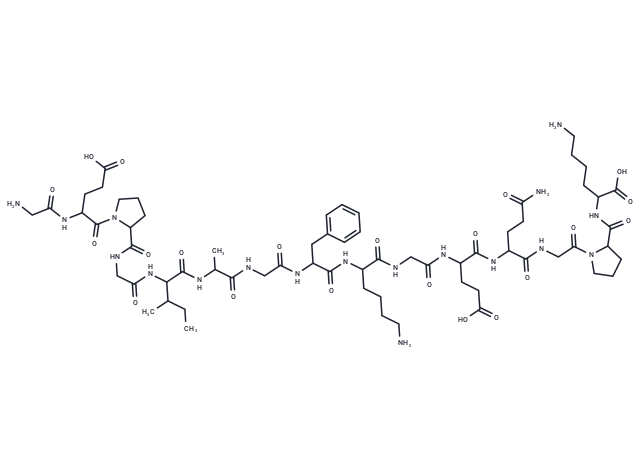
| Molecular Weight | 1471.61 |
| Formula | C65H102N18O21 |
| Smiles | NCC(NC(CCC(O)=O)C(N1CCCC1C(NCC(NC(C(C)CC)C(NC(C)C(NCC(NC(CC2=CC=CC=C2)C(NC(CCCCN)C(NCC(NC(CCC(O)=O)C(NC(CCC(N)=O)C(NCC(N3C(C(NC(CCCCN)C(O)=O)=O)CCC3)=O)=O)=O)=O)=O)=O)=O)=O)=O)=O)=O)=O)=O |
| Relative Density. | 1.31g/cm3 |
| Sequence | Pro-Thr-Gly-Pro-Leu-Gly-Pro-Lys-Gly-Gln-Thr-Gly-Glu-Leu-Gly-Ala-{Hyp}-Gly-Asn-Lys-Gly-Glu-Gln-Gly-Pro-Lys |
| Sequence Short | PTGPLGPKGQTGELGAXGNKGEQGPK |
| Storage | Keep away from moisture Powder: -20°C for 3 years | In solvent: -80°C for 1 year Shipping with blue ice/Shipping at ambient temperature. |
| Solubility Information | DMSO: ≥147.1 mg/mL, Sonication is recommended. |
 For example, if the intended dosage is 10 mg/kg for animals weighing 20 g , with a dosing volume of 100 μL per animal, and a total of 10 animals are to be administered, using a formulation of
  10% DMSO+ 40% PEG300+ 5% Tween 80+ 45% Saline/PBS/ddH2O , the resulting working solution concentration would be 2 mg/mL.
Dissolve 2 mg of the compound in 100 μL DMSO to obtain a stock solution at a concentration of 20 mg/mL . If the required concentration exceeds the compound's known solubility, please contact us for technical support before proceeding.
1) Add 100 μL of the DMSO stock solution to 400 µL PEG300 and mix thoroughly until the solution becomes clear.
2) Add 50 µL Tween 80 and mix well until fully clarified.
3) Add 450 µL Saline,PBS or ddH2O and mix thoroughly until a homogeneous solution is obtained.
| Size | Quantity | Unit Price | Amount | Operation |
|---|
 Feedback
 Hello! How can I help you today?
Copyright © 2015-2026 TargetMol Chemicals Inc. All Rights Reserved.
