


Shopping Cart
Remove All Your shopping cart is currently empty

Synonyms:
| Pack Size | Price | USA Stock | Global Stock | Quantity |
|---|---|---|---|---|
| 100 g | $29 | - | In Stock |
| Description | Sodium sulfite is a biochemical reagent utilized as a biomaterial or organic compound in life science research. Sodium sulfite is commonly employed in biochemical, analytical, and biomaterial-related investigations, where Sodium sulfite serves as a useful reagent for experimental and methodological applications. |
| In vitro | Method: Human hepatocyte L02 cells were exposed to sodium sulfite at concentrations ranging from 10⁻⁵ to 10⁻² M for 72 h, and cell viability was evaluated. Rresult: Sodium sulfite inhibited L02 cell viability in a concentration-dependent manner, with an IC50 of 4.68 × 10⁻⁴ M after 72 h.[1] Method: Isolated human neutrophils were treated with sodium sulfite, and superoxide production, fMLP-induced oxidative responses, total RNA synthesis, cell morphology, and apoptosis were evaluated. Rresult: Sodium sulfite directly induced superoxide production within 5 min and concentration-dependently enhanced fMLP-induced superoxide production. It also concentration-dependently increased gene expression within approximately 4 h, but did not induce cell-shape changes or alter neutrophil apoptosis after 20 h.[2] Method: Rat gastric mucosal RGM1 cells were exposed to sodium sulfite at concentrations of 0–5 mM for 20 h, and cytotoxicity and oxidative-stress markers were evaluated. Rresult: Sodium sulfite caused significant cytotoxicity in RGM1 cells and increased protein carbonyls, 8-hydroxy-2′-deoxyguanosine, and the accumulation of carbonylated protein aggregates, indicating oxidative protein and DNA damage.[3] Method: RBL-2H3 mast cells were exposed to 2–8 mM sodium sulfite, and reactive oxygen species generation, pyroptosis-related proteins, membrane integrity, and mast-cell degranulation were evaluated. NAC or MCC950 was used to investigate the involvement of ROS and NLRP3. Rresult: Sodium sulfite increased ROS generation and the expression of NLRP3, caspase-1, GSDMD-N, IL-1β, and IL-18; induced cell-membrane rupture; and increased β-hexosaminidase and histamine release. NAC and MCC950 attenuated these effects, indicating that sodium sulfite induced mast-cell pyroptosis and degranulation through the ROS/NLRP3 pathway.[4] |
| In vivo | Method: Sodium sulfite solutions were used to remove dissolved oxygen and establish a chemically induced hypoxia model in Caenorhabditis elegans. Rresult: Sodium sulfite generated controllable hypoxic conditions and induced hypoxia-related death, morphological cellular defects, and stabilization of hypoxia-inducible factor 1 in C. elegans, producing responses similar to physical hypoxia.[5] |
| Molecular Weight | 126.04 |
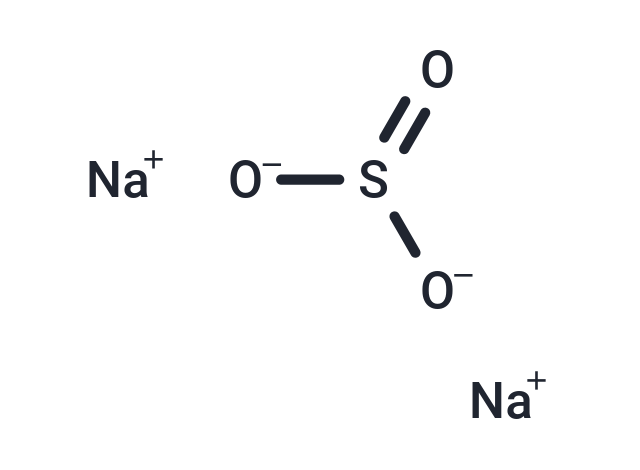
| Formula | Na2O3S |
| Cas No. | 7757-83-7 |
| Smiles | O=S([O-])[O-].[Na+].[Na+] |
| Storage | Powder: -20°C for 3 years | In solvent: -80°C for 1 year Shipping with blue ice/Shipping at ambient temperature. | |||||||||||||||||||||||||||||||||||
| Solubility Information | H2O: 160.00 mg/mL (1269.44 mM), Sonication is recommended. | |||||||||||||||||||||||||||||||||||
Solution Preparation Table | ||||||||||||||||||||||||||||||||||||
H2O
Note : The dilution table applies only to solid products. For liquid products, please calculate the stock solution based on the stated concentration and/or density. | ||||||||||||||||||||||||||||||||||||
 For example, if the intended dosage is 10 mg/kg for animals weighing 20 g , with a dosing volume of 100 μL per animal, and a total of 10 animals are to be administered, using a formulation of
  10% DMSO+ 40% PEG300+ 5% Tween 80+ 45% Saline/PBS/ddH2O , the resulting working solution concentration would be 2 mg/mL.
Dissolve 2 mg of the compound in 100 μL DMSO to obtain a stock solution at a concentration of 20 mg/mL . If the required concentration exceeds the compound's known solubility, please contact us for technical support before proceeding.
1) Add 100 μL of the DMSO stock solution to 400 µL PEG300 and mix thoroughly until the solution becomes clear.
2) Add 50 µL Tween 80 and mix well until fully clarified.
3) Add 450 µL Saline,PBS or ddH2O and mix thoroughly until a homogeneous solution is obtained.
| Size | Quantity | Unit Price | Amount | Operation |
|---|
 Feedback
 Hello! How can I help you today?
Copyright © 2015-2026 TargetMol Chemicals Inc. All Rights Reserved.
