Shopping Cart
Remove All
  • TargetMol
    Your shopping cart is currently empty

Sodium Thioglycolate

Copy Product Info
😃Good
Catalog No. T8530Cas No. 367-51-1
Alias Thioglycolate sodium

Sodium thioglycolate is a biochemical reagent with disulfide-reducing properties, used as a biomaterial or organic compound in life science research, and is commonly employed to induce peritonitis models.

Sodium Thioglycolate

Sodium Thioglycolate

Copy Product Info
😃Good
Purity: 99.65%
Catalog No. T8530Alias Thioglycolate sodiumCas No. 367-51-1
Sodium thioglycolate is a biochemical reagent with disulfide-reducing properties, used as a biomaterial or organic compound in life science research, and is commonly employed to induce peritonitis models.
Pack SizePriceUSA WarehouseGlobal WarehouseQuantity
1 g$29InquiryInquiry
Add to Cart
Add to Quotation
In Stock Estimated shipping dateUSA Warehouse[1-2 days] Global Warehouse[5-7 days]
All TargetMol products are for research purposes only and cannot be used for human consumption. We do not provide products or services to individuals. Please comply with the intended use and do not use TargetMol products for any other purpose.
Questions
TargetMol
View More

Batch Information

Select Batch
Purity:99.65%
Appearance:Solid
Color:White
Contact us for more batch information

Resource Download

Product Introduction

Bioactivity
Description
Sodium thioglycolate is a biochemical reagent with disulfide-reducing properties, used as a biomaterial or organic compound in life science research, and is commonly employed to induce peritonitis models.
Disease Modeling Protocol
Skin Inflammation and Injury Model
  • Modeling Mechanism:

    The core modeling mechanism of Sodium Thioglycolate is as follows: ① After skin contact, its thiol groups (-SH) are chemically irritating, directly damaging the stratum corneum and epithelial cells of the epidermis, causing epidermal hyperplasia and abnormal keratinization; ② Long-term exposure activates local inflammatory pathways, recruits inflammatory cells to infiltrate, leading to skin redness, thickening, and even ulceration. At the same time, it may affect the function of internal organs such as the liver, kidneys, and heart through skin absorption, simulating the skin toxicity and systemic damage caused by clinical occupational exposure or cosmetic contact, and is suitable for chemical skin safety evaluation and toxicity mechanism research.

  • Related Products:

    Sodium Thioglycolate (T8530)

  • Modeling Method:

    Experimental Subject:Rat , F344/N rat , 16 days old Mice , B6C3F1/N mice , 17 days old

    Dosage and Administration Route:① Pre-treatment: Depilate dorsal skin, ensuring no skin damage or inflammation; administer after 1–2 days of environmental acclimatisation; ② Core modelling (distinguishing short-term/long-term models): - Solvent preparation: 95% ethanol : deionised water = 1:1 (by volume) mixed solvent; - Short-term model: - Rats: Sodium Thioglycolate 11.25–180 mg/kg applied to depilated dorsal skin; - Mice: Sodium Thioglycolate 22.5–360 mg/kg applied to depilated dorsal skin; - Long-term model: - Rats: Sodium Thioglycolate 11.25–180 mg/kg · applied to depilated dorsal skin; - Mice: Sodium Thioglycolate 22.5–360 mg/kg · applied to depilated dorsal skin; ③ Control setup: - Solvent control: Apply equal volume of 95% ethanol: deionised water (1:1) mixed solvent; all other procedures identical

    Dosing Frequency and Duration Model:Short-term model: - Rats: 5 times weekly for 16 consecutive days; - Mice: 5 times weekly for 17 consecutive days; Long-term model: 5 times weekly for 3 consecutive months

  • Validation:

    1. Skin toxicity indicators (core validation): - Appearance observation: In the short-term model, rats in the 180 mg/kg group and mice in the 360 mg/kg group showed skin irritation (erythema, edema); in the long-term model, rats in the 90-180 mg/kg group and mice in the 45 mg/kg and above group showed skin thickening, and rats in the 90-180 mg/kg group and mice in the 360 mg/kg group showed skin ulceration; - Histopathology: In the short-term model, rats in the 45 mg/kg and above group and mice in the 45 mg/kg and above group showed minimal to mild epidermal hyperplasia; in the long-term model, epidermal hyperplasia, hyperkeratosis, sebaceous gland hypertrophy, and significant inflammatory cell infiltration were observed; 2. Visceral function indicators: - Rats: 180 mg/kg significantly increased the weight of the kidneys and liver in males, and significantly decreased the weight of the lungs in all male groups; - Mice: 180-360 mg/kg significantly increased the weight of the heart in males, and 180-360 mg/kg significantly increased the weight of the heart in males. 3. Genetic toxicity indicators: - Mouse peripheral blood erythrocytes: After 3 months of administration, the micronucleus rate of female mice increased significantly (no significant change in males); Salmonella mutation test (TA98, TA100 and other strains) showed no mutagenic effect.

*Precautions:

*References:National Toxicology Program. Toxicity studies of sodium thioglycolate administered dermally to F344/N rats and B6C3F1/N mice. Toxic Rep Ser. 2016 May;(80):NTP-TOX-80.

SynonymsThioglycolate sodium
Chemical Properties
Molecular Weight114.1
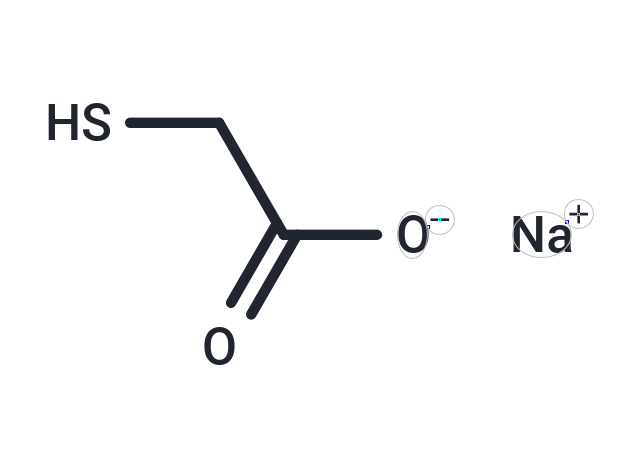
FormulaC2H3NaO2S
Cas No.367-51-1
Smiles[Na+].[O-]C(=O)CS
Relative Density.1.311g/cm3
Storage & Solubility Information
Storagekeep away from direct sunlight | Powder: -20°C for 3 years | In solvent: -80°C for 1 year

Calculator

  • Molarity Calculator
  • Dilution Calculator
  • Reconstitution Calculator
  • Molecular Weight Calculator

In Vivo Formulation Calculator (Clear solution)

Please enter your animal experiment information in the following box and click Calculate to obtain the stock solution preparation method and in vivo formula preparation method:
TargetMol | Animal experiments For example, if the intended dosage is 10 mg/kg for animals weighing 20 g , with a dosing volume of 100 μL per animal, TargetMol | Animal experiments and a total of 10 animals are to be administered, using a formulation of TargetMol | reagent 10% DMSO+ 40% PEG300+ 5% Tween 80+ 45% Saline/PBS/ddH2O , the resulting working solution concentration would be 2 mg/mL.

Stock Solution Preparation:

Dissolve 2 mg of the compound in 100 μL DMSOTargetMol | reagent to obtain a stock solution at a concentration of 20 mg/mL . If the required concentration exceeds the compound's known solubility, please contact us for technical support before proceeding.

Preparation of the In Vivo Formulation:

1) Add 100 μL of the DMSOTargetMol | reagent stock solution to 400 μL PEG300TargetMol | reagent and mix thoroughly until the solution becomes clear.

2) Add 50 μL Tween 80 and mix well until fully clarified.

3) Add 450 μL Saline,PBS or ddH2OTargetMol | reagent and mix thoroughly until a homogeneous solution is obtained.

This example is provided solely to demonstrate the use of the In Vivo Formulation Calculator and does not constitute a recommended formulation for any specific compound. Please select an appropriate dissolution and formulation strategy based on your experimental model and route of administration.
All co-solvents required for this protocol, includingDMSO, PEG300/PEG400, Tween 80, SBE-β-CD, and Corn oil, are available for purchase on the TargetMol website.
1 Enter information below:
mg/kg
g
μL
2 Enter the in vivo formulation:
% DMSO
%
% Tween 80
% Saline/PBS/ddH2O

Dose Conversion

You can also refer to dose conversion for different animals. More Dose Conversion

Tech Support

Please see Inhibitor Handling Instructions for more frequently ask questions. Topics include: how to prepare stock solutions, how to store products, and cautions on cell-based assays & animal experiments, etc

Keywords

Related Tags: buy Sodium Thioglycolate | purchase Sodium Thioglycolate | Sodium Thioglycolate cost | order Sodium Thioglycolate | Sodium Thioglycolate chemical structure | Sodium Thioglycolate formula | Sodium Thioglycolate molecular weight