Shopping Cart
Remove All
  • TargetMol
    Your shopping cart is currently empty

SLU-PP-915

(Synonyms: SLU-PP915) Copy Product Info
🥰Excellent

Synonyms: SLU-PP915

Catalog No. T73152 Copy Product Info
Purity: 99.85%
🥰Excellent
SLU-PP-915 is a pan-ERR (oestrogen-related receptor) agonist that activates ERRα, ERRβ and ERRγ (EC₅₀ ≈ 400 nM). SLU-PP-915 enhances ERR-mediated transcriptional activity and promotes the expression of genes associated with mitochondrial function and oxidative metabolism; it can be used in research into energy metabolism-related diseases such as heart failure and metabolic syndrome.
SLU-PP-915
Cas No. 2285432-92-8
TargetMol | Customer service
Customer service consultation
Pack SizePriceEUR StockGlobal StockQuantity
1 mg263 €-In Stock
5 mg649 €-In Stock
10 mg888 €-In Stock
25 mg1.368 €-In Stock
50 mg1.782 €-In Stock
100 mg2.250 €-In Stock
For In stock only · Estimated delivery: EUR Stock (1-2 days) Global Stock (5-7 days)
Add to Cart
Add to Quotation
For research use only—not for human use. No sales to individuals. Use as intended only.
Questions
TargetMol
View More

Batch Information

Select Batch
Purity:99.85%
Appearance:Solid
Color:White
Contact us for more batch information

Resource Download

Product Information

Bioactivity
Description
SLU-PP-915 is a pan-ERR (oestrogen-related receptor) agonist that activates ERRα, ERRβ and ERRγ (EC₅₀ ≈ 400 nM). SLU-PP-915 enhances ERR-mediated transcriptional activity and promotes the expression of genes associated with mitochondrial function and oxidative metabolism; it can be used in research into energy metabolism-related diseases such as heart failure and metabolic syndrome.
In vitro
Method: Neonatal rat ventricular myocytes (NRVMs) were treated with SLU-PP-915 (10 μM) for 72 h, and RNA-seq transcriptomic analysis was performed to detect changes in gene expression.
Result: SLU-PP-915 treatment induced 602 upregulated and 1521 downregulated genes in NRVMs. Upregulated genes were enriched in fatty acid metabolism, oxidative phosphorylation, and cardiac contraction pathways, while downregulated genes were enriched in cell cycle and developmental pathways[2].
Method: Neonatal rat ventricular myocytes (NRVMs) were treated with SLU-PP-915 (10 μM) for 24 h. ERK1/2 phosphorylation levels were detected by Western blot, and NFAT transcriptional activity was assessed by NFAT luciferase reporter assay.
Result: SLU-PP-915 mildly induced ERK1/2 phosphorylation at baseline but did not block phenylephrine-induced enhancement of ERK1/2 phosphorylation; moreover, SLU-PP-915 did not inhibit phenylephrine-induced NFAT transcriptional activation[2].
Method: Neonatal rat ventricular myocytes (NRVMs) were treated with SLU-PP-915 (10 μM) for 72 h. LC3-II and p62 protein levels were detected by Western blot, and autophagic flux was assessed by treatment with bafilomycin.
Result: SLU-PP-915 treatment increased LC3-II and p62 protein levels, and both were further elevated upon bafilomycin treatment, suggesting that SLU-PP-915 induces autophagy in cardiomyocytes[2].
In vivo
Method: In a mouse model of MLL-rearranged leukemia, Menin-MLL inhibitor 19 was administered, and its in vivo anti-leukemic efficacy was evaluated by assessing tumor burden and survival.
Result: Menin-MLL inhibitor 19 exhibited dose-dependent tumor growth inhibition in the mouse model and effectively prolonged the survival of mice bearing MLL-rearranged leukemia, providing in vivo evidence for its efficacy as an antitumor drug candidate[1].
SynonymsSLU-PP915
Chemical Properties
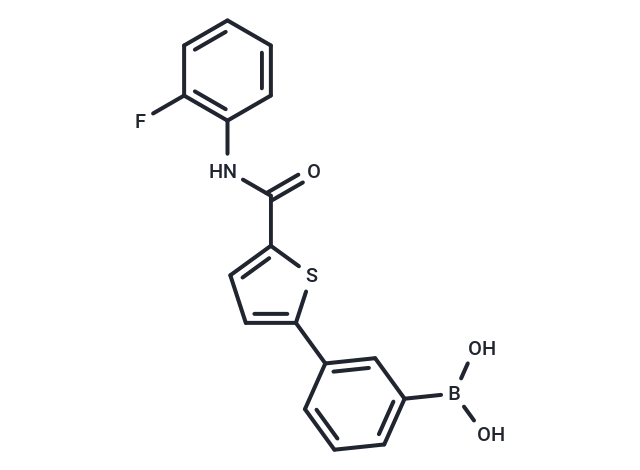
Molecular Weight341.16
FormulaC17H13BFNO3S
Cas No.2285432-92-8
SmilesO=C(NC=1C=CC=CC1F)C=2SC(=CC2)C=3C=CC=C(C3)B(O)O
Storage & Solubility Information
StoragePowder: -20°C for 3 years | In solvent: -80°C for 1 year Shipping with blue ice/Shipping at ambient temperature.

Calculator

  • Molarity Calculator
  • Dilution Calculator
  • Reconstitution Calculator
  • Molecular Weight Calculator

In Vivo Formulation Calculator (Clear solution)

Please enter your animal experiment information in the following box and click Calculate to obtain the stock solution preparation method and in vivo formula preparation method:
TargetMol | Animal experiments For example, if the intended dosage is 10 mg/kg for animals weighing 20 g , with a dosing volume of 100 μL per animal, TargetMol | Animal experiments and a total of 10 animals are to be administered, using a formulation of TargetMol | reagent 10% DMSO+ 40% PEG300+ 5% Tween 80+ 45% Saline/PBS/ddH2O , the resulting working solution concentration would be 2 mg/mL.

Stock Solution Preparation:

Dissolve 2 mg of the compound in 100 μL DMSOTargetMol | reagent to obtain a stock solution at a concentration of 20 mg/mL . If the required concentration exceeds the compound's known solubility, please contact us for technical support before proceeding.

Preparation of the In Vivo Formulation:

1) Add 100 μL of the DMSOTargetMol | reagent stock solution to 400 µL PEG300TargetMol | reagent and mix thoroughly until the solution becomes clear.

2) Add 50 µL Tween 80 and mix well until fully clarified.

3) Add 450 µL Saline,PBS or ddH2OTargetMol | reagent and mix thoroughly until a homogeneous solution is obtained.

This example is provided solely to demonstrate the use of the In Vivo Formulation Calculator and does not constitute a recommended formulation for any specific compound. Please select an appropriate dissolution and formulation strategy based on your experimental model and route of administration.
All co-solvents required for this protocol, includingDMSO, PEG300/PEG400, Tween 80, SBE-β-CD, and Corn oil, are available for purchase on the TargetMol website.
1 Enter information below:
mg/kg
g
µL
2 Enter the in vivo formulation:
% DMSO
%
% Tween 80
% Saline/PBS/ddH2O

Dose Conversion

You can also refer to dose conversion for different animals. More Dose Conversion

Tech Support

Please see Product Handling Instructions for more frequently ask questions. Topics include: how to prepare stock solutions, how to store products, and cautions on cell-based assays & animal experiments, etc
Related Tags: SLU-PP-915 chemical structure | SLU-PP-915 in vivo | SLU-PP-915 in vitro | SLU-PP-915 formula | SLU-PP-915 molecular weight