


Shopping Cart
Remove All Your shopping cart is currently empty

Synonyms:

| Pack Size | Price | USA Stock | Global Stock | Quantity |
|---|---|---|---|---|
| 1 mg | $45 | - | In Stock | |
| 5 mg | $106 | - | In Stock | |
| 10 mg | $172 | - | In Stock | |
| 25 mg | $342 | - | In Stock | |
| 50 mg | $548 | - | In Stock | |
| 100 mg | $882 | - | In Stock | |
| 1 mL x 10 mM (in DMSO) | $117 | - | In Stock |
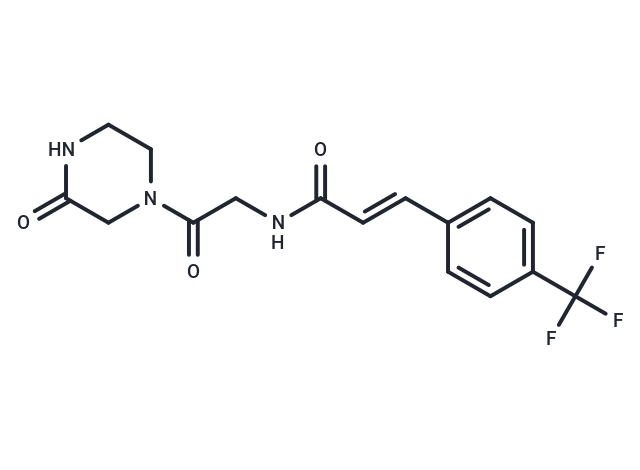
| Description | SLC6A19-IN-4 is an allosteric competitive and orally active B0AT1 (SLC6A19) inhibitor. SLC6A19-IN-4 exhibits inhibitory activity against both human and mouse B0AT1, with corresponding IC50 values of 513 nM and 295 nM, respectively. In addition, SLC6A19-IN-4 also shows excellent metabolic stability. Its main mechanism of action is the dual inhibition of B0AT1 in the intestines (reducing phenylalanine absorption) and kidneys (promoting phenylalanine excretion), thereby significantly increasing the excretion of phenylalanine (Phe) in urine and decreasing the level of phenylalanine in plasma. Based on the above characteristics, SLC6A19-IN-4 can be used in the research of phenylketonuria (PKU) and other diseases related to SLC6 family transporters . |
| Targets & IC50 | B0AT1/SLC6A19 (human):513 nM, B0AT1/SLC6A19 (mouse):295 nM |
| In vitro | After treating Jump-In TI platform cells stably expressing human SLC6A19 and human Collectrin with SLC6A19-IN-4 at a concentration range of 1500-4000 nM, SLC6A19-IN-4 can increase the Km value of the cells for d5-phenylalanine (d5-Phe) uptake, while the Vmax value does not change significantly. This result confirms its competitive inhibitory property; the Km values corresponding to different concentrations are 0.866, 5.19, and 12.1 mM, respectively, and the Vmax values are 337, 351, and 380 μmol/min/mg-protein, respectively [1]. In the cell system where mock cells are co-expressed with mouse B0AT1 and ACE2, the dissociation constant (Kd) of SLC6A19-IN-4 is 123.1 nM; while in the cell system where mock cells are co-expressed with human B0AT1 and ACE2, the Kd value of SLC6A19-IN-4 is 46.98 nM [1]. |
| In vivo | When SLC6A19-IN-4 was administered as a single oral dose of 30 mg/kg to male Pahenu2 mice homozygous for the F263S mutation, it could reduce the systemic phenylalanine (Phe) levels in the mice by inhibiting the absorption of phenylalanine (Phe) in the intestines and promoting its excretion from the urine [1]. |
| Molecular Weight | 355.31 |
| Formula | C16H16F3N3O3 |
| Cas No. | 2962069-39-0 |
| Smiles | C(CNC(/C=C/C1=CC=C(C(F)(F)F)C=C1)=O)(=O)N2CC(=O)NCC2 |
| Relative Density. | no data available |
| Storage | Powder: -20°C for 3 years | In solvent: -80°C for 1 year Shipping with blue ice/Shipping at ambient temperature. |
 For example, if the intended dosage is 10 mg/kg for animals weighing 20 g , with a dosing volume of 100 μL per animal, and a total of 10 animals are to be administered, using a formulation of
  10% DMSO+ 40% PEG300+ 5% Tween 80+ 45% Saline/PBS/ddH2O , the resulting working solution concentration would be 2 mg/mL.
Dissolve 2 mg of the compound in 100 μL DMSO to obtain a stock solution at a concentration of 20 mg/mL . If the required concentration exceeds the compound's known solubility, please contact us for technical support before proceeding.
1) Add 100 μL of the DMSO stock solution to 400 µL PEG300 and mix thoroughly until the solution becomes clear.
2) Add 50 µL Tween 80 and mix well until fully clarified.
3) Add 450 µL Saline,PBS or ddH2O and mix thoroughly until a homogeneous solution is obtained.
| Size | Quantity | Unit Price | Amount | Operation |
|---|
 Feedback
 Hello! How can I help you today?
Copyright © 2015-2026 TargetMol Chemicals Inc. All Rights Reserved.
