


Shopping Cart
Remove All Your shopping cart is currently empty

Synonyms:
| Pack Size | Price | USA Stock | Global Stock | Quantity |
|---|---|---|---|---|
| 5 mg | $970 | 6-8 weeks | 6-8 weeks | |
| 50 mg | $1,980 | 6-8 weeks | 6-8 weeks | |
| 100 mg | $2,500 | 6-8 weeks | 6-8 weeks |
| Description | SB-334867 (SB 334867A) is a potent, selective, and blood-brain barrier permeable antagonist of the orexin-1 (OX1) receptor, demonstrating significant selectivity against OX2 (pKb=7.4), and exhibiting 100-fold selectivity over 5-HT2B and 5-HT2C, with pKi values of 5.4 and 5.3, respectively [1]. This compound effectively reduces ethanol consumption and obstructs the development of morphine-induced sensitization to locomotor activity in vivo [2] [3]. |
| In vitro | SB-334867, ranging from 100 pM to 10 μM, selectively blocks calcium responses induced by orexin-A (10 nM) and orexin-B (100 nM) in a concentration-dependent fashion, exhibiting pKb values of 7.27±0.04 and 7.23±0.03, respectively. It does not impact the calcium response triggered by UTP (3 μM), which stimulates a native purinergic receptor in CHO-OX1 and CHO-OX2 cells [4]. |
| In vivo | SB-334867, administered via intraperitoneal injection at dosages of 20 mg/kg for 20 days and 15 minutes before morphine, significantly diminishes the impact of a morphine challenge dose in mice compared to a control group receiving sporadic morphine treatments. Similarly, doses of 3, 10, and 30 mg/kg of SB-334867 markedly decrease ethanol consumption in female P rats without affecting water intake, with the 30 mg/kg dosage notably reducing ethanol consumption, suppressing sucrose intake when compared to vehicle treatment, and resulting in lower blood ethanol concentrations (BECs) than both the 10 and 30 mg/kg dosages. In male Swiss mice, a 20 mg/kg dose inhibits the development of morphine-induced sensitization to locomotor activity. In C57BL/6J mice, the same compound at dosages of 3, 10, and 30 mg/kg reduces ethanol intake, BECs, and suppresses sucrose consumption. |
| Molecular Weight | 355.78 |
| Formula | C17H14ClN5O2 |
| Cas No. | 249889-64-3 |
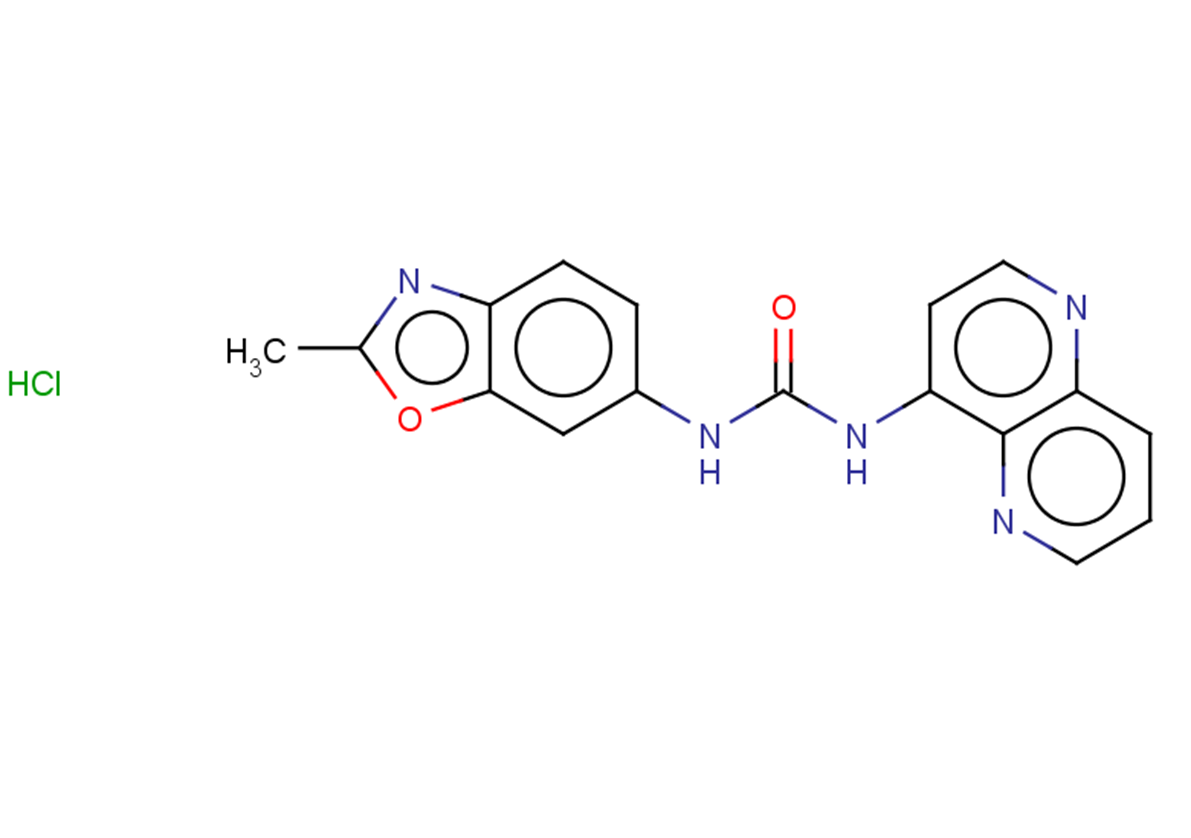
| Smiles | Cl.Cc1nc2ccc(NC(=O)Nc3ccnc4cccnc34)cc2o1 |
| Relative Density. | 1.472g/cm3 |
| Storage | Powder: -20°C for 3 years | In solvent: -80°C for 1 year Shipping with blue ice/Shipping at ambient temperature. |
 For example, if the intended dosage is 10 mg/kg for animals weighing 20 g , with a dosing volume of 100 μL per animal, and a total of 10 animals are to be administered, using a formulation of
  10% DMSO+ 40% PEG300+ 5% Tween 80+ 45% Saline/PBS/ddH2O , the resulting working solution concentration would be 2 mg/mL.
Dissolve 2 mg of the compound in 100 μL DMSO to obtain a stock solution at a concentration of 20 mg/mL . If the required concentration exceeds the compound's known solubility, please contact us for technical support before proceeding.
1) Add 100 μL of the DMSO stock solution to 400 µL PEG300 and mix thoroughly until the solution becomes clear.
2) Add 50 µL Tween 80 and mix well until fully clarified.
3) Add 450 µL Saline,PBS or ddH2O and mix thoroughly until a homogeneous solution is obtained.
| Size | Quantity | Unit Price | Amount | Operation |
|---|
 Feedback
 Hello! How can I help you today?
Copyright © 2015-2026 TargetMol Chemicals Inc. All Rights Reserved.
