


Shopping Cart
Remove All Your shopping cart is currently empty

Synonyms:
| Pack Size | Price | USA Stock | Global Stock | Quantity |
|---|---|---|---|---|
| 1 mg | $68 | Inquiry | Inquiry | |
| 5 mg | $198 | Inquiry | Inquiry | |
| 10 mg | $329 | Inquiry | Inquiry | |
| 25 mg | $459 | Inquiry | Inquiry |
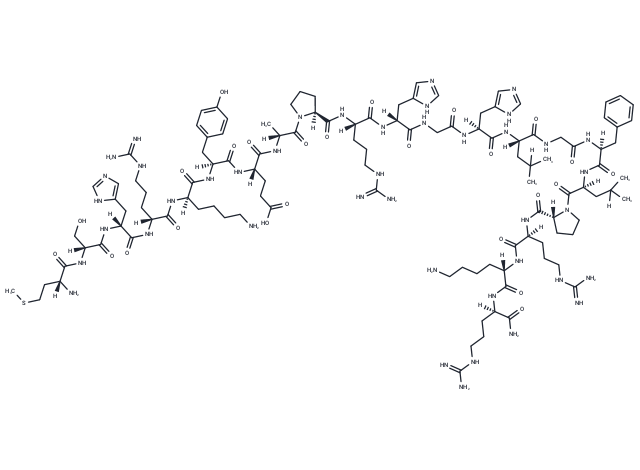
| Description | Ribosomal protein L3 peptide (202-222) is a peptide with the sequenceH2N-Met-Ser-His-Arg-Lys-Tyr-Glu-Ala-Pro-Arg-His-Gly-His-Leu-Gly-Phe-Leu-Pro-Arg-Lys-Arg-amide, MW=2573. |
| In vitro | Ribosomes are the particles that catalyze mRNA-directed protein synthesis in all organisms. The codons of the mRNA are exposed on the ribosome to allow tRNA binding. This leads to the incorporation of amino acids into the growing polypeptide chain in accordance with the genetic information. Ribosomal protein L3 is one of the proteins from the large ribosomal subunit. In Escherichia coli, L3 is known to bind to the 23S rRNA and may participate in the formation of the peptidyltransferase center of the ribosome [1][2]. |
| In vivo | This gene encodes a ribosomal protein that is a component of the 60S subunit. The protein belongs to the L3P family of ribosomal proteins and it is located in the cytoplasm. The protein can bind to the HIV-1 TAR mRNA, and it has been suggested that the protein contributes to Tat-mediated transactivation [3]. |
| Molecular Weight | 2573 |
| Formula | C114H182N42O25S |
| Smiles | N[C@]([H])(CC[S]C)C(=O)N[C@]([H])(CO)C(=O)N[C@]([H])(CC=1NC=NC=1)C(=O)N[C@]([H])(CCCNC(N)=N)C(=O)N[C@]([H])(CCCCN)C(=O)N[C@@]([H])(C/C2=C/C=C(/O)C=C2)C(=O)N[C@@]([H])(CCC(=O)O)C(=O)N[C@@](C)([H])C(=O)N3CCC[C@@]3([H])C(=O)N[C@@]([H])(CCCNC(N)=N)C(=O)N[C@]([H])(C/C4=C/N=CN4)C(=O)NCC(=O)N[C@@]([H])(C/C5=C/N=CN5)C(=O)N[C@@]([H])(CC(C)(C)[H])C(=O)NCC(=O)N[C@@]([H])(C/C6=C/C=CC=C6)C(=O)N[C@@]([H])(CC(C)(C)[H])C(=O)N7CCC[C@]7([H])C(=O)N[C@@]([H])(CCCNC(N)=N)C(=O)N[C@@]([H])(CCCCN)C(=O)N[C@]([H])(CCCNC(N)=N)C(N)=O |
| Relative Density. | no data available |
| Sequence | H-{D-Met}-{D-Ser}-{D-His}-{D-Arg}-{D-Lys}-Tyr-Glu-{D-Ala}-Pro-Arg-{D-His}-Gly-His-Leu-Gly-Phe-Leu-{D-Pro}-Arg-Lys-{D-Arg}-NH₂ |
| Sequence Short | MSHRKYEAPRHGHLGFLPRKR |
| Storage | Keep away from moisture Powder: -20°C for 3 years | In solvent: -80°C for 1 year Shipping with blue ice/Shipping at ambient temperature. |
| Solubility Information | DMSO: ≥257.3 mg/mL, Sonication is recommended. |
 For example, if the intended dosage is 10 mg/kg for animals weighing 20 g , with a dosing volume of 100 μL per animal, and a total of 10 animals are to be administered, using a formulation of
  10% DMSO+ 40% PEG300+ 5% Tween 80+ 45% Saline/PBS/ddH2O , the resulting working solution concentration would be 2 mg/mL.
Dissolve 2 mg of the compound in 100 μL DMSO to obtain a stock solution at a concentration of 20 mg/mL . If the required concentration exceeds the compound's known solubility, please contact us for technical support before proceeding.
1) Add 100 μL of the DMSO stock solution to 400 µL PEG300 and mix thoroughly until the solution becomes clear.
2) Add 50 µL Tween 80 and mix well until fully clarified.
3) Add 450 µL Saline,PBS or ddH2O and mix thoroughly until a homogeneous solution is obtained.
| Size | Quantity | Unit Price | Amount | Operation |
|---|
 Feedback
 Hello! How can I help you today?
Copyright © 2015-2026 TargetMol Chemicals Inc. All Rights Reserved.
