


Shopping Cart
Remove All Your shopping cart is currently empty

Synonyms:
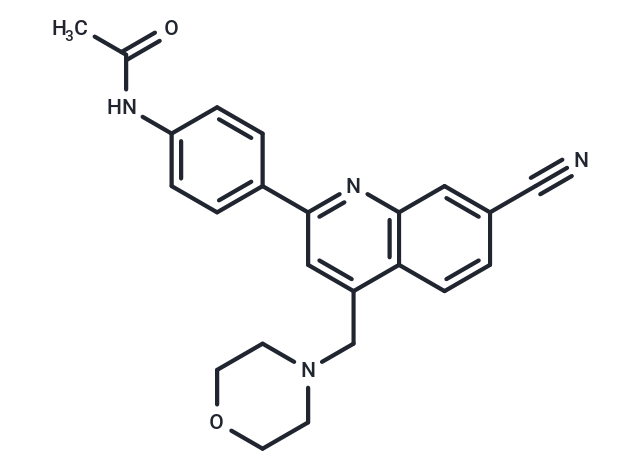

| Pack Size | Price | USA Stock | Global Stock | Quantity |
|---|---|---|---|---|
| 2 mg | $595 | 5 days | 5 days | |
| 5 mg | $970 | 5 days | 5 days | |
| 25 mg | $1,170 | 6-8 weeks | 6-8 weeks | |
| 50 mg | $1,530 | 6-8 weeks | 6-8 weeks | |
| 100 mg | $2,500 | 6-8 weeks | 6-8 weeks |
| Description | RAGE 229, N-(4-(7-cyano-4-(morpholin-4ylmethyl) quinolin-2-yl)phenyl)acetamide, is an orally active ctRAGE-DIAPH1 inhibitor. RAGE 229 can inhibit the intracellular RAGE signaling by inhibiting the interaction between the cytoplasmic tail of RAGE(ctRAGE) and Diaphanous-1(DIAPH1) [1]. |
| In vitro | RAGE229 demonstrates high affinity for ctRAGE, exhibiting a dissociation constant (K D) of 2 nM, and effectively inhibits smooth muscle cell (SMC) migration, as indicated by an inhibitory concentration 50 (IC 50) value of 26 nM [1]. In a Cell Migration Assay [1], employing SMCs at concentrations ranging from 0.00006 to 10 μM and an incubation time of 1.5 hours, RAGE229 consistently inhibited SMC migration, reaffirming its IC 50 value at 26 nM. |
| In vivo | RAGE229, administered via oral gavage at a dosage of 5 mg/kg twice daily for four days, effectively mitigates both short- and long-term diabetic complications in mice. Additionally, RAGE229, given either orally or intravenously (150, 50, and 15 ppm chow; 30, 10, and 3 mg/kg per day per mouse) and through intraperitoneal injections (5 mg/kg, every 12 hours for four total doses), significantly reduces plasma levels of pro-inflammatory markers TNF-α, IL-6, and CCL2/JE-MCP1 in diabetic mice. This results in decreased pathological and functional signs of diabetes-like kidney disease. In female CF-1 and male diabetic mice, a dosage of 5 mg/kg administered orally twice daily for four days lowered inflammation scores and the area of infarcts. Similarly, in C57BL/6J and BTBR ob/ob mice models, varying dosages (30, 10, and 3 mg/kg; 5 mg/kg) delivered orally or intravenously, including specific chow concentrations (150, 50, and 15 ppm) and intraperitoneal injections (5 mg/kg, every 12 hours for four doses), effectively reduced the concentrations of inflammatory markers CCL2, TNF-α, and IL-6. |
| Molecular Weight | 386.45 |
| Formula | C23H22N4O2 |
| Cas No. | 2143072-85-7 |
| Smiles | C(C=1C2=C(N=C(C1)C3=CC=C(NC(C)=O)C=C3)C=C(C#N)C=C2)N4CCOCC4 |
| Storage | Powder: -20°C for 3 years | In solvent: -80°C for 1 year Shipping with blue ice/Shipping at ambient temperature. |
 For example, if the intended dosage is 10 mg/kg for animals weighing 20 g , with a dosing volume of 100 μL per animal, and a total of 10 animals are to be administered, using a formulation of
  10% DMSO+ 40% PEG300+ 5% Tween 80+ 45% Saline/PBS/ddH2O , the resulting working solution concentration would be 2 mg/mL.
Dissolve 2 mg of the compound in 100 μL DMSO to obtain a stock solution at a concentration of 20 mg/mL . If the required concentration exceeds the compound's known solubility, please contact us for technical support before proceeding.
1) Add 100 μL of the DMSO stock solution to 400 µL PEG300 and mix thoroughly until the solution becomes clear.
2) Add 50 µL Tween 80 and mix well until fully clarified.
3) Add 450 µL Saline,PBS or ddH2O and mix thoroughly until a homogeneous solution is obtained.
| Size | Quantity | Unit Price | Amount | Operation |
|---|
 Feedback
 Hello! How can I help you today?
Copyright © 2015-2026 TargetMol Chemicals Inc. All Rights Reserved.
