


Shopping Cart
Remove All Your shopping cart is currently empty

Synonyms:
| Pack Size | Price | USA Stock | Global Stock | Quantity |
|---|---|---|---|---|
| 1 mg | Inquiry | Inquiry | Inquiry | |
| 100 mg | Inquiry | Inquiry | Inquiry | |
| 500 mg | Inquiry | Inquiry | Inquiry |
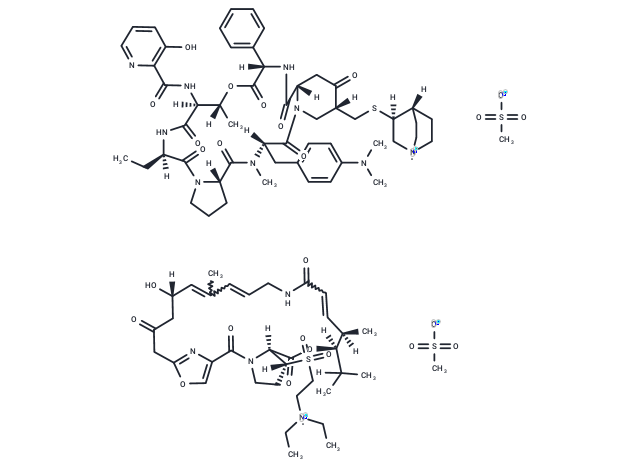
| Description | Quinupristin-Dalfopristin Complex is a mixture of two streptogramin antibiotics. Quinupristin-dalfopristin complex is a mixture of two streptogramin antibiotics, dalfopristin, and quinupristin. Streptogramin antibiotics are divided into types A and B, which in combination can act synergistically. |
| In vitro | In vitro: A previous study compared the molecular interactions of the streptogramin combinations Synercid (type A, dalfopristin; type B, quinupristin) and NXL 103 (type A, flopristin; type B, linopristin) with the Escherichia coli 70S ribosome. Results showed that the streptogramin A and B components in Synercid and NXL 103 exhibited synergistic antimicrobial activity against certain pathogenic bacteria. Moreover, in transcription-coupled translation assays, only combinations including dalfopristin, the streptogramin A component of Synercid, showed synergy [1]. |
| In vivo | In vivo: A previous animal study aimed to investigate the efficacy of quinupristin/dalfopristin in the prevention of prosthetic graft infection in a rat subcutaneous pouch model. Results showed that quinupristin/dalfopristin had significantly higher efficacy than levofloxacin and doxycycline. In addition, only the group treated with quinupristin/dalfopristin combined with levofloxacin or doxycycline showed no evidence of staphylococcal infection [2]. |
| Molecular Weight | 1905.3 |
| Formula | C34H51N4O9S[CH3SO3]·C53H68N9O10S[CH3SO3] |
| Smiles | O=C6C[C@@]5([H])C(=O)N[C@@]([H])(C1=CC=CC=C1)C(=O)O[C@@](C)([H])[C@]([H])(NC(=O)C=2N=CC=CC=2O)C(=O)N[C@]([H])(CC)C(=O)N3CCC[C@@]3([H])C(=O)N(C)[C@@]([H])(C/C4=C/C=C(C=C4)N(C)C)C(=O)N5C[C@@]6([H])C[S][C@]7([H])C[N+]8CC[C@]7([H])CC8.C[S]([O-])(=O)=O.O=C2C=C[C@](C)([H])[C@]([H])(OC(=O)[C@]1([H])N(CC[C@@]1([H])[S](=O)(=O)CC[N+](CC)CC)C(=O)C3=COC(CC(=O)C[C@@](O)([H])C=C(C)C=CCN2)=N3)C(C)(C)[H].C[S]([O-])(=O)=O |
| Relative Density. | no data available |
| Storage | Keep away from moisture Powder: -20°C for 3 years | In solvent: -80°C for 1 year Shipping with blue ice/Shipping at ambient temperature. |
| Solubility Information | DMSO: Soluble Ethanol: Soluble |
 For example, if the intended dosage is 10 mg/kg for animals weighing 20 g , with a dosing volume of 100 μL per animal, and a total of 10 animals are to be administered, using a formulation of
  10% DMSO+ 40% PEG300+ 5% Tween 80+ 45% Saline/PBS/ddH2O , the resulting working solution concentration would be 2 mg/mL.
Dissolve 2 mg of the compound in 100 μL DMSO to obtain a stock solution at a concentration of 20 mg/mL . If the required concentration exceeds the compound's known solubility, please contact us for technical support before proceeding.
1) Add 100 μL of the DMSO stock solution to 400 µL PEG300 and mix thoroughly until the solution becomes clear.
2) Add 50 µL Tween 80 and mix well until fully clarified.
3) Add 450 µL Saline,PBS or ddH2O and mix thoroughly until a homogeneous solution is obtained.
| Size | Quantity | Unit Price | Amount | Operation |
|---|
 Feedback
 Hello! How can I help you today?
Copyright © 2015-2026 TargetMol Chemicals Inc. All Rights Reserved.
