


Shopping Cart
Remove All Your shopping cart is currently empty

Synonyms:
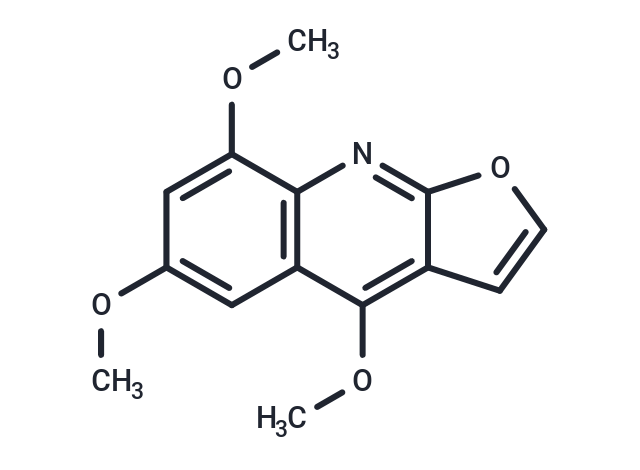
| Pack Size | Price | USA Stock | Global Stock | Quantity |
|---|---|---|---|---|
| 5 mg | $900 | Inquiry | Inquiry |
| Description | Maculosidine affect the PS I electron acceptors on leaf discs, it can inhibit ATP synthesis, basal, phosphorylating and uncoupled electron transport acting as Hill reaction inhibitors on spinach chloroplasts. |
| In vitro | METHODS AND RESULTS:In the search for natural inhibitors of plant growth, we investigate the mechanism of action of the natural furoquinoline alkaloids isolated from Balfourodendron riedelianum (Rutaceae): evolitrine (1), kokusaginine (2), γ-fagarine (3), skimmianine (4) and Maculosidine (5) on the photosynthesis light reactions. Their effect on the electron transport chain on thylakoids was analyzed. Alkaloids 1, 2, 4 and 5 inhibited ATP synthesis, basal, phosphorylating and uncoupled electron transport acting as Hill reaction inhibitors on spinach chloroplasts. Alkaloid 3 was not active. The inhibition and interaction site of alkaloids 1, 2, 4 and 5 on the non-cyclic electron transport chain was studied by polarography and fluorescence of the chlorophyll a (Chl a). CONCLUSIONS: The results indicate that the target for 1 was localized on the donor and acceptor side of PS II. In addition alkaloids 2 and 5 affect the PS I electron acceptors on leaf discs. |
| Molecular Weight | 259.26 |
| Formula | C14H13NO4 |
| Cas No. | 522-19-0 |
| Smiles | N1=C2OC=CC2=C(OC)C=3C=C(OC)C=C(OC)C13 |
| Relative Density. | 1.26g/cm3 |
| Storage | Powder: -20°C for 3 years | In solvent: -80°C for 1 year Shipping with blue ice/Shipping at ambient temperature. |
 For example, if the intended dosage is 10 mg/kg for animals weighing 20 g , with a dosing volume of 100 μL per animal, and a total of 10 animals are to be administered, using a formulation of
  10% DMSO+ 40% PEG300+ 5% Tween 80+ 45% Saline/PBS/ddH2O , the resulting working solution concentration would be 2 mg/mL.
Dissolve 2 mg of the compound in 100 μL DMSO to obtain a stock solution at a concentration of 20 mg/mL . If the required concentration exceeds the compound's known solubility, please contact us for technical support before proceeding.
1) Add 100 μL of the DMSO stock solution to 400 µL PEG300 and mix thoroughly until the solution becomes clear.
2) Add 50 µL Tween 80 and mix well until fully clarified.
3) Add 450 µL Saline,PBS or ddH2O and mix thoroughly until a homogeneous solution is obtained.
| Size | Quantity | Unit Price | Amount | Operation |
|---|
 Feedback
 Hello! How can I help you today?
Copyright © 2015-2026 TargetMol Chemicals Inc. All Rights Reserved.
