


Shopping Cart
Remove All Your shopping cart is currently empty

Synonyms:
| Pack Size | Price | USA Stock | Global Stock | Quantity |
|---|---|---|---|---|
| 1 g | $29 | - | In Stock |
| Description | Lithium acetate dihydrate is a commonly used source of lithium. In molecular biology research, it is a key component of the "lithium acetate/single-stranded carrier DNA/polyethylene glycol (LiAc/SS-DNA/PEG)" method for yeast transformation. This product significantly enhances the efficiency of exogenous DNA (e.g., plasmids) entry into cells by altering the permeability of the yeast cell wall and plasma membrane. It serves as an important pharmacological and biochemical reagent for synthesizing other lithium compounds and conducting fungal genetic engineering research. |
| In vitro | In biochemical and molecular protocols, Lithium acetate dihydrate acts as a chemical competence-inducing agent that prepares yeast cells for DNA uptake; when combined with PEG and carrier DNA, it optimizes the interaction between the negatively charged DNA and the yeast cell surface, resulting in efficient delivery of genetic material into the cytoplasm with high cell viability [1]. |
| In vivo | In yeast models such as S. cerevisiae, 0.1 M Lithium acetate dihydrate used in the LiAc/SS-DNA/PEG protocol significantly increases transformation efficiency. Lithium ions facilitate the passage of high-molecular-weight DNA through the cell wall and plasma membrane, ensuring genomic integration or plasmid maintenance for genetic screening [1]. |
| Molecular Weight | 102.02 |
| Formula | C2H7LiO4 |
| Cas No. | 6108-17-4 |
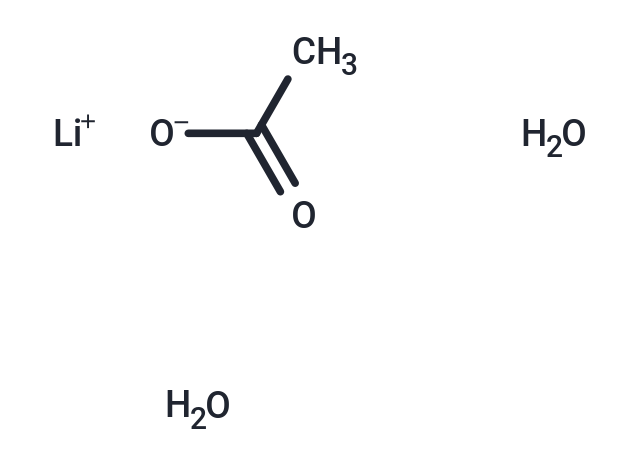
| Smiles | O=C(C)[O-].[Li+].O.O |
| Storage | Keep away from moisture Powder: -20°C for 3 years | In solvent: -80°C for 1 year Shipping with blue ice/Shipping at ambient temperature. | |||||||||||||||||||||||||||||||||||
| Solubility Information | DMSO: 80 mg/mL (784.16 mM), Sonication is recommended. H2O: 80 mg/mL (784.16 mM), Sonication is recommended. | |||||||||||||||||||||||||||||||||||
Solution Preparation Table | ||||||||||||||||||||||||||||||||||||
DMSO/H2O
Note : The dilution table applies only to solid products. For liquid products, please calculate the stock solution based on the stated concentration and/or density. | ||||||||||||||||||||||||||||||||||||
 For example, if the intended dosage is 10 mg/kg for animals weighing 20 g , with a dosing volume of 100 μL per animal, and a total of 10 animals are to be administered, using a formulation of
  10% DMSO+ 40% PEG300+ 5% Tween 80+ 45% Saline/PBS/ddH2O , the resulting working solution concentration would be 2 mg/mL.
Dissolve 2 mg of the compound in 100 μL DMSO to obtain a stock solution at a concentration of 20 mg/mL . If the required concentration exceeds the compound's known solubility, please contact us for technical support before proceeding.
1) Add 100 μL of the DMSO stock solution to 400 µL PEG300 and mix thoroughly until the solution becomes clear.
2) Add 50 µL Tween 80 and mix well until fully clarified.
3) Add 450 µL Saline,PBS or ddH2O and mix thoroughly until a homogeneous solution is obtained.
| Size | Quantity | Unit Price | Amount | Operation |
|---|
 Feedback
 Hello! How can I help you today?
Copyright © 2015-2026 TargetMol Chemicals Inc. All Rights Reserved.
