


Shopping Cart
Remove All Your shopping cart is currently empty

Synonyms:
| Pack Size | Price | USA Stock | Global Stock | Quantity |
|---|---|---|---|---|
| 2 mg | $31 | 5 days | 5 days |
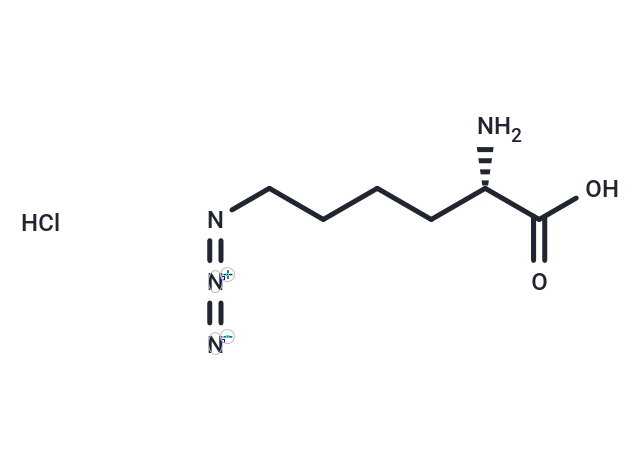
| Description | L-Azidonorleucine hydrochloride, an unnatural amino acid, serves as a substitute for Methionine, and is used for labeling mammalian cell proteins and identifying various methionyl-tRNA synthetase (MetRS) mutants. |
| In vitro | CHO cells transfected with pMaRSC and incubated with L-Azidonorleucine (Anl; 1.5 mM; 6 h) are fixed, permeabilized, and treated with alkyne-TAMRA. The TAMRA fluorescence is observed exclusively in mCherry-expressing cells, indicating selective incorporation of Anl into cellular proteins[1]. |
| In vivo | When administering L-Azidonorleucine (ANL) through drinking water, it is recommended to maintain an intake of 0.9 mg/day/g body weight for 21 days to label specific brain neuronal populations. For other cell types, reduced dosages or shorter labeling durations may suffice. Alternatively, for intraperitoneal (i.p.) injection, exploring dosages between 4-400 mM is advised. Specifically, a 400 mM dose administered i.p. (10 ml/kg volume) daily for a week effectively labels certain neuronal populations, like the excitatory neurons in the hippocampus, whereas lower concentrations (e.g., 4 mM) are suitable for labeling different cell types or for extended labeling periods[2]. |
| Molecular Weight | 208.646 |
| Formula | C6H13ClN4O2 |
| Cas No. | 1454334-76-9 |
| Smiles | Cl.N[C@@H](CCCCN=[N+]=[N-])C(O)=O |
| Relative Density. | no data available |
| Storage | Powder: -20°C for 3 years | In solvent: -80°C for 1 year Shipping with blue ice/Shipping at ambient temperature. |
 For example, if the intended dosage is 10 mg/kg for animals weighing 20 g , with a dosing volume of 100 μL per animal, and a total of 10 animals are to be administered, using a formulation of
  10% DMSO+ 40% PEG300+ 5% Tween 80+ 45% Saline/PBS/ddH2O , the resulting working solution concentration would be 2 mg/mL.
Dissolve 2 mg of the compound in 100 μL DMSO to obtain a stock solution at a concentration of 20 mg/mL . If the required concentration exceeds the compound's known solubility, please contact us for technical support before proceeding.
1) Add 100 μL of the DMSO stock solution to 400 µL PEG300 and mix thoroughly until the solution becomes clear.
2) Add 50 µL Tween 80 and mix well until fully clarified.
3) Add 450 µL Saline,PBS or ddH2O and mix thoroughly until a homogeneous solution is obtained.
| Size | Quantity | Unit Price | Amount | Operation |
|---|
 Feedback
 Hello! How can I help you today?
Copyright © 2015-2026 TargetMol Chemicals Inc. All Rights Reserved.
