


Shopping Cart
Remove All Your shopping cart is currently empty

Synonyms:
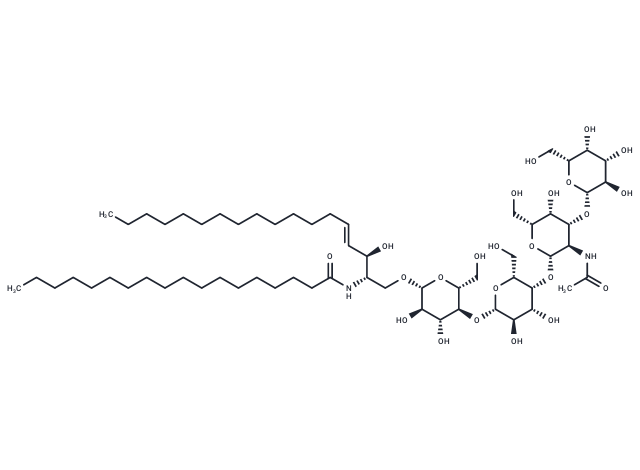
| Pack Size | Price | USA Stock | Global Stock | Quantity |
|---|---|---|---|---|
| 500 µg | $892 | 35 days | 35 days | |
| 1 mg | $1,680 | 35 days | 35 days |
| Description | Ganglioside GM1 asialo is a component of cellular lipid rafts and can be formed by the cleavage of the sialic acid residue from ganglioside GM1 by neuraminidase. Ganglioside GM1 asialo is a glycolipid receptor for P. aeruginosa flagellin and stimulates defensive responses in host cells, including extracellular ATP release, calcium mobilization, and ERK1/2 phosphorylation when stimulated by flagellin and an anti-ganglioside GM1 asialo antibody. The percentage of ganglioside GM1 asialo-positive natural killer (NK) and CD8+ T cells in lung is increased in a mouse model of respiratory syncytial virus (RSV) infection compared with healthy animals. Depletion of ganglioside GM1 asialo-positive NK and T cells reduces IFN-γ levels in the lung, reduces weight loss, and increases lung viral load in RSV-infected mice. Ganglioside GM1 asialo mixture contains ganglioside GM1 asialo molecular species with C18:1 and C20:1 sphingoid backbones. |
| Molecular Weight | 1255.585 |
| Formula | C62H114N2O23 |
| Cas No. | 71012-19-6 |
| Smiles | CCCCCCCCCCCCCCCCCC(=O)N[C@@H](CO[C@@H]1O[C@H](CO)[C@@H](O[C@@H]2O[C@H](CO)[C@H](O[C@@H]3O[C@H](CO)[C@H](O)[C@H](O[C@@H]4O[C@H](CO)[C@H](O)[C@H](O)[C@H]4O)[C@H]3NC(C)=O)[C@H](O)[C@H]2O)[C@H](O)[C@H]1O)[C@H](O)\C=C\CCCCCCCCCCCCC |
| Storage | Powder: -20°C for 3 years | In solvent: -80°C for 1 year Shipping with blue ice/Shipping at ambient temperature. |
| Solubility Information | Chloroform:Methanol (2:1): Soluble |
 For example, if the intended dosage is 10 mg/kg for animals weighing 20 g , with a dosing volume of 100 μL per animal, and a total of 10 animals are to be administered, using a formulation of
  10% DMSO+ 40% PEG300+ 5% Tween 80+ 45% Saline/PBS/ddH2O , the resulting working solution concentration would be 2 mg/mL.
Dissolve 2 mg of the compound in 100 μL DMSO to obtain a stock solution at a concentration of 20 mg/mL . If the required concentration exceeds the compound's known solubility, please contact us for technical support before proceeding.
1) Add 100 μL of the DMSO stock solution to 400 µL PEG300 and mix thoroughly until the solution becomes clear.
2) Add 50 µL Tween 80 and mix well until fully clarified.
3) Add 450 µL Saline,PBS or ddH2O and mix thoroughly until a homogeneous solution is obtained.
| Size | Quantity | Unit Price | Amount | Operation |
|---|
 Feedback
 Hello! How can I help you today?
Copyright © 2015-2026 TargetMol Chemicals Inc. All Rights Reserved.
