


Shopping Cart
Remove All Your shopping cart is currently empty

Synonyms:
| Pack Size | Price | USA Stock | Global Stock | Quantity |
|---|---|---|---|---|
| 5 mg | $87 | Inquiry | Inquiry | |
| 10 mg | $143 | Inquiry | Inquiry | |
| 25 mg | $198 | Inquiry | Inquiry |
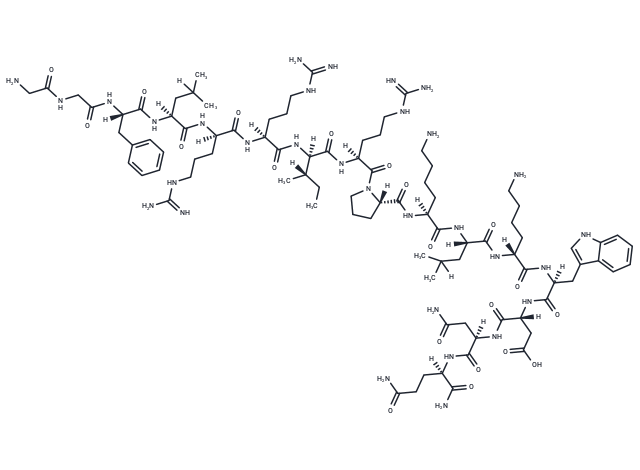
| Description | Dynorphins are a class of opioid peptides that arise from the precursor protein prodynorphin. When prodynorphin is cleaved during processing by proprotein convertase 2 (PC2), multiple active peptides are released: dynorphin A, dynorphin B, and α/β-neo-endorphin [1]. |
| In vitro | Dynorphin is produced in many different parts of the brain, including the hypothalamus, the striatum, the hippocampus, and the spinal cord. Dynorphin has been shown to be a modulator of pain response. injecting dynorphin into the subarachnoid space of the rat spinal cord produced dose-dependent analgesia that was measured by tail-flick latency. Analgesia was partially eliminated by opioid antagonist naloxone. dynorphin activates bradykinin receptors, which triggers the release of calcium ions into the cell through voltage-sensitive channels in the cell membrane. Blocking bradykinin receptors in the lumbar region of the spinal cord reversed persistent pain. A multiple pathway system might help explain the conflicting effects of dynorphin in the CNS [3]. |
| Molecular Weight | 1983.33 |
| Formula | C90H147N31O20 |
| Smiles | NCC(=O)NCC(=O)N[C@@]([H])(C/C1=C/C=CC=C1)C(=O)N[C@@]([H])(CC(C)(C)[H])C(=O)N[C@]([H])(CCCNC(=N)N)C(=O)N[C@@]([H])(CCCNC(N)=N)C(=O)N[C@@]([H])(C(=O)N[C@@]([H])(CCCNC(N)=N)C(=O)N2CCC[C@@]2([H])C(=O)N[C@@]([H])(CCCCN)C(=O)N[C@@]([H])(CC(C)(C)[H])C(=O)N[C@]([H])(CCCCN)C(=O)N[C@@]([H])(C/C4=C/NC3=CC=CC=C34)C(=O)N[C@]([H])(CC(O)=O)C(=O)N[C@]([H])(CC(N)=O)C(=O)N[C@]([H])(CCC(=O)N)C(N)=O)[C@](C)([H])CC |
| Relative Density. | no data available |
| Sequence | H-Gly-Gly-Phe-Leu-Arg-Arg-Ile-Arg-Pro-Lys-Leu-Lys-Trp-Asp-Asn-Gln-OH |
| Sequence Short | GGFLRRIRPKLKWDNQ |
| Storage | Keep away from moisture Powder: -20°C for 3 years | In solvent: -80°C for 1 year Shipping with blue ice/Shipping at ambient temperature. |
| Solubility Information | DMSO: ≥198.3 mg/mL, Sonication is recommended. |
 For example, if the intended dosage is 10 mg/kg for animals weighing 20 g , with a dosing volume of 100 μL per animal, and a total of 10 animals are to be administered, using a formulation of
  10% DMSO+ 40% PEG300+ 5% Tween 80+ 45% Saline/PBS/ddH2O , the resulting working solution concentration would be 2 mg/mL.
Dissolve 2 mg of the compound in 100 μL DMSO to obtain a stock solution at a concentration of 20 mg/mL . If the required concentration exceeds the compound's known solubility, please contact us for technical support before proceeding.
1) Add 100 μL of the DMSO stock solution to 400 µL PEG300 and mix thoroughly until the solution becomes clear.
2) Add 50 µL Tween 80 and mix well until fully clarified.
3) Add 450 µL Saline,PBS or ddH2O and mix thoroughly until a homogeneous solution is obtained.
| Size | Quantity | Unit Price | Amount | Operation |
|---|
 Feedback
 Hello! How can I help you today?
Copyright © 2015-2026 TargetMol Chemicals Inc. All Rights Reserved.
