Shopping Cart
Remove All
  • TargetMol
    Your shopping cart is currently empty

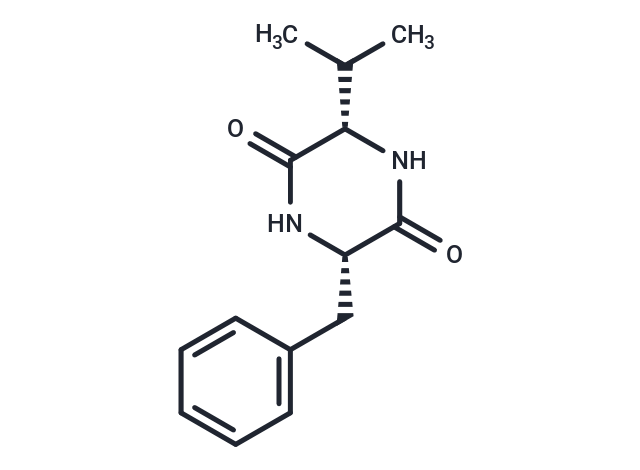
Cyclo(L-Phe-L-Val)

🥰Excellent
Catalog No. T37476Cas No. 35590-86-4

Cyclo(L-Phe-L-Val) is a metabolite of the sponge bacterium Pseudoalteromonas sp. NJ6-3-1, capable of autoinducing the production of antibacterial substances active against S. aureus at low cell density. It induces neurite outgrowth and branching of chick cortical neurons in vitro at concentrations of 16 and 32 μM, increases phosphorylation of the PI3K substrate Akt, and this induction can be blocked by the PI3K inhibitor LY294002. Additionally, it enhances axon sprouting of calcitonin gene-related protein positive (CGRP+) primary afferents in the spinal cord post-crush injury and of serotonin neurons in the uninjured spinal cord. Cyclo(L-Phe-L-Val) is also a bitter taste component of cocoa and roasted coffee.

Cyclo(L-Phe-L-Val)

Cyclo(L-Phe-L-Val)

🥰Excellent
Catalog No. T37476Cas No. 35590-86-4
Cyclo(L-Phe-L-Val) is a metabolite of the sponge bacterium Pseudoalteromonas sp. NJ6-3-1, capable of autoinducing the production of antibacterial substances active against S. aureus at low cell density. It induces neurite outgrowth and branching of chick cortical neurons in vitro at concentrations of 16 and 32 μM, increases phosphorylation of the PI3K substrate Akt, and this induction can be blocked by the PI3K inhibitor LY294002. Additionally, it enhances axon sprouting of calcitonin gene-related protein positive (CGRP+) primary afferents in the spinal cord post-crush injury and of serotonin neurons in the uninjured spinal cord. Cyclo(L-Phe-L-Val) is also a bitter taste component of cocoa and roasted coffee.
TargetMol
Product information is being updated, if you want to purchase, please click the bulk custom button.
Add to Quotation
Questions
TargetMol
View More

Resource Download

Product Introduction

Bioactivity
Description
Cyclo(L-Phe-L-Val) is a metabolite of the sponge bacterium Pseudoalteromonas sp. NJ6-3-1, capable of autoinducing the production of antibacterial substances active against S. aureus at low cell density. It induces neurite outgrowth and branching of chick cortical neurons in vitro at concentrations of 16 and 32 μM, increases phosphorylation of the PI3K substrate Akt, and this induction can be blocked by the PI3K inhibitor LY294002. Additionally, it enhances axon sprouting of calcitonin gene-related protein positive (CGRP+) primary afferents in the spinal cord post-crush injury and of serotonin neurons in the uninjured spinal cord. Cyclo(L-Phe-L-Val) is also a bitter taste component of cocoa and roasted coffee.
Chemical Properties
Molecular Weight246.31
FormulaC14H18N2O2
Cas No.35590-86-4
SmilesCC(C)[C@@H]1NC(=O)[C@H](Cc2ccccc2)NC1=O
Relative Density.1.109 g/cm3 (Predicted)
SequenceCyclo-(L-Phe-L-Val)
Sequence ShortFV
Storage & Solubility Information
Storagekeep away from moisture | Powder: -20°C for 3 years | In solvent: -80°C for 1 year | Shipping with blue ice/Shipping at ambient temperature.
Solubility Information
DMSO: Soluble

Calculator

  • Molarity Calculator
  • Dilution Calculator
  • Reconstitution Calculator
  • Molecular Weight Calculator

In Vivo Formulation Calculator (Clear solution)

Please enter your animal experiment information in the following box and click Calculate to obtain the stock solution preparation method and in vivo formula preparation method:
TargetMol | Animal experiments For example, if the intended dosage is 10 mg/kg for animals weighing 20 g , with a dosing volume of 100 μL per animal, TargetMol | Animal experiments and a total of 10 animals are to be administered, using a formulation of TargetMol | reagent 10% DMSO+ 40% PEG300+ 5% Tween 80+ 45% Saline/PBS/ddH2O , the resulting working solution concentration would be 2 mg/mL.

Stock Solution Preparation:

Dissolve 2 mg of the compound in 100 μL DMSOTargetMol | reagent to obtain a stock solution at a concentration of 20 mg/mL . If the required concentration exceeds the compound's known solubility, please contact us for technical support before proceeding.

Preparation of the In Vivo Formulation:

1) Add 100 μL of the DMSOTargetMol | reagent stock solution to 400 μL PEG300TargetMol | reagent and mix thoroughly until the solution becomes clear.

2) Add 50 μL Tween 80 and mix well until fully clarified.

3) Add 450 μL Saline,PBS or ddH2OTargetMol | reagent and mix thoroughly until a homogeneous solution is obtained.

This example is provided solely to demonstrate the use of the In Vivo Formulation Calculator and does not constitute a recommended formulation for any specific compound. Please select an appropriate dissolution and formulation strategy based on your experimental model and route of administration.
All co-solvents required for this protocol, includingDMSO, PEG300/PEG400, Tween 80, SBE-β-CD, and Corn oil, are available for purchase on the TargetMol website.
1 Enter information below:
mg/kg
g
μL
2 Enter the in vivo formulation:
% DMSO
%
% Tween 80
% Saline/PBS/ddH2O

Dose Conversion

You can also refer to dose conversion for different animals. More Dose Conversion

Tech Support

Please see Inhibitor Handling Instructions for more frequently ask questions. Topics include: how to prepare stock solutions, how to store products, and cautions on cell-based assays & animal experiments, etc

Keywords

Related Tags: buy Cyclo(L-Phe-L-Val) | purchase Cyclo(L-Phe-L-Val) | Cyclo(L-Phe-L-Val) cost | order Cyclo(L-Phe-L-Val) | Cyclo(L-Phe-L-Val) chemical structure | Cyclo(L-Phe-L-Val) formula | Cyclo(L-Phe-L-Val) molecular weight