


Shopping Cart
Remove All Your shopping cart is currently empty

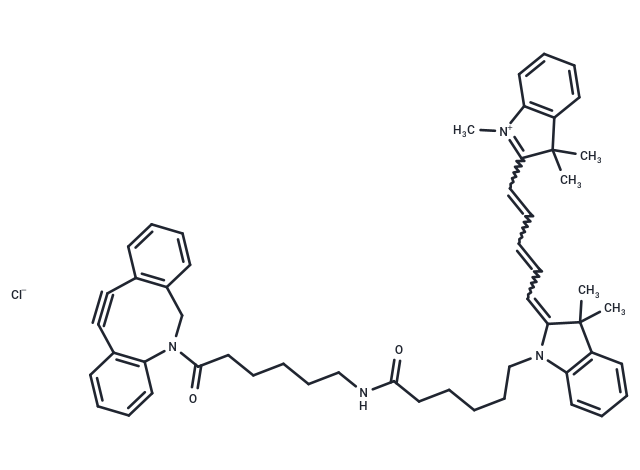
Synonyms: DBCO-Cy5, Cyanine5 dibenzocyclooctyne
| Pack Size | Price | USA Stock | Global Stock | Quantity |
|---|---|---|---|---|
| 10 mg | Inquiry | Inquiry | Inquiry | |
| 50 mg | Inquiry | Inquiry | Inquiry |
| Description | Cyanine5 DBCO (DBCO-Cy5) is a low-toxicity azide-reactive probe (near-infrared fluorescent dye) designed for imaging azide-labeled biomolecules via copper-free "click chemistry" [Ex=635 nm, Em=650-700 nm]. It exhibits no significant cytotoxicity in cells or animals and does not impact the physiological functions of non-target cells. Cyanine5 DBCO is suitable for labeling and tracking cells both in vivo and in vitro. |
| In vitro | Guide (The following is our recommended solution. This solution is merely a guideline and should be modified according to your specific needs.): For solution preparation, 1) Stock Solution: Use DMSO as the solvent with a recommended concentration of 20 mM. Store in aliquots at -20°C or -80°C, shielded from light, and avoid repeated freeze-thaw cycles. 2) Working Solution: Dilute with PBS or serum-free medium to 20 μM (optimize for specific experiments), and use immediately while protecting from light. For cell labeling (e.g., A549 cells), 3) Seed 2 mL of growing cells at a density of 3×10^4 (cell-dependent) in a 35 mm glass-bottom culture dish. 4) Add Ac4ManNAz (50 μM, final concentration) and incubate for 3 days to produce azide groups on the cell surface. 5) Wash cells twice with DPBS (pH 7.4). 6) Incubate cells with Cyanine5 DBCO (20 μM, final concentration) at 37°C for 1 hour. 7) Rinse with DPBS (pH 7.4) and fix with a formaldehyde-glutaraldehyde solution at 25°C for 15 minutes. 8) Wash cells twice with DPBS (pH 7.4) and stain with DAPI to label nuclei. 9) Measure Cyanine5 DBCO fluorescence using a confocal laser scanning microscope (Ex=635 nm, Em=650-700 nm). Note: 1) After Ac4ManNAz treatment, Cyanine5 DBCO can target azide groups introduced on the cell surface for over 3 days. 2) Cyanine5 DBCO labeling is dose-dependent. The above information is based on published literature. Experimental procedures should be appropriately modified to meet specific research demands. |
| Synonyms | DBCO-Cy5, Cyanine5 dibenzocyclooctyne |
| Molecular Weight | 819.51 |
| Formula | C53H59ClN4O2 |
| Cas No. | 3091879-39-6 |
| Smiles | [Cl-].O=C(NCCCCCC(=O)N1C=2C=CC=CC2C#CC=3C=CC=CC3C1)CCCCCN4C=5C=CC=CC5C(C4=CC=CC=CC6=[N+](C=7C=CC=CC7C6(C)C)C)(C)C |
| Storage | Keep away from direct sunlight Powder: -20°C for 3 years | In solvent: -80°C for 1 year Shipping with blue ice/Shipping at ambient temperature. |
 For example, if the intended dosage is 10 mg/kg for animals weighing 20 g , with a dosing volume of 100 μL per animal, and a total of 10 animals are to be administered, using a formulation of
  10% DMSO+ 40% PEG300+ 5% Tween 80+ 45% Saline/PBS/ddH2O , the resulting working solution concentration would be 2 mg/mL.
Dissolve 2 mg of the compound in 100 μL DMSO to obtain a stock solution at a concentration of 20 mg/mL . If the required concentration exceeds the compound's known solubility, please contact us for technical support before proceeding.
1) Add 100 μL of the DMSO stock solution to 400 µL PEG300 and mix thoroughly until the solution becomes clear.
2) Add 50 µL Tween 80 and mix well until fully clarified.
3) Add 450 µL Saline,PBS or ddH2O and mix thoroughly until a homogeneous solution is obtained.
| Size | Quantity | Unit Price | Amount | Operation |
|---|
 Feedback
 Hello! How can I help you today?
Copyright © 2015-2026 TargetMol Chemicals Inc. All Rights Reserved.
