


Shopping Cart
Remove All Your shopping cart is currently empty

Synonyms:
| Pack Size | Price | USA Stock | Global Stock | Quantity |
|---|---|---|---|---|
| 10 mg | Inquiry | 10-14 weeks | 10-14 weeks | |
| 50 mg | Inquiry | 10-14 weeks | 10-14 weeks |
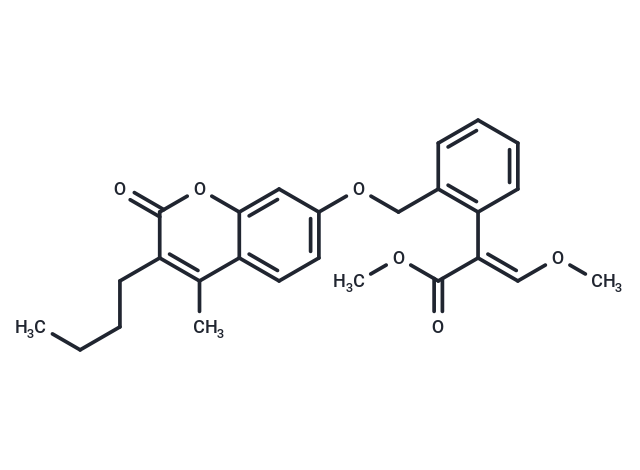
| Description | Coumoxystrobin is a methoxyacrylate strobilurin fungicide that exhibits antifungal (fungal) activity. It inhibits the hyphal growth of rice blast fungus, enhances cell membrane permeability, and reduces respiration. In ex vivo barley leaves, it provides protective activity against rice blast fungus. Coumoxystrobin also decreases ATP activity in Chlorella vulgaris, leading to algal death. It is applicable in research related to rice blast disease. |
| In vitro | Coumoxystrobin effectively inhibits the hyphal growth of 100 Magnaporthe oryzae strains with an average EC50 value of 0.0163 μg/mL when used at concentrations of 0.0025-0.08 μg/mL over 7 days. At 0.1 μg/mL for 3 days, it induces morphological aberrations in hyphal growth of Magnaporthe oryzae strains L-14, L-15, and YE-9, causing twisted hyphal tips and increased apical branching. Additionally, at a concentration of 0.1 μg/mL for 48 hours, Coumoxystrobin disrupts cell membrane permeability in strains L-15 and YE-9, leading to increased electrolyte leakage. It also significantly decreases the respiration rate of these strains at 0.1 μg/mL. The compound exhibits dose-dependent protective activity against the Magnaporthe oryzae strain YE-9 on detached barley leaves at concentrations of 1-4 μg/mL. Coumoxystrobin shows acute toxicity to Chlorella vulgaris with an EC50 of 1.62 mg/L and reduces cell yield by 97.8% at a concentration of 4.23 mg/L after 96 hours. Furthermore, it inhibits the mitochondrial complex III activity and decreases ATP survival rate in Chlorella vulgaris at concentrations of 0.15-1.08 mg/L over 24-96 hours. |
| Molecular Weight | 436.50 |
| Formula | C26H28O6 |
| Cas No. | 850881-70-8 |
| Smiles | CC=1C=2C(=CC(OCC3=C(\C(\C(OC)=O)=C/OC)C=CC=C3)=CC2)OC(=O)C1CCCC |
| Storage | Powder: -20°C for 3 years | In solvent: -80°C for 1 year Shipping with blue ice/Shipping at ambient temperature. |
 For example, if the intended dosage is 10 mg/kg for animals weighing 20 g , with a dosing volume of 100 μL per animal, and a total of 10 animals are to be administered, using a formulation of
  10% DMSO+ 40% PEG300+ 5% Tween 80+ 45% Saline/PBS/ddH2O , the resulting working solution concentration would be 2 mg/mL.
Dissolve 2 mg of the compound in 100 μL DMSO to obtain a stock solution at a concentration of 20 mg/mL . If the required concentration exceeds the compound's known solubility, please contact us for technical support before proceeding.
1) Add 100 μL of the DMSO stock solution to 400 µL PEG300 and mix thoroughly until the solution becomes clear.
2) Add 50 µL Tween 80 and mix well until fully clarified.
3) Add 450 µL Saline,PBS or ddH2O and mix thoroughly until a homogeneous solution is obtained.
| Size | Quantity | Unit Price | Amount | Operation |
|---|
 Feedback
 Hello! How can I help you today?
Copyright © 2015-2026 TargetMol Chemicals Inc. All Rights Reserved.
