


Shopping Cart
Remove All Your shopping cart is currently empty

Synonyms: U 19646, Rinlaxer, Maolate, Kolpicortin-sine
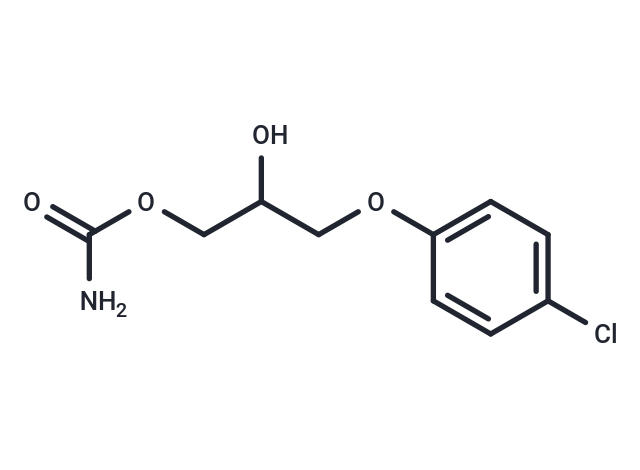
| Pack Size | Price | USA Stock | Global Stock | Quantity |
|---|---|---|---|---|
| 5 mg | $30 | - | In Stock | |
| 10 mg | $42 | - | In Stock | |
| 25 mg | Preferential | - | In Stock | |
| 1 mL x 10 mM (in DMSO) | $46 | - | In Stock |
| Description | Chlorphenesin Carbamate is a skeletal muscle relaxant acting on the central nervous system, which can be used in research related to skeletal muscle injury and inflammation-associated pain. Its mechanism of action mainly involves the selective blockade of spinal polysynaptic transmission pathways and certain analgesic activity. |
| In vivo | Chlorphenesin Carbamate (CPC) inhibits monosynaptic reflex (MSR) and polysynaptic reflex (PSR) at an intravenous dose of 50 mg/kg. The polysynaptic reflex is more sensitive to CPC inhibition than the monosynaptic reflex.In addition, CPC exerts a marked inhibitory effect on spinal neurons and induces hyperpolarization of both ventral and dorsal roots in the isolated frog spinal cord [2]. Chlorphenesin Carbamate (CPC) exhibits antinociceptive effects in a rat model of adjuvant-induced arthritis.Behavioral studies show that CPC produces dose-dependent antinociceptive effects when administered orally at doses of 100–400 mg/kg.Electrophysiological studies demonstrate that intravenous administration of CPC at 25–50 mg/kg inhibits evoked responses of nociceptive neurons in the ventrobasal thalamus (VB). At an intravenous dose of 50 mg/kg, CPC also suppresses spontaneous firing of nociceptive neurons in the VB region [3]. |
| Synonyms | U 19646, Rinlaxer, Maolate, Kolpicortin-sine |
| Molecular Weight | 245.66 |
| Formula | C10H12ClNO4 |
| Cas No. | 886-74-8 |
| Smiles | O=C(OCC(O)COC1=CC=C(Cl)C=C1)N |
| Relative Density. | 1.365g/cm3 |
| Storage | Keep away from direct sunlight Powder: -20°C for 3 years | In solvent: -80°C for 1 year Shipping with blue ice/Shipping at ambient temperature. | |||||||||||||||||||||||||||||||||||
| Solubility Information | DMSO: 100 mg/mL (407.07 mM), Sonication is recommended. H2O: Insoluble | |||||||||||||||||||||||||||||||||||
Solution Preparation Table | ||||||||||||||||||||||||||||||||||||
DMSO
Note : The dilution table applies only to solid products. For liquid products, please calculate the stock solution based on the stated concentration and/or density. | ||||||||||||||||||||||||||||||||||||
 For example, if the intended dosage is 10 mg/kg for animals weighing 20 g , with a dosing volume of 100 μL per animal, and a total of 10 animals are to be administered, using a formulation of
  10% DMSO+ 40% PEG300+ 5% Tween 80+ 45% Saline/PBS/ddH2O , the resulting working solution concentration would be 2 mg/mL.
Dissolve 2 mg of the compound in 100 μL DMSO to obtain a stock solution at a concentration of 20 mg/mL . If the required concentration exceeds the compound's known solubility, please contact us for technical support before proceeding.
1) Add 100 μL of the DMSO stock solution to 400 µL PEG300 and mix thoroughly until the solution becomes clear.
2) Add 50 µL Tween 80 and mix well until fully clarified.
3) Add 450 µL Saline,PBS or ddH2O and mix thoroughly until a homogeneous solution is obtained.
| Size | Quantity | Unit Price | Amount | Operation |
|---|
 Feedback
 Hello! How can I help you today?
Copyright © 2015-2026 TargetMol Chemicals Inc. All Rights Reserved.
