


Shopping Cart
Remove All Your shopping cart is currently empty

Synonyms:
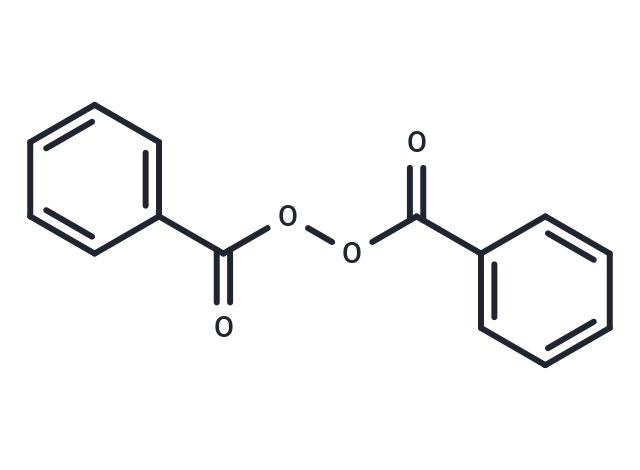
| Pack Size | Price | USA Stock | Global Stock | Quantity |
|---|---|---|---|---|
| 2 g | $37 | - | In Stock | |
| 5 g | $58 | - | In Stock | |
| 10 g | $78 | - | In Stock | |
| 25 g | $138 | - | In Stock |
| Description | Benzoyl peroxide is a compound with antibacterial and keratolytic properties that inhibits the growth of acne-associated bacteria and helps unclog pores; it is widely used in research on acne and related skin conditions. |
| Targets & IC50 | ROS:13 μM, PKC:1 mM, PKM:1.7 mM |
| In vitro | Method: Human peripheral blood polymorphonuclear leukocytes (PMNLs) were isolated and pretreated with various concentrations of Benzoyl peroxide for 10 min, followed by stimulation with phorbol myristate acetate (PMA, 1.5 μg) for 20 min. Reactive oxygen species (ROS) release was measured using the cytochrome C reduction assay. Result: Benzoyl peroxide dose-dependently inhibited PMA-induced ROS release from PMNLs, with an IC₅₀ of approximately 13 μM (n=6) [1]. Method: Human peripheral blood PMNLs were isolated and treated with various concentrations of Benzoyl peroxide under incubation conditions identical to those used in the ROS release assay. Cell viability was assessed by trypan blue staining, and lactate dehydrogenase (LDH) activity released into the culture medium was measured to evaluate cytotoxicity. Result: Benzoyl peroxide dose-dependently reduced PMNL cell viability. At concentrations of 0.3 mM and above, cell viability dropped below 10%; at 1 mM, released LDH accounted for 68.3 ± 3.7% of total LDH (n=3) [1]. Method: Protein kinase C (PKC) was partially purified from Wistar rat brains, and its catalytic domain PKM was prepared by limited tryptic digestion. The effects of various concentrations of Benzoyl peroxide on PKC and PKM activities were determined using histone as a substrate and γ-[³²P]ATP as a phosphate donor. Result: Benzoyl peroxide inhibited PKC activity with an IC₅₀ of approximately 1 mM (n=5); its inhibitory potency against PKM was comparable to that against PKC (IC₅₀ ≈ 1.7 mM, n=5) [1]. |
| Molecular Weight | 242.23 |
| Formula | C14H10O4 |
| Cas No. | 94-36-0 |
| Smiles | O=C(OOC(=O)C=1C=CC=CC1)C=2C=CC=CC2 |
| Storage | Powder: -20°C for 3 years | In solvent: -80°C for 1 year Shipping with blue ice/Shipping at ambient temperature. |
 For example, if the intended dosage is 10 mg/kg for animals weighing 20 g , with a dosing volume of 100 μL per animal, and a total of 10 animals are to be administered, using a formulation of
  10% DMSO+ 40% PEG300+ 5% Tween 80+ 45% Saline/PBS/ddH2O , the resulting working solution concentration would be 2 mg/mL.
Dissolve 2 mg of the compound in 100 μL DMSO to obtain a stock solution at a concentration of 20 mg/mL . If the required concentration exceeds the compound's known solubility, please contact us for technical support before proceeding.
1) Add 100 μL of the DMSO stock solution to 400 µL PEG300 and mix thoroughly until the solution becomes clear.
2) Add 50 µL Tween 80 and mix well until fully clarified.
3) Add 450 µL Saline,PBS or ddH2O and mix thoroughly until a homogeneous solution is obtained.
| Size | Quantity | Unit Price | Amount | Operation |
|---|
 Feedback
 Hello! How can I help you today?
Copyright © 2015-2026 TargetMol Chemicals Inc. All Rights Reserved.
