


Shopping Cart
Remove All Your shopping cart is currently empty

Synonyms:
| Pack Size | Price | USA Stock | Global Stock | Quantity |
|---|---|---|---|---|
| 25 mg | Inquiry | 3-6 months | 3-6 months | |
| 50 mg | Inquiry | 3-6 months | 3-6 months | |
| 100 mg | Inquiry | 3-6 months | 3-6 months |
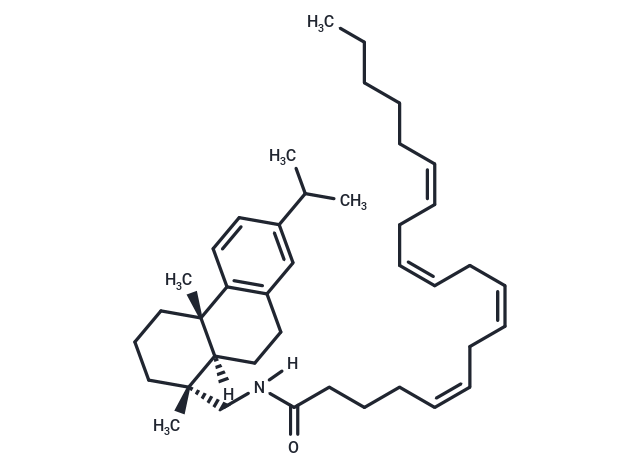
| Description | Arachidonic acid leelamide is a phospholipase A2 inhibitor. Phospholipase A is a hydrolase responsible for the release of arachidonic acid from the sn2 position of phospholipids. The released arachidonic acid is then converted to mediators of inflammation by the enzymes prostaglandin synthetase and 5lipoxygenase, respectively. The inhibition of phospholipase A leads to a decrease in the release of arachidonic acid and, consequently, the inflammatory mediators. |
| In vitro | Arachidonic acid leelamide is the arachidonic amide analog of leelamine with no published pharmacological properties. For leelamine, it was found that electron micrographs of leelamine-treated cancer cells had an accumulation of autophagosomes, membrane whorls, and lipofuscin-like structures. In addition, leelamine-mediated killing was a caspase-independent event triggered by cholesterol accumulation in the early process [1]. |
| In vivo | In a previous study, authors identified the inductive effect of leelamine on CYP2B at doses of 5, 10, or 20 mg/kg in male ICR mice for 1 or 3 days. It was found that in the liver, the activity of CYP2B significantly increased 3.6-fold after leelamine treatment. Activities of benzyloxyresorufin O-dealkylase and pentoxyresorufin O-dealkylase significantly increased 6.3- and 5.3-fold, respectively, with a single treatment of 20 mg/kg leelamine. Moreover, immunoblot analyses showed that significantly and dose-dependently increased CYP2B10 protein levels in the liver. However, PCR results demonstrated that there were no significant changes in the CAR and CYP2B mRNA levels after leelamine treatment [2]. |
| Molecular Weight | 571.9 |
| Formula | C40H61NO |
| Smiles | CC(C)C(C=C1)=CC2=C1[C@]3(C)[C@](CC2)([H])[C@@](CN([H])C(CCC/C=C\C/C=C\C/C=C\C/C=C\CCCCC)=O)(C)CCC3 |
| Relative Density. | no data available |
| Storage | Powder: -20°C for 3 years | In solvent: -80°C for 1 year Shipping with blue ice/Shipping at ambient temperature. |
| Solubility Information | DMSO: ≤20 mg/mL, Sonication is recommended. |
 For example, if the intended dosage is 10 mg/kg for animals weighing 20 g , with a dosing volume of 100 μL per animal, and a total of 10 animals are to be administered, using a formulation of
  10% DMSO+ 40% PEG300+ 5% Tween 80+ 45% Saline/PBS/ddH2O , the resulting working solution concentration would be 2 mg/mL.
Dissolve 2 mg of the compound in 100 μL DMSO to obtain a stock solution at a concentration of 20 mg/mL . If the required concentration exceeds the compound's known solubility, please contact us for technical support before proceeding.
1) Add 100 μL of the DMSO stock solution to 400 µL PEG300 and mix thoroughly until the solution becomes clear.
2) Add 50 µL Tween 80 and mix well until fully clarified.
3) Add 450 µL Saline,PBS or ddH2O and mix thoroughly until a homogeneous solution is obtained.
| Size | Quantity | Unit Price | Amount | Operation |
|---|
 Feedback
 Hello! How can I help you today?
Copyright © 2015-2026 TargetMol Chemicals Inc. All Rights Reserved.
