


Shopping Cart
Remove All Your shopping cart is currently empty

Synonyms:
| Pack Size | Price | USA Stock | Global Stock | Quantity |
|---|---|---|---|---|
| 1 mg | $198 | 35 days | 35 days | |
| 5 mg | $816 | 35 days | 35 days | |
| 10 mg | $1,420 | 35 days | 35 days |
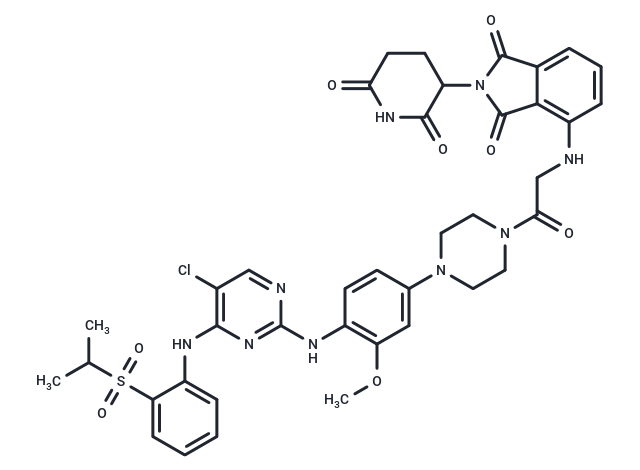
| Description | AP-1, a miniaturized proteolysis-targeting chimera (PROTAC) incorporating an anaplastic lymphoma kinase (ALK) ligand connected to (±)-thalidomide via an ultrashort linker, effectively degrades ALK fusion proteins such as NPM-ALK in Karpas-299 cells and EML4-ALK and ALKF1174L in SN-N-SH and NCI H3122 cells, respectively. Concentrations ranging from 10 to 300 nM are sufficient for its action, which is hindered by the proteasome inhibitor MG-132. Demonstrating selectivity, AP-1 exhibits cytotoxicity towards ALK-dependent Karpas-299 cells with an IC50 value of 0.1265 nM, while showing significantly less toxicity to non-ALK-dependent THP-1 cells (IC50 = 2,704 nM). Furthermore, it effectively reduces tumor volume in NCI H3122 mouse xenograft models at doses of 25, 50, and 100 mg/kg. |
| Molecular Weight | 830.31 |
| Formula | C39H40ClN9O8S |
| Smiles | O=C(CNC1=C(C(N(C2C(NC(CC2)=O)=O)C3=O)=O)C3=CC=C1)N4CCN(C5=CC(OC)=C(NC6=NC(NC7=CC=CC=C7S(C(C)C)(=O)=O)=C(Cl)C=N6)C=C5)CC4 |
| Storage | Powder: -20°C for 3 years | In solvent: -80°C for 1 year Shipping with blue ice/Shipping at ambient temperature. | |||||||||||||||||||||||||
| Solubility Information | DMF: 30 mg/mL (36.13 mM), Sonication is recommended. DMSO: 30 mg/mL (36.13 mM), Sonication is recommended. | |||||||||||||||||||||||||
Solution Preparation Table | ||||||||||||||||||||||||||
DMF/DMSO
Note : The dilution table applies only to solid products. For liquid products, please calculate the stock solution based on the stated concentration and/or density. | ||||||||||||||||||||||||||
 For example, if the intended dosage is 10 mg/kg for animals weighing 20 g , with a dosing volume of 100 μL per animal, and a total of 10 animals are to be administered, using a formulation of
  10% DMSO+ 40% PEG300+ 5% Tween 80+ 45% Saline/PBS/ddH2O , the resulting working solution concentration would be 2 mg/mL.
Dissolve 2 mg of the compound in 100 μL DMSO to obtain a stock solution at a concentration of 20 mg/mL . If the required concentration exceeds the compound's known solubility, please contact us for technical support before proceeding.
1) Add 100 μL of the DMSO stock solution to 400 µL PEG300 and mix thoroughly until the solution becomes clear.
2) Add 50 µL Tween 80 and mix well until fully clarified.
3) Add 450 µL Saline,PBS or ddH2O and mix thoroughly until a homogeneous solution is obtained.
| Size | Quantity | Unit Price | Amount | Operation |
|---|
 Feedback
 Hello! How can I help you today?
Copyright © 2015-2026 TargetMol Chemicals Inc. All Rights Reserved.
