


Shopping Cart
Remove All Your shopping cart is currently empty

Synonyms: SBP-1, HMGB1, HMG3, HMG-1, HMG1
Anti-HMGB1 Polyclonal Antibody
| Pack Size | Price | USA Stock | Global Stock | Quantity |
|---|---|---|---|---|
| 50 µL | $220 | 7-10 days | 7-10 days | |
| 100 µL | $372 | 7-10 days | 7-10 days | |
| 200 µL | $529 | 7-10 days | 7-10 days |
| Description | Anti-HMGB1 Polyclonal Antibody is a Rabbit antibody targeting HMGB1. Anti-HMGB1 Polyclonal Antibody can be used in FCM. |
| Synonyms | SBP-1, HMGB1, HMG3, HMG-1, HMG1 |
| Ig Type | IgG |
| Reactivity | Human,Rat (predicted:Mouse,Cow) |
| Verified Activity | 1. The figure annotation: The blue histogram is unstained cells. The Orange histogram is cells stained with Rabbit IgG/FITC The green histogram is cells stained with Rabbit Anti-HMGB1/FITC Conjugated antibody (TMAB-00870-FITC). Controls Positive control: HepG 2 cells Isotype control: Cell lines treated with Rabbit IgG/FITC. instead of the primary antibody to confirm that primary antibody binding is specific. 5 μgin 100 μL 1 X PBS containing 0.5% BSA. 2. Positive control: HepG2 cells Concebtration: 5 μg/10^6 cells Incubation conditions: Avoid light , 30 minutes on the ice. 3. Rat splenocytes stained with Anti-HMGB1 Polyclonal Antibody, A488 Conjugated (TMAB-00870-A488) at 1:50. 4. Blank control (blue line): MCF7 (blue). Primary Antibody (green line): Rabbit Anti-HMGB1 antibody (TMAB-00870) Dilution: 1 μg/10^6 cells; Isotype Control Antibody (orange line): Rabbit IgG. Secondary Antibody (white blue line): Goat anti-rabbit IgG-FITC Dilution: 1 μg/test. Protocol The cells were fixed with 70% ethanol (Overnight at 4°C) and then permeabilized with 90% ice-cold methanol for 30 min on ice. Cells stained with Primary Antibody for 30 min at room temperature. The cells were then incubated in 1 X PBS/2% BSA/10% goat serum to block non-specific protein-protein interactions followed by the antibody for 15 min at room temperature. The secondary antibody used for 40 min at room temperature. 5. Blank control: HL-60. Primary Antibody (green line): Rabbit Anti-HMGB1 antibody (TMAB-00870) Dilution: 1 μg/10^6 cells; Isotype Control Antibody (orange line): Rabbit IgG. Secondary Antibody: Goat anti-rabbit IgG-AF488 Dilution: 1 μg/test. Protocol The cells were fixed with 4% PFA (10 min at room temperature) and then permeabilized with 90% ice-cold methanol for 20 min at-20°C. The cells were then incubated in 5% BSA to block non-specific protein-protein interactions for 30 min at room temperature. Cells stained with Primary Antibody for 30 min at room temperature. The secondary antibody used for 40 min at room temperature.  , ,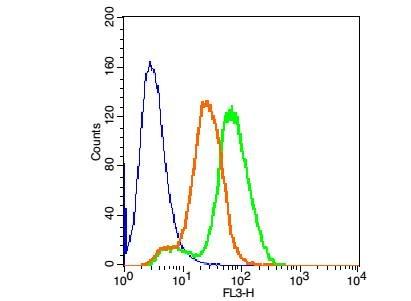 , ,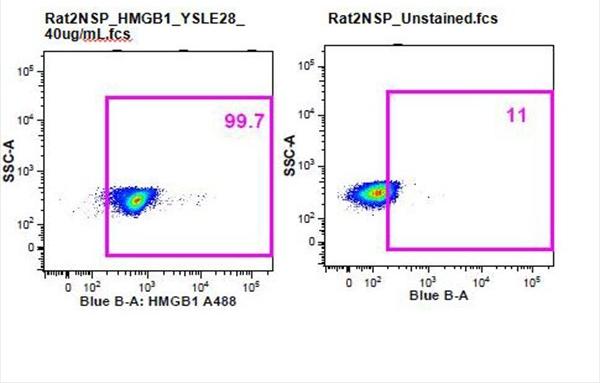 , ,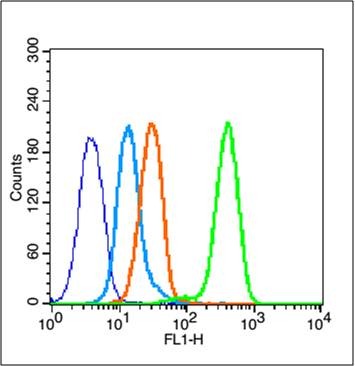 , ,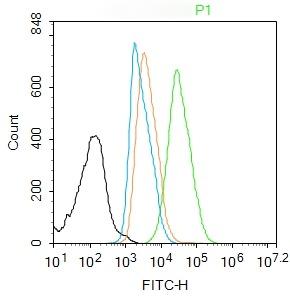 |
| Application | |
| Recommended Dose | FCM: 1μg/Test |
| Antibody Type | Polyclonal |
| Host Species | Rabbit |
| Subcellular Localization | Nucleus. Chromosome. |
| Construction | Polyclonal Antibody |
| Purification | Protein A purified |
| Appearance | Liquid |
| Formulation | 0.01M TBS (pH7.4) with 1% BSA, 0.02% Proclin300 and 50% Glycerol. |
| Concentration | 1 mg/mL |
| Research Background | High Mobility Group Box-1 (HMGB1) is a cytokine implicated in the pathogenesis of rheumatoid arthritis (RA) and other inflammatory diseases. The cholinergic anti-inflammatory pathway, a vagus nerve dependent mechanism, inhibits HMGB1 release in experimental disease models |
| Immunogen | KLH conjugated synthetic peptide: human HMGB1 |
| Antigen Species | Human |
| Gene Name | HMGB1 |
| Gene ID | |
| Protein Name | High mobility group protein B1 |
| Uniprot ID | |
| Biology Area | HMGs,HMG Box,SARS Coronavirus,hmgb1 |
| Function | DNA binding proteins that associates with chromatin and has the ability to bend DNA. Binds preferentially single-stranded DNA. Involved in V(D)J recombination by acting as a cofactor of the RAG complex. Acts by stimulating cleavage and RAG protein binding at the 23 bp spacer of conserved recombination signal sequences (RSS). Heparin-binding protein that has a role in the extension of neurite-type cytoplasmic processes in developing cells. |
| Molecular Weight | Theoretical: 25 kDa. |
| Stability & Storage | Store at -20°C or -80°C for 12 months. Avoid repeated freeze-thaw cycles. |
| Transport | Shipping with blue ice. |
| Size | Quantity | Unit Price | Amount | Operation |
|---|
 Feedback
 Hello! How can I help you today?
Copyright © 2015-2026 TargetMol Chemicals Inc. All Rights Reserved.
