


Shopping Cart
Remove All Your shopping cart is currently empty

Synonyms:
| Pack Size | Price | USA Stock | Global Stock | Quantity |
|---|---|---|---|---|
| 1 mg | $80 | 6-8 weeks | 6-8 weeks | |
| 5 mg | $313 | 6-8 weeks | 6-8 weeks | |
| 10 mg | $390 | 6-8 weeks | 6-8 weeks |
| Description | Adenosine kinase is the key metabolizing enzyme regulating cellular adenosine concentrations. Inhibition of adenosine kinase can selectively enhance the protective actions of adenosine during tissue trauma without producing the nonspecific effects associated with the systemic administration of adenosine receptor agonists (IC50: 1.7 nM in cell-free assays). |
| In vitro | Adenosine Kinase Inhibitor was found to be a potent non-nucleoside adenosine kinase inhibitor with several folds of magnitude selectivity over other sites of adenosine interaction. Adenosine Kinase Inhibitor was 1300- to 7700-fold selective for adenosine kinase compared with other neurotransmitters and peptide receptors, neurotransmitter/nucleoside reuptake sites, and enzymes. Adenosine Kinase Inhibitor was equipped in inhibiting native human adenosine kinase, human recombinant isoforms, as well as adenosine kinase from dog, rat, monkey, and mouse brain [1]. |
| In vivo | Adenosine Kinase Inhibitor was orally active and efficacious in reducing acute somatic nociception in the mouse hot-plate assay. Adenosine Kinase Inhibitor could dose-dependently reduce nociception in the phenyl-p-quinone-induced abdominal constriction assay. The antinociceptive effects of Adenosine Kinase Inhibitor in the hotplate assay were stopped by the nonselective adenosine receptor antagonist theophylline, but not by a peripherally selective adenosine receptor antagonist [1]. |
| Molecular Weight | 470.5 |
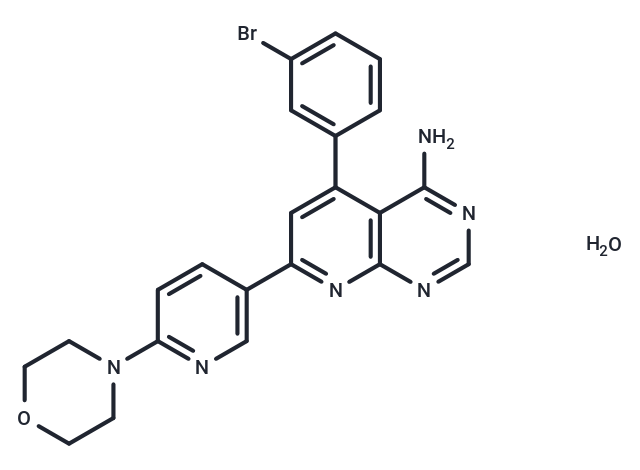
| Formula | C22H19BrN6O·0.4H2O |
| Smiles | BrC1=CC=CC(C2=CC(C3=CN=C(N4CCOCC4)C=C3)=NC5=C2C(N)=NC=N5)=C1.O |
| Relative Density. | no data available |
| Storage | Powder: -20°C for 3 years | In solvent: -80°C for 1 year Shipping with blue ice/Shipping at ambient temperature. |
| Solubility Information | DMSO: ≤30 mg/mL, Sonication is recommended. |
 For example, if the intended dosage is 10 mg/kg for animals weighing 20 g , with a dosing volume of 100 μL per animal, and a total of 10 animals are to be administered, using a formulation of
  10% DMSO+ 40% PEG300+ 5% Tween 80+ 45% Saline/PBS/ddH2O , the resulting working solution concentration would be 2 mg/mL.
Dissolve 2 mg of the compound in 100 μL DMSO to obtain a stock solution at a concentration of 20 mg/mL . If the required concentration exceeds the compound's known solubility, please contact us for technical support before proceeding.
1) Add 100 μL of the DMSO stock solution to 400 µL PEG300 and mix thoroughly until the solution becomes clear.
2) Add 50 µL Tween 80 and mix well until fully clarified.
3) Add 450 µL Saline,PBS or ddH2O and mix thoroughly until a homogeneous solution is obtained.
| Size | Quantity | Unit Price | Amount | Operation |
|---|
 Feedback
 Hello! How can I help you today?
Copyright © 2015-2026 TargetMol Chemicals Inc. All Rights Reserved.
