


Shopping Cart
Remove All Your shopping cart is currently empty

Synonyms:
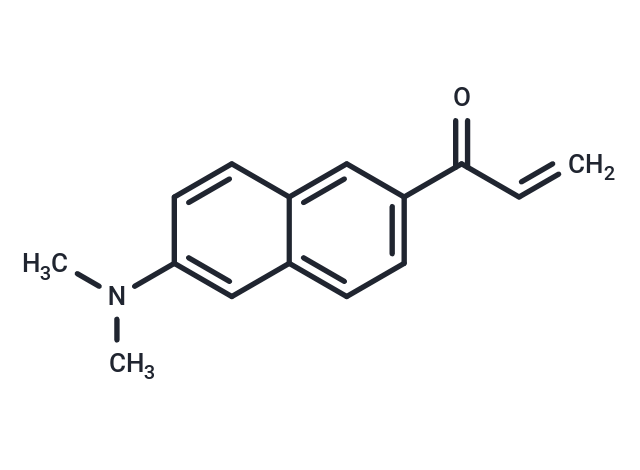
| Pack Size | Price | USA Stock | Global Stock | Quantity |
|---|---|---|---|---|
| 50 mg | Inquiry | 7-10 days | 7-10 days | |
| 100 mg | Inquiry | 7-10 days | 7-10 days |
| Description | Acrylodan, when subjected to thiol reactions, exhibits sensitivity to the dipolarity and dynamics of its surrounding binding pocket, specifically those surrounding Cys 34. |
| In vitro | Guidelines recommend a protocol, which should be tailored to specific requirements, for the purification and labeling of Act1. Initially, a 20-fold molar excess of acrylodan (Anaspec) is mixed with polymerized actin and incubated on ice overnight. Following incubation, the actin-acrylodan mixture is centrifuged for 2 hours at 4°C and 100,000 × g. The resultant pellet is subsequently resuspended in a buffer containing 10 mm Tris (pH 7.5), 0.5 mm β-mercaptoethanol, 0.2 mm CaCl2, and 50 μm ATP, and then dialyzed against the same buffer for 70 hours at 4 °C. The supernatant is collected, and the actin concentration along with the degree of labeling are determined using specific extinction coefficients for actin, acrylodan, and Alexa Fluor 488 at their respective wavelengths. The characterization reveals that Acrylodan-labeled Act1 (Acryl Act1 NAT) exhibits significantly distinct properties compared to EDTA-unfolded Acryl Act1 (Acryl Act1I3), the latter having an emission spectrum closely resembling that of CCT-bound Acryl Act1. |
| Molecular Weight | 225.29 |
| Formula | C15H15NO |
| Cas No. | 86636-92-2 |
| Smiles | CN(C)c1ccc2cc(ccc2c1)C(=O)C=C |
| Relative Density. | 1.100 g/cm3 (Predicted) |
| Storage | Keep away from direct sunlight Powder: -20°C for 3 years | In solvent: -80°C for 1 year Shipping with blue ice/Shipping at ambient temperature. |
 For example, if the intended dosage is 10 mg/kg for animals weighing 20 g , with a dosing volume of 100 μL per animal, and a total of 10 animals are to be administered, using a formulation of
  10% DMSO+ 40% PEG300+ 5% Tween 80+ 45% Saline/PBS/ddH2O , the resulting working solution concentration would be 2 mg/mL.
Dissolve 2 mg of the compound in 100 μL DMSO to obtain a stock solution at a concentration of 20 mg/mL . If the required concentration exceeds the compound's known solubility, please contact us for technical support before proceeding.
1) Add 100 μL of the DMSO stock solution to 400 µL PEG300 and mix thoroughly until the solution becomes clear.
2) Add 50 µL Tween 80 and mix well until fully clarified.
3) Add 450 µL Saline,PBS or ddH2O and mix thoroughly until a homogeneous solution is obtained.
| Size | Quantity | Unit Price | Amount | Operation |
|---|
 Feedback
 Hello! How can I help you today?
Copyright © 2015-2026 TargetMol Chemicals Inc. All Rights Reserved.
