


Shopping Cart
Remove All Your shopping cart is currently empty

Synonyms:
| Pack Size | Price | USA Stock | Global Stock | Quantity |
|---|---|---|---|---|
| 10 mg | Inquiry | Inquiry | Inquiry | |
| 50 mg | Inquiry | Inquiry | Inquiry |
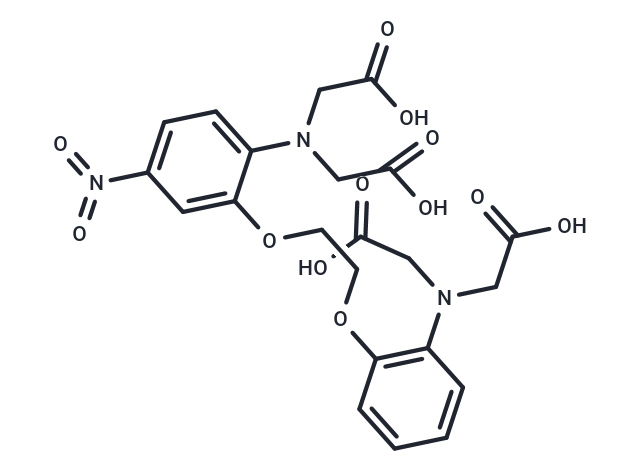
| Description | 5-Nitro BAPTA, a calcium chelator, combined with 2-Me-substituted TM (as a fluorescent moiety), forms a red fluorescent probe (CaTM-2 AM) for imaging cytoplasmic Ca 2+ in cultured living cells. It serves as a building block for synthesizing Ca 2+ specific chelators, Ca 2+ buffers, and fluorescent Ca 2+ indicators [1] [2]. |
| In vitro | 5-Nitro BAPTA, designed as a red fluorescent probe for cytoplasmic Ca2+ with strong emission in the long-wavelength region [1]. General procedure for fluorescence imaging of cultured HeLa cells [1]: Plate cells onto a 35-mm poly-L-lysine-coated glass-bottomed dish (Matsunami) in DMEM supplemented with 10% (v/v) fetal bovine serum, 1% penicillin, and 1% streptomycin. Remove DMEM, wash the dish with HBSS 3 times, and then add CaTM-2 AM (3 μM) in Hanks’ Balanced Salt Solution (HBSS) containing 0.3% DMSO as a cosolvent. Incubate at 37°C for 30 min, remove the medium, and wash dishes with HBSS 3 times. The cells can be observed in HBSS. Capture fluorescence images with excitation and emission wavelength of 590/610–680 nm. General procedure for fluorescence imaging of slices [1]: Incubate slide cultures with 2 mL dye solution at 37°C for 40 min. The dye solution is artificial cerebrospinal fluid (aCSF) containing 10 μM CaTM-2 AM, 0.01% Pluronic F-127, and 0.005% Cremophor EL. aCSF contains 126 mM NaCl, 26 mM NaHCO3, 3.5 mM KCl, 1.24 mM NaH2PO4, 1.3 mM MgSO4, 1.2 mM CaCl2, and 10 mM glucose. Wash slides with aCSF three times and recover in 2 mL aCSF at 37°C for 45 min, with 2 µL of 1 mM Acridine orange added to the aCSF at 40 min. Transfer slice cultures into a recording chamber heated at 35°C and continuously perfused with aCSF at 2 mL/min. Acquire images at 10 frames/s with a Nipkow-disk confocal unit (CSUX-1, Yokogawa Electric, Tokyo, Japan), cooled CCD camera (iXon DU897, Andor, Belfast, UK), a water-immersion objective lens (16×, 0. NA, Nikon, Tokyo, Japan), and image acquisition software (Solis, Andor Technology, Belfast, UK). Set the excitation wavelength to 488 nm (7 mW) and 568 nm (15 mW) for Acridine orange and CaTM-2 with an argon-krypton laser (641-YB-A01; Melles Griot, Carlsbad, CA, USA) and set the emission wavelength to 520-535 nm and 617-673 nm band-pass emission filters, respectively. Analyze data with custom-made software written in Microsoft Visual Basic. Calculate fluorescence change ΔF/F as (Ft-F0)/F0, where Ft is the fluorescence intensity at frame time t, and F0 is the average baseline. The above information is based on published literature. Experimental procedures should be appropriately modified to meet specific research demands. |
| Molecular Weight | 521.43 |
| Formula | C22H23N3O12 |
| Cas No. | 124251-83-8 |
| Smiles | O=C(O)CN(C=1C=CC=CC1OCCOC2=CC(=CC=C2N(CC(=O)O)CC(=O)O)N(=O)=O)CC(=O)O |
| Storage | Powder: -20°C for 3 years | In solvent: -80°C for 1 year Shipping with blue ice/Shipping at ambient temperature. |
 For example, if the intended dosage is 10 mg/kg for animals weighing 20 g , with a dosing volume of 100 μL per animal, and a total of 10 animals are to be administered, using a formulation of
  10% DMSO+ 40% PEG300+ 5% Tween 80+ 45% Saline/PBS/ddH2O , the resulting working solution concentration would be 2 mg/mL.
Dissolve 2 mg of the compound in 100 μL DMSO to obtain a stock solution at a concentration of 20 mg/mL . If the required concentration exceeds the compound's known solubility, please contact us for technical support before proceeding.
1) Add 100 μL of the DMSO stock solution to 400 µL PEG300 and mix thoroughly until the solution becomes clear.
2) Add 50 µL Tween 80 and mix well until fully clarified.
3) Add 450 µL Saline,PBS or ddH2O and mix thoroughly until a homogeneous solution is obtained.
| Size | Quantity | Unit Price | Amount | Operation |
|---|
 Feedback
 Hello! How can I help you today?
Copyright © 2015-2026 TargetMol Chemicals Inc. All Rights Reserved.
