


Shopping Cart
Remove All Your shopping cart is currently empty

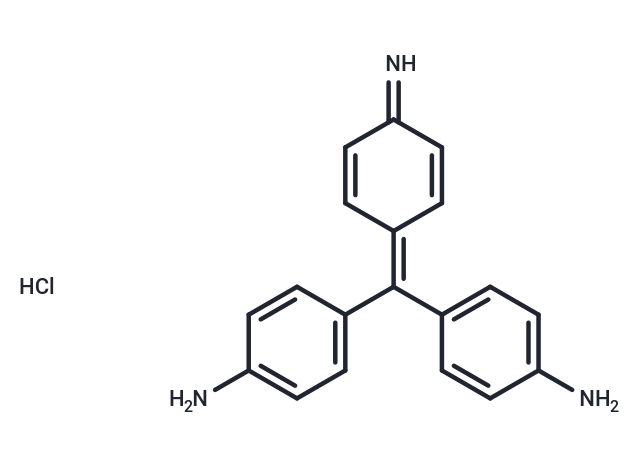
Synonyms: Basic red 9, 4,4'-((4-Iminocyclohexa-2,5-dien-1-ylidene)methylene)dianiline hydrochloride
| Pack Size | Price | USA Stock | Global Stock | Quantity |
|---|---|---|---|---|
| 10 g | $31 | 7-10 days | 7-10 days | |
| 1 mL x 10 mM (in DMSO) | $35 | 7-10 days | 7-10 days |
| Description | 4,4'-((4-Iminocyclohexa-2,5-dien-1-ylidene)methylene)dianiline hydrochloride is a useful organic compound for life science research |
| In vitro | Method: C.I. Basic Red 9 monohydrochloride was tested in Salmonella typhimurium TA98, TA100, TA1535 and TA1537 with and without metabolic activation, in L5178Y/TK mouse lymphoma cells, and in Chinese hamster ovary sister-chromatid-exchange and chromosomal-aberration assays.[1] Rresult: The compound was mutagenic in TA98 and TA100 and induced mutations in L5178Y/TK cells. It was negative in TA1535 and TA1537 and did not induce chromosomal aberrations in Chinese hamster ovary cells; sister-chromatid exchange increased under metabolic-activation conditions.[1] |
| In vivo | Method: Groups of 50 male and 50 female F344/N rats and B6C3F1 mice received pararosaniline hydrochloride in feed for 103 weeks. Male rats received 0, 1000 or 2000 ppm; female rats and mice received 0, 500 or 1000 ppm.[1] Rresult: Long-term dietary exposure produced clear evidence of carcinogenic activity in male and female F344/N rats and B6C3F1 mice, with increased incidences of treatment-related neoplasms.[1] |
| Synonyms | Basic red 9, 4,4'-((4-Iminocyclohexa-2,5-dien-1-ylidene)methylene)dianiline hydrochloride |
| Molecular Weight | 323.82 |
| Formula | C19H18ClN3 |
| Cas No. | 569-61-9 |
| Smiles | Cl.N=C1C=CC(C=C1)=C(C2=CC=C(N)C=C2)C3=CC=C(N)C=C3 |
| Storage | Keep away from moisture,Keep away from direct sunlight, Powder: -20°C for 3 years | In solvent: -80°C for 1 year Shipping with blue ice/Shipping at ambient temperature. | ||||||||||||||||||||||||||||||||||||||||
| Solubility Information | DMSO: 80 mg/mL (247.05 mM), Sonication is recommended. H2O: 7.568 mg/mL (23.37 mM), Sonication is recommended. | ||||||||||||||||||||||||||||||||||||||||
Solution Preparation Table | |||||||||||||||||||||||||||||||||||||||||
H2O/DMSO
DMSO
Note : The dilution table applies only to solid products. For liquid products, please calculate the stock solution based on the stated concentration and/or density. | |||||||||||||||||||||||||||||||||||||||||
 For example, if the intended dosage is 10 mg/kg for animals weighing 20 g , with a dosing volume of 100 μL per animal, and a total of 10 animals are to be administered, using a formulation of
  10% DMSO+ 40% PEG300+ 5% Tween 80+ 45% Saline/PBS/ddH2O , the resulting working solution concentration would be 2 mg/mL.
Dissolve 2 mg of the compound in 100 μL DMSO to obtain a stock solution at a concentration of 20 mg/mL . If the required concentration exceeds the compound's known solubility, please contact us for technical support before proceeding.
1) Add 100 μL of the DMSO stock solution to 400 µL PEG300 and mix thoroughly until the solution becomes clear.
2) Add 50 µL Tween 80 and mix well until fully clarified.
3) Add 450 µL Saline,PBS or ddH2O and mix thoroughly until a homogeneous solution is obtained.
| Size | Quantity | Unit Price | Amount | Operation |
|---|
 Feedback
 Hello! How can I help you today?
Copyright © 2015-2026 TargetMol Chemicals Inc. All Rights Reserved.
