


Shopping Cart
Remove All Your shopping cart is currently empty

Synonyms: p-Nitrophenol
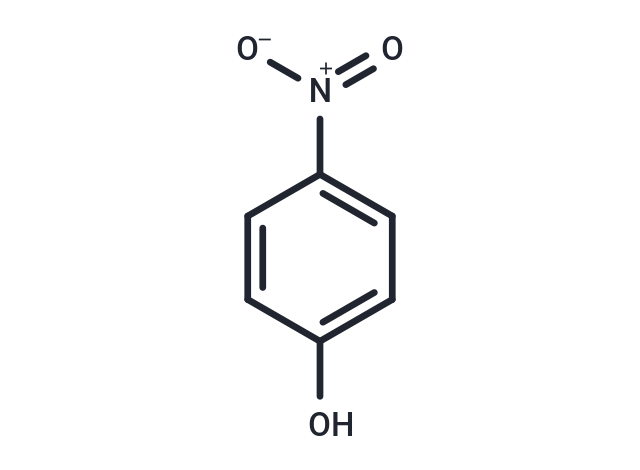

| Pack Size | Price | USA Stock | Global Stock | Quantity |
|---|---|---|---|---|
| 5 mg | $50 | - | In Stock | |
| 10 mg | $70 | - | In Stock | |
| 25 mg | $113 | - | In Stock | |
| 50 mg | $163 | - | In Stock | |
| 100 mg | $239 | - | In Stock | |
| 500 mg | $589 | - | In Stock |
| Description | 4-Nitrophenol is a synthetic phenolic compound and an organic synthetic intermediate for drugs such as acetaminophen (Paracetamol). 4-Nitrophenol can be used in the preparation of fungicides, dyes, and leather treatment agents, and is commonly applied in the fine chemicals industry and organic synthesis research. |
| In vitro | Method: NHPrE1 normal human prostate epithelial progenitor cells were treated with 4-Nitrophenol (10 μmol/L) for different time periods (2, 4, 8, 24 h), and LC3 mRNA expression was detected by RT-PCR; NHPrE1 cells were treated with 4-Nitrophenol (10 μmol/L) for 8 h, and the protein expression levels of LC3-I/II, Beclin-1, and p62 were detected by Western blot. Result: 4-Nitrophenol treatment increased LC3 mRNA expression in NHPrE1 cells, reaching a peak at 8 h; the LC3-II/LC3-I ratio and Beclin-1 protein expression were increased, while p62 expression was decreased, indicating that 4-Nitrophenol induced autophagy activation in NHPrE1 cells [1]. Method: NHPrE1 cells were treated with 4-Nitrophenol (10 μmol/L) for 24 h, and SOD activity, GSH-Px activity, and MDA levels were measured using biochemical assay kits. Result: Compared with the control group, the 4-Nitrophenol-treated group showed significantly increased MDA levels and significantly decreased SOD and GSH-Px activities, indicating that 4-Nitrophenol induced oxidative stress in NHPrE1 cells [1]. Method: NHPrE1 cells were treated with 4-Nitrophenol (10 μmol/L) for 24 h, cell viability was assessed by CCK-8 assay, Cleaved-caspase-3 expression was detected by Western blot, and apoptosis was detected by Hoechst 33258 staining. Result: 4-Nitrophenol treatment significantly reduced NHPrE1 cell viability, increased Cleaved-caspase-3 expression, and increased the number of apoptotic cells, indicating that 4-Nitrophenol induced apoptosis in NHPrE1 cells [1]. Method: Recombinant yeast reporter gene systems expressing human estrogen receptor α or human androgen receptor were treated with 4-Nitrophenol, and β-galactosidase activity was measured. Result: 4-Nitrophenol exhibited estrogenic and anti-androgenic activities [2]. |
| In vivo | Method: Ovariectomized immature female rats were subcutaneously injected with 4-Nitrophenol (1, 10, 100 mg/kg/d) for 7 consecutive days. After sacrifice, uterine weight was measured, and plasma FSH and LH levels were detected. Result: Uterine weight was significantly increased in the 10 and 100 mg/kg/d dose groups, to approximately 125% of the control value, while plasma FSH and LH levels showed no significant change [2]. Method: Castrated immature male rats were subcutaneously implanted with silastic tubing (5 mm) containing crystalline testosterone and simultaneously injected subcutaneously with 4-Nitrophenol (0.01, 0.1, 1 mg/kg/d) for 5 consecutive days. After sacrifice, the weights of seminal vesicles, ventral prostate, levator ani/bulbocavernosus muscles, glans penis, and Cowper's glands were measured, and plasma FSH and LH levels were detected. Result: At the 0.1 mg/kg/d dose, the weights of seminal vesicles, ventral prostate, levator ani/bulbocavernosus muscles, and glans penis were significantly decreased, while plasma FSH and LH levels were significantly increased, demonstrating anti-androgenic effects [2]. |
| Synonyms | p-Nitrophenol |
| Molecular Weight | 139.11 |
| Formula | C6H5NO3 |
| Cas No. | 100-02-7 |
| Smiles | [O-][N+](C1=CC=C(C=C1)O)=O |
| Storage | Powder: -20°C for 3 years | In solvent: -80°C for 1 year Shipping with blue ice/Shipping at ambient temperature. |
 For example, if the intended dosage is 10 mg/kg for animals weighing 20 g , with a dosing volume of 100 μL per animal, and a total of 10 animals are to be administered, using a formulation of
  10% DMSO+ 40% PEG300+ 5% Tween 80+ 45% Saline/PBS/ddH2O , the resulting working solution concentration would be 2 mg/mL.
Dissolve 2 mg of the compound in 100 μL DMSO to obtain a stock solution at a concentration of 20 mg/mL . If the required concentration exceeds the compound's known solubility, please contact us for technical support before proceeding.
1) Add 100 μL of the DMSO stock solution to 400 µL PEG300 and mix thoroughly until the solution becomes clear.
2) Add 50 µL Tween 80 and mix well until fully clarified.
3) Add 450 µL Saline,PBS or ddH2O and mix thoroughly until a homogeneous solution is obtained.
| Size | Quantity | Unit Price | Amount | Operation |
|---|
 Feedback
 Hello! How can I help you today?
Copyright © 2015-2026 TargetMol Chemicals Inc. All Rights Reserved.
