


Shopping Cart
Remove All Your shopping cart is currently empty

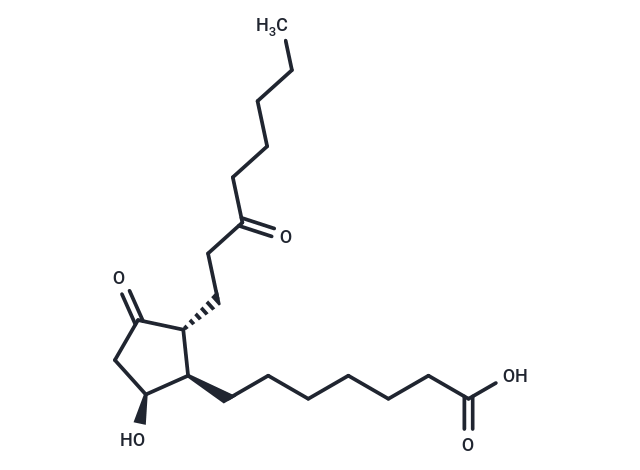
Synonyms: 13,14-dihydro-15-keto Prostaglandin D1
| Pack Size | Price | USA Stock | Global Stock | Quantity |
|---|---|---|---|---|
| 1 mg | $456 | 35 days | 35 days | |
| 5 mg | $1,960 | 35 days | 35 days | |
| 10 mg | $3,550 | 35 days | 35 days |
| Description | Prostaglandin D1 (PGD1) is the theoretical D-series metabolite of dihomo-γ-linolenic acid (DGLA), but to date it has not been isolated as a natural product. It is an inhibitor of ADP-induced platelet aggregation in humans with an IC50 value of 320 ng/ml, about 1/10 as potent as PGD2. 13,14-dihydro-15-keto Prostaglandin D1 (13,14-dihydro-15-keto PGD1) is the theoretical metabolite of PGD1 via the 15-hydroxy PG dehydrogenase metabolic pathway. No biological studies for this compound have been reported. |
| Synonyms | 13,14-dihydro-15-keto Prostaglandin D1 |
| Molecular Weight | 354.487 |
| Formula | C20H34O5 |
| Cas No. | 1392219-79-2 |
| Smiles | CCCCCC(=O)CC[C@@H]1[C@@H](CCCCCCC(O)=O)[C@@H](O)CC1=O |
| Storage | Powder: -20°C for 3 years | In solvent: -80°C for 1 year Shipping with blue ice/Shipping at ambient temperature. | |||||||||||||||||||||||||||||||||||||||||||||
| Solubility Information | PBS (pH 7.2): 2 mg/mL (5.64 mM), Sonication is recommended. DMF: 50 mg/mL (141.05 mM), Sonication is recommended. Ethanol: 50 mg/mL (141.05 mM), Sonication is recommended. DMSO: 30 mg/mL (84.63 mM), Sonication is recommended. | |||||||||||||||||||||||||||||||||||||||||||||
Solution Preparation Table | ||||||||||||||||||||||||||||||||||||||||||||||
PBS (pH 7.2)/DMSO/DMF/Ethanol
DMSO/DMF/Ethanol
DMF/Ethanol
Note : The dilution table applies only to solid products. For liquid products, please calculate the stock solution based on the stated concentration and/or density. | ||||||||||||||||||||||||||||||||||||||||||||||
 For example, if the intended dosage is 10 mg/kg for animals weighing 20 g , with a dosing volume of 100 μL per animal, and a total of 10 animals are to be administered, using a formulation of
  10% DMSO+ 40% PEG300+ 5% Tween 80+ 45% Saline/PBS/ddH2O , the resulting working solution concentration would be 2 mg/mL.
Dissolve 2 mg of the compound in 100 μL DMSO to obtain a stock solution at a concentration of 20 mg/mL . If the required concentration exceeds the compound's known solubility, please contact us for technical support before proceeding.
1) Add 100 μL of the DMSO stock solution to 400 µL PEG300 and mix thoroughly until the solution becomes clear.
2) Add 50 µL Tween 80 and mix well until fully clarified.
3) Add 450 µL Saline,PBS or ddH2O and mix thoroughly until a homogeneous solution is obtained.
| Size | Quantity | Unit Price | Amount | Operation |
|---|
 Feedback
 Hello! How can I help you today?
Copyright © 2015-2026 TargetMol Chemicals Inc. All Rights Reserved.
