


Shopping Cart
Remove All Your shopping cart is currently empty
Synonyms: UCP1, UCP 1, UCP, Thermogenin, Solute carrier family 25 member 7, SLC25A7, Mitochondrial brown fat uncoupling protein 1
| Pack Size | Price | USA Stock | Global Stock | Quantity |
|---|---|---|---|---|
| 5 µg | $75 | - | In Stock | |
| 10 µg | $119 | - | In Stock | |
| 20 µg | $198 | 20 days | 20 days | |
| 50 µg | $297 | 20 days | 20 days | |
| 100 µg | $427 | 20 days | 20 days | |
| 200 µg | $658 | 20 days | 20 days | |
| 500 µg | $1,170 | 20 days | 20 days | |
| 1 mg | $1,830 | 20 days | 20 days |
| Bioactivity | Activity has not been tested. It is theoretically active, but we cannot guarantee it. If you require protein activity, we recommend choosing the eukaryotic expression version first. |
| Description | UCP1 Protein, Human, Recombinant (His & SUMO) is expressed in E. coli expression system with N-6xHis-SUMO tag. The predicted molecular weight is 48.9 kDa and the accession number is P25874. |
| Species | Human |
| Expression System | E. coli |
| Tag | N-6xHis-SUMO |
| Accession Number | P25874 |
| Amino Acid | GGLTASDVHPTLGVQLFSAGIAACLADVITFPLDTAKVRLQVQGECPTSSVIRYKGVLGTITAVVKTEGRMKLYSGLPAGLQRQISSASLRIGLYDTVQEFLTAGKETAPSLGSKILAGLTTGGVAVFIGQPTEVVKVRLQAQSHLHGIKPRYTGTYNAYRIIATTEGLTGLWKGTTPNLMRSVIINCTELVTYDLMKEAFVKNNILADDVPCHLVSALIAGFCATAMSSPVDVVKTRFINSPPGQYKSVPNCAMKVFTNEGPTAFFKGLVPSFLRLGSWNVIMFVCFEQLKRELSKSRQTMDCAT |
| Construction | 2-307 aa |
| Protein Purity | > 90% as determined by SDS-PAGE. 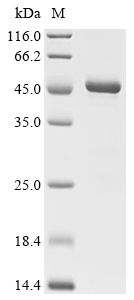 |
| Endotoxin | < 1.0 EU/μg of the protein as determined by the LAL method. |
| Formulation | Tris-based buffer, 50% glycerol |
| Reconstitution | A Certificate of Analysis (CoA) containing reconstitution instructions is included with the products. Please refer to the CoA for detailed information. |
| Synonyms | UCP1, UCP 1, UCP, Thermogenin, Solute carrier family 25 member 7, SLC25A7, Mitochondrial brown fat uncoupling protein 1 |
| Research Background | Mitochondrial protein responsible for thermogenic respiration, a specialized capacity of brown adipose tissue and beige fat that participates in non-shivering adaptive thermogenesis to temperature and diet variations and more generally to the regulation of energy balance. Functions as a long-chain fatty acid/LCFA and proton symporter, simultaneously transporting one LCFA and one proton through the inner mitochondrial membrane. However, LCFAs remaining associated with the transporter via their hydrophobic tails, it results in an apparent transport of protons activated by LCFAs. Thereby, dissipates the mitochondrial proton gradient and converts the energy of substrate oxydation into heat instead of ATP. Regulates the production of reactive oxygen species/ROS by mitochondria. |
| Molecular Weight | 48.9 kDa (predicted) |
| Shipping | In general, lyophilized powders are shipped with blue ice, while solutions are shipped with dry ice. |
| Storage | Lyophilized powders can be stably stored for over 12 months, while liquid products can be stored for 6-12 months at -80°C. For reconstituted protein solutions, the solution can be stored at -20°C to -80°C for at least 3 months. Please avoid multiple freeze-thaw cycles and store products in aliquots. |
| Size | Quantity | Unit Price | Amount | Operation |
|---|
 Feedback
 Hello! How can I help you today?
Copyright © 2015-2026 TargetMol Chemicals Inc. All Rights Reserved.
