


Shopping Cart
Remove All Your shopping cart is currently empty
Synonyms: transferrin, F3, Cf-3, Cf3
| Pack Size | Price | USA Stock | Global Stock | Quantity |
|---|---|---|---|---|
| 5 µg | $44 | - | In Stock | |
| 10 µg | $68 | 7-10 days | 7-10 days | |
| 20 µg | $109 | - | In Stock | |
| 50 µg | $198 | - | In Stock | |
| 100 µg | $349 | - | In Stock | |
| 200 µg | $617 | 7-10 days | 7-10 days | |
| 500 µg | $1,310 | 7-10 days | 7-10 days |
| Bioactivity | Measured in a serum-free cell proliferation assay using MCF-7 human breast cancer cells. Karey, K.P. et al. (1988) Cancer Research 48:4083. The ED50 for this effect is typically 0.05-0.2 μg/mL. |
| Description | Transferrin Protein, Mouse, Recombinant (His) is expressed in HEK293 mammalian cells with His tag. The predicted molecular weight is 76.3 kDa and the accession number is Q921I1. |
| Species | Mouse |
| Expression System | HEK293 Cells |
| Tag | C-His |
| Accession Number | Q921I1 |
| Construction | A DNA sequence encoding the mouse TRF (Q921I1) (Met1-His697) was expressed with a C-terminal polyhistidine tag. Predicted N terminal: Val 20 |
| Protein Purity | > 95 % as determined by SDS-PAGE 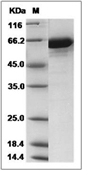 |
| Endotoxin | < 1.0 EU/μg of the protein as determined by the LAL method. |
| Formulation | Lyophilized from a solution filtered through a 0.22 μm filter, containing PBS, pH 7.4. Typically, a mixture containing 5% to 8% trehalose, mannitol, and 0.01% Tween 80 is incorporated as a protective agent before lyophilization. |
| Reconstitution | Reconstituted with sterile deionized water to 0.25 mg/mL. Reconstitution conditions may vary depending on the lot. |
| Synonyms | transferrin, F3, Cf-3, Cf3 |
| Research Background | Transferrin is a glycoprotein with an approximate molecular weight of 76.5 kDa. This glycoprotein is thought to have been created as a result of an ancient gene duplication event that led to generation of homologous C and N-terminal domains each of which binds one ion of ferric iron. The function of Transferrin is to transport iron from the intestine, reticuloendothelial system, and liver parenchymal cells to all proliferating cells in the body. This protein may also have a physiologic role as granulocyte / pollen-binding protein (GPBP) involved in the removal of certain organic matter and allergens from serum. Transferrins are iron binding transport proteins that bind Fe3+ion in association with the binding of an anion, usually bicarbonate. This transferrin binds only one Fe3+ion per protein molecule. Transports iron ions from the hemolymph into the eggs during the vitellogenic stage. Transferrins are iron binding transport proteins which can bind two Fe(3+) ions in association with the binding of an anion, usually bicarbonate. It is responsible for the transport of iron from sites of absorption and heme degradation to those of storage and utilization. Serum transferrin may also have a further role in stimulating cell proliferation. When a transferrin loaded with iron encounters with a transferring receptor on cell surface, transferring binds to it and, as a consequence, is transported into the cell in a visicle by receptor-mediated endocytosis. The PH is reduced by hydrogen iron pumps. The lower pH causes transferrin to release its iron ions. The receptor is then transported through the endocytic cycle back to the cell surface, ready for another round of iron uptake. Each transferrin molecule has the ability to carry two iron ions in the ferric form. |
| Molecular Weight | 76.3 kDa (predicted); 61-66 kDa (reducing condition, due to glycosylation) |
| Shipping | In general, lyophilized powders are shipped with blue ice, while solutions are shipped with dry ice. |
| Storage | It is recommended to store recombinant proteins at -20°C to -80°C for future use. Lyophilized powders can be stably stored for over 12 months, while liquid products can be stored for 6-12 months at -80°C. For reconstituted protein solutions, the solution can be stored at -20°C to -80°C for at least 3 months. Please avoid multiple freeze-thaw cycles and store products in aliquots. |
| Size | Quantity | Unit Price | Amount | Operation |
|---|
 Feedback
 Hello! How can I help you today?
Copyright © 2015-2026 TargetMol Chemicals Inc. All Rights Reserved.
