


Shopping Cart
Remove All Your shopping cart is currently empty

NKG2A/CD159a Protein, Cynomolgus/Rhesus, Recombinant (hFc) is expressed in HEK293 mammalian cells with hFc tag. The predicted molecular weight is 30.8 kDa and the accession number is Q68VD2.
| Pack Size | Price | USA Stock | Global Stock | Quantity |
|---|---|---|---|---|
| 5 μg | $55 | 7-10 days | 7-10 days | |
| 10 μg | $86 | 7-10 days | 7-10 days | |
| 20 μg | $139 | 7-10 days | 7-10 days | |
| 50 μg | $269 | 7-10 days | 7-10 days | |
| 100 μg | $451 | - | In Stock | |
| 200 μg | $798 | 7-10 days | 7-10 days | |
| 500 μg | $1,690 | 7-10 days | 7-10 days |
| Biological Activity | Activity testing is in progress. It is theoretically active, but we cannot guarantee it. If you require protein activity, we recommend choosing the eukaryotic expression version first. |
| Description | NKG2A/CD159a Protein, Cynomolgus/Rhesus, Recombinant (hFc) is expressed in HEK293 mammalian cells with hFc tag. The predicted molecular weight is 30.8 kDa and the accession number is Q68VD2. |
| Species | Cynomolgus,Rhesus |
| Expression System | HEK293 Cells |
| Tag | N-hFc |
| Accession Number | Q68VD2 |
| Synonyms | killer cell lectin-like receptor subfamily C, member 1 |
| Construction | A DNA sequence encoding the cynomolgus / rhesus KLRC1 (NP_001271106.1/Q9MZJ2) (Pro94-Leu233) was expressed with the Fc region of human IgG1 at the N-terminus. Cynomolgus and Rhesus KLRC1 sequences are identical. Predicted N terminal: Glu |
| Protein Purity | > 85 % as determined by SDS-PAGE 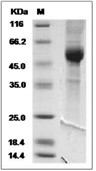 |
| Molecular Weight | 44.4 kDa (predicted); 47-55 kDa (reducing conditions) |
| Endotoxin | < 1.0 EU/μg of the protein as determined by the LAL method. |
| Formulation | Lyophilized from a solution filtered through a 0.22 μm filter, containing PBS, pH 7.4. Typically, a mixture containing 5% to 8% trehalose, mannitol, and 0.01% Tween 80 is incorporated as a protective agent before lyophilization. |
| Reconstitution | Reconstituted with sterile deionized water to 0.25 mg/mL. Reconstitution conditions may vary depending on the lot. |
| Stability & Storage | It is recommended to store recombinant proteins at -20°C to -80°C for future use. Lyophilized powders can be stably stored for over 12 months, while liquid products can be stored for 6-12 months at -80°C. For reconstituted protein solutions, the solution can be stored at -20°C to -80°C for at least 3 months. Please avoid multiple freeze-thaw cycles and store products in aliquots. |
| Shipping | In general, lyophilized powders are shipped with blue ice, while solutions are shipped with dry ice. |
| Research Background | NKG2, also known as NKG2A(CD159A), is a member of the killer cell lectin-like receptor family. This family is a group of transmembrane proteins preferentially expressed in NK cells. Members of this family are characterized by the type II membrane orientation and the presence of a C-type lectin domain. NKG2 contains 1 C-type lectin domain and forms a complex with another family member, KLRD1/CD94. It is expressed only in NK-cells, but not in T-cells or B-cells. It has been shown that NKG2 represents a family of related cDNA clones, designated NKG2A, NKG2B, NKG2C, and NKG2D, which encode type 2 integral membrane proteins (extracellular C-terminus) containing a C-type lectin domain. Natural killer (NK) cells are lymphocytes that can mediate lysis of certain tumor cells and virus-infected cells without previous activation. They can also regulate specific humoral and cell-mediated immunity. NKG2 functions as a receptor for the recognition of MHC class I HLA-E molecules by NK cells and some cytotoxic T-cells. |
| Size | Quantity | Unit Price | Amount | Operation |
|---|
 Feedback
 Hello! How can I help you today?
Copyright © 2015-2026 TargetMol Chemicals Inc. All Rights Reserved.