


Shopping Cart
Remove All Your shopping cart is currently empty
Synonyms: GBP28, APM-1, APM1, ADPN, ADIPQTL1, adiponectin, C1Q and collagen domain containing, Adiponectin, ACRP30, ACDC
| Pack Size | Price | USA Stock | Global Stock | Quantity |
|---|---|---|---|---|
| 5 µg | $48 | - | In Stock | |
| 10 µg | $76 | - | In Stock | |
| 20 µg | $123 | - | In Stock | |
| 50 µg | $238 | - | In Stock | |
| 100 µg | $397 | - | In Stock | |
| 200 µg | $679 | 7-10 days | 7-10 days | |
| 500 µg | $1,370 | 7-10 days | 7-10 days |
| Bioactivity | Activity testing is in progress. It is theoretically active, but we cannot guarantee it. If you require protein activity, we recommend choosing the eukaryotic expression version first. |
| Description | Adiponectin Protein, Human, Recombinant (His) is expressed in Baculovirus insect cells with His tag. The predicted molecular weight is 26 kDa and the accession number is A8K660. |
| Species | Human |
| Expression System | Baculovirus Insect Cells |
| Tag | C-His |
| Accession Number | A8K660 |
| Construction | A DNA sequence encoding the human ADIPOQ (NP_001171271.1) (Met1-Asn244) was expressed with a polyhistidine tag at the C-terminus. Predicted N terminal: Glu 19 |
| Protein Purity | > 90 % as determined by SDS-PAGE. 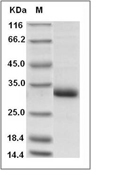 |
| Endotoxin | < 1.0 EU/μg of the protein as determined by the LAL method. |
| Formulation | Lyophilized from a solution filtered through a 0.22 μm filter, containing 20 mM Tris, 150 mM NaCl, pH 8.0, 10% glycerol. Typically, a mixture containing 5% to 8% trehalose, mannitol, and 0.01% Tween 80 is incorporated as a protective agent before lyophilization. |
| Reconstitution | Reconstituted with sterile deionized water to 0.25 mg/mL. Reconstitution conditions may vary depending on the lot. |
| Synonyms | GBP28, APM-1, APM1, ADPN, ADIPQTL1, adiponectin, C1Q and collagen domain containing, Adiponectin, ACRP30, ACDC |
| Research Background | Adiponectin (ADIPOQ), or 30 kDa adipocyte complement-related protein (Acrp30) is a protein secreted by adipose tissue, which acts to reduce insulin resistance and atherogenic damage, but it also exerts actions in other tissues. Adiponectin mediates its actions in the periphery mainly via two receptors, AdipoR1 and AdipoR2. Adiponectin influences gonadotropin release, normal pregnancy, and assisted reproduction outcomes. Adiponectin, a beneficial adipokine, represents a major link between obesity and reproduction. Higher levels of adiponectin are associated with improved menstrual function and better outcomes in assisted reproductive cycles. Unlike other adipocytokines produced by adipose tissue, adiponectin appears to have anti-inflammatory, anti-diabetic, and anti-atherogenic properties. Several clinical studies demonstrate the inverse relationship between plasma adiponectin levels and several inflammatory markers including C-reactive protein. Adiponectin attenuates inflammatory responses to multiple stimuli by modulating signaling pathways in a variety of cell types. The anti-inflammatory properties of adiponectin may be a major component of its beneficial effects on cardiovascular and metabolic disorders including atherosclerosis and insulin resistance. Additionally, it is important factor in chronic liver diseases and chronic kidney diseases. Some cancer cell types express adiponectin receptors. Thus Adiponectin may act on tumour cells directly by binding and activating adiponectin receptors and downstream signalling pathways. |
| Molecular Weight | 26 kDa (predicted) |
| Shipping | In general, lyophilized powders are shipped with blue ice, while solutions are shipped with dry ice. |
| Storage | It is recommended to store recombinant proteins at -20°C to -80°C for future use. Lyophilized powders can be stably stored for over 12 months, while liquid products can be stored for 6-12 months at -80°C. For reconstituted protein solutions, the solution can be stored at -20°C to -80°C for at least 3 months. Please avoid multiple freeze-thaw cycles and store products in aliquots. |
| Size | Quantity | Unit Price | Amount | Operation |
|---|
 Feedback
 Hello! How can I help you today?
Copyright © 2015-2026 TargetMol Chemicals Inc. All Rights Reserved.
