


Shopping Cart
Remove All Your shopping cart is currently empty
Synonyms: Inhibin β A chain, Inhibin beta A chain, INHBA, Activin A
| Pack Size | Price | USA Stock | Global Stock | Quantity |
|---|---|---|---|---|
| 5 µg | $143 | - | In Stock | |
| 10 µg | $236 | - | In Stock | |
| 20 µg | $362 | - | In Stock | |
| 50 µg | $643 | - | In Stock | |
| 100 µg | $915 | - | In Stock |
| Bioactivity | 1. Measured by its ability to induce SMAD signaling in 293-Activin A Res cells. The ED50 for this effect is 1.3 ng/mL. 2. Human intestinal organoids (ipsc source) were cultured with Activin A , BMP-4, EGF, Wnt3a, Noggin, R-spondin 1 and FGF-4 . |
| Description | Activin and inhibin are two closely related protein complexes that have almost directly opposite biological effects. Activins, members of the TGF-beta superfamily, are disulfide-linked dimeric proteins originally purified from gonadal fluids as proteins that stimulated pituitary follicle stimulating hormone (FSH) release. Inhibins/activins are involved in regulating a number of diverse functions such as hypothalamic and pituitary hormone secretion, gonadal hormone secretion, germ cell development and maturation, erythroid differentiation, insulin secretion, nerve cell survival, embryonic axial development or bone growth, depending on their subunit composition. Activins are homodimers or heterodimers of the various beta subunit isoforms, while inhibins are heterodimers of a unique alpha subunit and one of the various beta subunits. |
| Species | Human/Mouse/Rat |
| Expression System | HEK293 Cells |
| Tag | Tag Free |
| Accession Number | P08476 |
| Amino Acid | Gly311-Ser426 |
| Construction | Gly311-Ser426 |
| Protein Purity | Greater than 95% as determined by reducing SDS-PAGE. (QC verified) 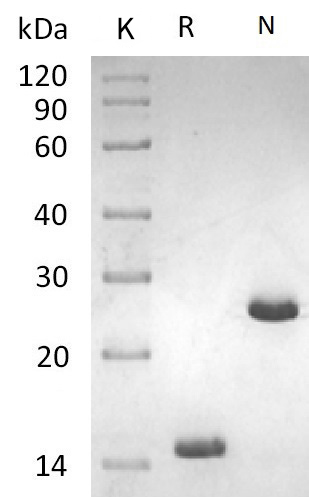 |
| Endotoxin | < 0.001 ng/µg (0.01 EU/µg) as determined by LAL test. |
| Formulation | Lyophilized from a solution filtered through a 0.22 μm filter, containing 4 mM HCl. |
| Reconstitution | Reconstitute the lyophilized protein in distilled water. The product concentration should not be less than 100 μg/ml. Before opening, centrifuge the tube to collect powder at the bottom. After adding the reconstitution buffer, avoid vortexing or pipetting for mixing. |
| Synonyms | Inhibin β A chain, Inhibin beta A chain, INHBA, Activin A |
| Research Background | Activin and inhibin are two closely related protein complexes that have almost directly opposite biological effects. Activins, members of the TGF-beta superfamily, are disulfide-linked dimeric proteins originally purified from gonadal fluids as proteins that stimulated pituitary follicle stimulating hormone (FSH) release. Inhibins/activins are involved in regulating a number of diverse functions such as hypothalamic and pituitary hormone secretion, gonadal hormone secretion, germ cell development and maturation, erythroid differentiation, insulin secretion, nerve cell survival, embryonic axial development or bone growth, depending on their subunit composition. Activins are homodimers or heterodimers of the various beta subunit isoforms, while inhibins are heterodimers of a unique alpha subunit and one of the various beta subunits. |
| Shipping | In general, lyophilized powders are shipped with blue ice, while solutions are shipped with dry ice. |
| Storage | It is recommended to store recombinant proteins at -20°C to -80°C for future use. Lyophilized powders can be stably stored for over 12 months, while liquid products can be stored for 6-12 months at -80°C. For reconstituted protein solutions, the solution can be stored at -20°C to -80°C for at least 3 months. Please avoid multiple freeze-thaw cycles and store products in aliquots. |
| Size | Quantity | Unit Price | Amount | Operation |
|---|
 Feedback
 Hello! How can I help you today?
Copyright © 2015-2026 TargetMol Chemicals Inc. All Rights Reserved.
