


Shopping Cart
Remove All Your shopping cart is currently empty

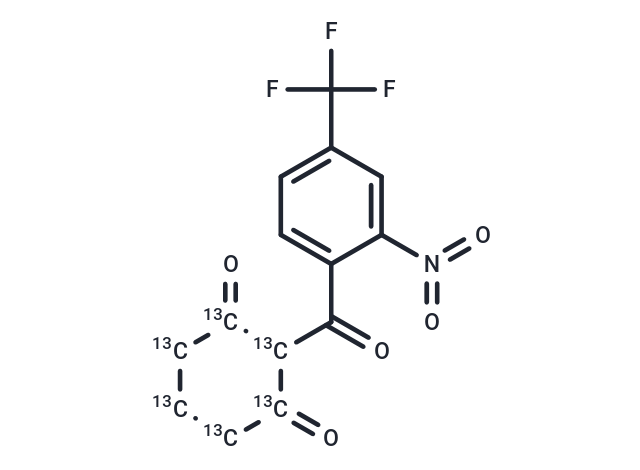
Synonyms: Nitisinone-13C6
| Pack Size | Price | USA Stock | Global Stock | Quantity |
|---|---|---|---|---|
| 1 mg | $990 | 35 days | 35 days |
| Description | Nitisinone-13C6 is intended for use as an internal standard for the quantification of nitisinone by GC- or LC-MS. Nitisinone (T1684) is an inhibitor of 4-hydroxyphenylpyruvate dioxygenase (HPPD), which converts 4-hydroxyphenylpyruvate (HPPA) to homogentisate in the tyrosine catabolic pathway.1Nitisinone increases urinary levels of HPPA and 4-hydroxyphenyllactate (HPLA) in rats when administered at a dose of 10 mg/kg. Nitisinone (T1684) (3 mg/kg) prevents the neonatal lethality of fumarylacetoacetate hydrolase (FAH) deficiency in mice when administered to pregnant dams.2It exhibits hepatoprotective effects inFAH-/-mice, such as prevention of increases in plasma levels of aspartate serine aminotransferase (AST) and conjugated bilirubin, when administration is continued following birth at a dose of 1 mg/kg. Nitisinone (T1684) (100 μg) decreases urinary excretion of homogentisate and increases urinary excretion of HPPA, HPLA, and 4-hydroxyphenylacetate in a mouse model of alkaptonuria induced by ethylnitrosourea.3Formulations containing nitisinone have been used in the treatment of hereditary tyrosinemia type 1 (HT-1). |
| Synonyms | Nitisinone-13C6 |
| Molecular Weight | 335.185 |
| Formula | C14H10F3NO5 |
| Cas No. | 1246815-63-3 |
| Smiles | FC(F)(F)c1ccc(C(=O)[13CH]2[13C](=O)[13CH2][13CH2][13CH2][13C]2=O)c(c1)N(=O)=O |
| Relative Density. | no data available |
| Storage | Powder: -20°C for 3 years | In solvent: -80°C for 1 year Shipping with blue ice/Shipping at ambient temperature. |
| Solubility Information | Chloroform: Slightly soluble Ethyl Acetate: Slightly soluble |
 For example, if the intended dosage is 10 mg/kg for animals weighing 20 g , with a dosing volume of 100 μL per animal, and a total of 10 animals are to be administered, using a formulation of
  10% DMSO+ 40% PEG300+ 5% Tween 80+ 45% Saline/PBS/ddH2O , the resulting working solution concentration would be 2 mg/mL.
Dissolve 2 mg of the compound in 100 μL DMSO to obtain a stock solution at a concentration of 20 mg/mL . If the required concentration exceeds the compound's known solubility, please contact us for technical support before proceeding.
1) Add 100 μL of the DMSO stock solution to 400 µL PEG300 and mix thoroughly until the solution becomes clear.
2) Add 50 µL Tween 80 and mix well until fully clarified.
3) Add 450 µL Saline,PBS or ddH2O and mix thoroughly until a homogeneous solution is obtained.
| Size | Quantity | Unit Price | Amount | Operation |
|---|
 Feedback
 Hello! How can I help you today?
Copyright © 2015-2026 TargetMol Chemicals Inc. All Rights Reserved.
