


Shopping Cart
Remove All Your shopping cart is currently empty

Synonyms:
| Pack Size | Price | USA Stock | Global Stock | Quantity |
|---|---|---|---|---|
| 10 mg | Inquiry | Inquiry | Inquiry | |
| 50 mg | Inquiry | Inquiry | Inquiry |
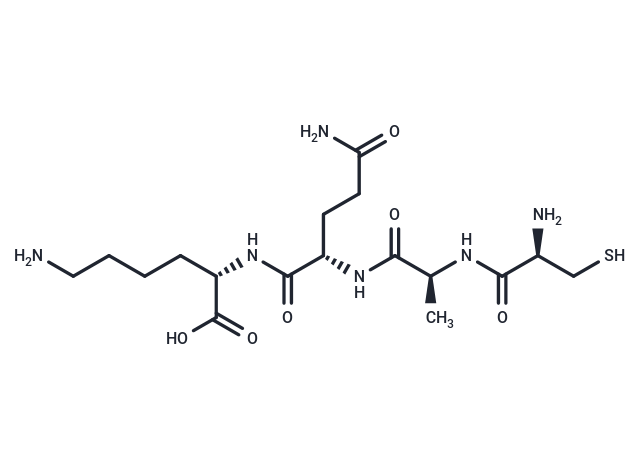
| Description | CAQK peptide specifically binds to injured mouse brain tissue and targets demyelinating areas without affecting healthy tissue. It interacts with a proteoglycan complex that is upregulated in brain injuries, making it useful for drug delivery applications. Additionally, CAQK peptide can penetrate the blood-brain barrier [1] [2]. |
| In vitro | FAM-CAQK selectively associates with brain injuries caused by localized or impact trauma, without interacting with healthy brain tissue or other organs. At the lesion sites, the peptide primarily binds to the fibrous extracellular matrix (ECM) deposited in the interstitial spaces near reactive astrocytes [1] [2]. |
| In vivo | CAQK was employed in a murine model to address localized demyelination caused by acute hemolytic phospholipids. The specific dose administered was 100 nmoles in 100 μL, delivered via tail vein injection at either 24 hours or five days post-injury, targeting the injury sites located in the right abdominal area. The subjects of the study were 8-week-old male C57BL/6J mice [1]. Research findings indicate that CAQK promotes an increased density of multinuclear DAPI+ cells and fragmented myelin at the injury site, along with an accumulation of peptide substances stained for with myelin basic protein staining. Contrarily, the control group, treated with PBS sham surgery, showed no presence of these peptide substances in the spinal cord and maintained normal DAPI+ cell density. |
| Molecular Weight | 448.54 |
| Formula | C17H32N6O6S |
| Cas No. | 2088281-24-5 |
| Smiles | [C@H](C(N[C@@H](CCCCN)C(O)=O)=O)(NC([C@@H](NC([C@H](CS)N)=O)C)=O)CCC(N)=O |
| Sequence | Cys-Ala-Gln-Lys |
| Sequence Short | CAQK |
| Storage | Powder: -20°C for 3 years | In solvent: -80°C for 1 year Shipping with blue ice/Shipping at ambient temperature. |
 For example, if the intended dosage is 10 mg/kg for animals weighing 20 g , with a dosing volume of 100 μL per animal, and a total of 10 animals are to be administered, using a formulation of
  10% DMSO+ 40% PEG300+ 5% Tween 80+ 45% Saline/PBS/ddH2O , the resulting working solution concentration would be 2 mg/mL.
Dissolve 2 mg of the compound in 100 μL DMSO to obtain a stock solution at a concentration of 20 mg/mL . If the required concentration exceeds the compound's known solubility, please contact us for technical support before proceeding.
1) Add 100 μL of the DMSO stock solution to 400 µL PEG300 and mix thoroughly until the solution becomes clear.
2) Add 50 µL Tween 80 and mix well until fully clarified.
3) Add 450 µL Saline,PBS or ddH2O and mix thoroughly until a homogeneous solution is obtained.
| Size | Quantity | Unit Price | Amount | Operation |
|---|
 Feedback
 Hello! How can I help you today?
Copyright © 2015-2026 TargetMol Chemicals Inc. All Rights Reserved.
